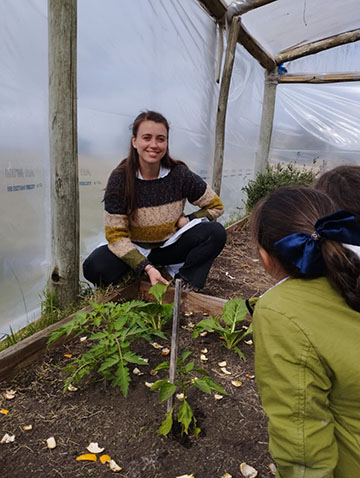
Leguísamo currently serves as principal of School No. 88 in Florida and as a computer science teacher at the Regional Teacher Training Center. Until 2021, she worked as a teacher assigned to the National Coordination Office of the Global Learning Network and as a digital technology instructor.
Was the health crisis an opportunity to modernize education? Or are we still facing the same challenges and problems we had before the pandemic?
The health crisis highlighted the need for change. It provided an opportunity for self-assessment, for identifying training needs in emerging pedagogies, and for framing education within a framework of ongoing reflection and action.
The pandemic has exacerbated existing educational and social inequalities. We still have a long way to go before we achieve true equity.
Although we already had students who were “disengaged” in the physical classroom—albeit in a somewhat subtle way—emergency remote learning allowed for the systematization—or rather, the quantification—of this reality.
After two years of COVID-19, what lessons have we learned? Of all the measures we’ve implemented and lessons we’ve learned, which ones can we continue to apply in the classroom in the future?
We have learned many lessons. The context of emergency remote learning facilitated interdisciplinary and collaborative work among teachers. It made it possible to open our classrooms to other teachers and various members of the educational community, while also highlighting the role of families as co-educators.
The two years of the COVID-19 pandemic called for new strategies to ensure educational continuity for all students. Teaching practices had to adapt: we had to rethink our decisions, prioritize content, and design approaches that emphasized learning by doing, as well as the development of key skills and competencies for the 21st century.
We came to believe that technology should be our ally in enhancing and leveraging learning processes.
What do you think teachers should focus on today in order to address the consequences of pandemic-era education?
Today more than ever, we must take into account the needs and interests of our students. We must design and implement approaches that address the uniqueness of each learner. We must also foster the development of bonds between students and teachers, and among teachers as partners in learning.
Finally, many professionals recognize the need for training to further develop their digital literacy and to make effective use of digital technologies in educational settings. In other words, it is not enough to simply ensure access to devices and internet connectivity. It is imperative to consider how to effectively integrate digital technologies into teaching practices.