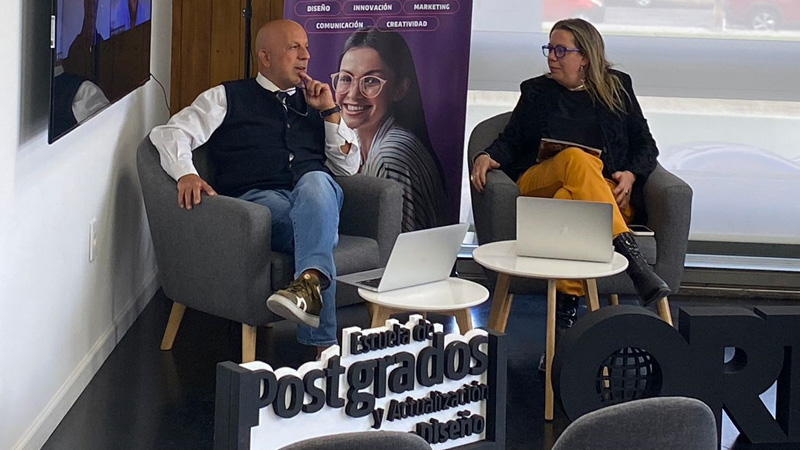
For several years now, Merco (Corporate Reputation Business Monitor) has been ranking the companies and leaders with the best reputations in Uruguay. In partnership with Merco and Pompeu Fabra University – Barcelona School of Management, Mag. Sabrina Bianchi—academic secretary of professional development School of Graduate Studies and professional development —moderated the conversation between Joan Francesc Cánovas —a consultant specializing in spokesperson training and crisis communication— Guillermo Bentancur —Chief Development Officer and partner at Remove Group, a startup focused on the strategic and tactical management of digital reputation and reputation crises in web search engines—and Jorge Pérez Esquivel —general director of Merco Argentina, Uruguay, and Paraguay—.
The three experts explained what steps companies and organizations should take to promote the “true value” of their reputation and what role communications departments play.
Everyone agreed that reputation is an intangible asset. Pérez Esquivel asserted that, today, it plays a crucial role in the future of companies. “Reputation per se does not belong to us; it is given to us by others,” explained Bentancur. Cánovas elaborated: “It is associated with a series of concepts linked to the product itself; it is something we struggle to see but can sense; (the people working with us) try to provide guidelines for measuring reputation.”
Today, what matters most is a company’s responsibility toward the various communities in which it operates, toward its employees, in its social and environmental commitment, toward society at large, and in the quality of its products. That is what current and future generations value; that is what builds a company’s reputation.
Jorge Pérez Esquivel
It is generally believed that the areas in which reputation is measured are directly linked to communication. According to Cánovas, this is “partially true,” since reputation depends not only on communication but also on other areas of the organization. “If the product is poor, we in the communications department can already work to ensure that the reputation generated by that product will not be positive, ” he explained. “Organizations have come to realize that having a good reputation benefits them and allows them to do more business, but since they didn’t know where to place it, they assigned it to the Communications departments.”
The focus on reputation began “many years ago,” explained Bentancur, but it intensified with the 2008 financial crisis, when “companies began to realize that their product or service is now almost a commodity; we all make sales, but in the end, people, investors, society, regulators, and even employees don’t choose us for that reason.” Bentancur argued that embracing this shift “provides a multi-stakeholder perspective” because “reputation, in the end, is ultimately a consequence of impeccable management of intangible assets.”
We need to break away from the notion that doing things right is less profitable. Doing things right is actually much more profitable; it’s just a long-term game.
Guillermo Bentancur
The work Merco is carrying out to assess companies’ reputations is a multi-stakeholder process. “In the past, what we looked at was a company’s or brand’s image, how it behaved, and how it interacted with its consumers,” said Pérez Esquivel. “Now, reputation has many more dimensions: it’s no longer something that’s built solely through effective communication or by making a good product. What about the employees? Once we do things right, what do we do with the money we earn? Do we do something for the community, or support some kind of social initiative?” he asked.
“Today, a company’s reputation is built on its commitment to product quality, its relationship with its employees , and the connection between the company’s structure and the social and environmental context in which it operates,” the expert explained. “It doesn’t yet have a book value, but it does have an impact: better or worse financial results.”
https://www.youtube.com/watch?v=EbTn9BDLpTU