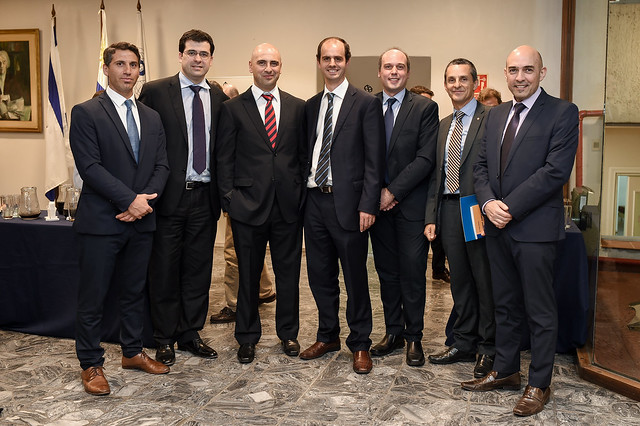
The book launch for “Legal Structures for Entrepreneurs: A Guide to Choosing the Right Legal Structure” featured presentations by the authors: Alejandro Grilli, a tenured professor in the graduate programs in accounting and taxation at Universidad ORT Uruguay, and Dr. Pedro Bellocq, a visiting professor in the graduate programs in accounting and taxation. The event took place in the Hemiciclo at the Pocitos Campus on Thursday, November 14, 2017.
The presentation featured remarks by Félix Abadi, a professor of taxation at the university; Álvaro Romano, deputy director general of Revenue at the General Tax Directorate (DGI); Joaquín Morixe, executive director of Endeavor Uruguay; and Pedro Bicudo, representing the University Culture Foundation (FCU), the book’s publisher. Mr. Abadi served as moderator and noted: “This is a truly welcome book. It is very useful, very educational, and very practical, with a clearly interdisciplinary approach,” which makes it well-suited to addressing legal, accounting, and tax issues.
"It is destined to become a frequently consulted book of great value to our professional practice," added the professor.
An invaluable asset
Pedro Bicudo briefly reviewed the history of the Fundación de Cultura Universitaria, “one of the leading legal publishers in Uruguay and the region.”
He said that the foundation has invaluable asset in its authors,” and described the second edition of the book as “a source of distinction and recognition for the authors.”
A useful tool
According to Álvaro Romano, the book’s purpose “goes far beyond the realm of taxation.” “There aren’t many publications on tax issues in Uruguay,” he said, though he noted that there are many topics to address.
“All of us authors are practitioners in the tax field; almost no one approaches the subject from a strictly academic perspective,” he said, commenting on the scarcity of tax-related works. “It’s a very easy read,” he said. “It answers the question: ‘When starting a business, what legal structure should I choose?’”
Romano pointed out that in our system, different legal structures are taxed differently, which should not be the case. “If this book had been written under the previous tax system, it would have twice as many pages,” he noted, adding that the book “takes on the challenge of providing tax practitioners and entrepreneurs with a useful tool (…) to help them determine the appropriate legal structure when starting a particular business.”
“Its usefulness does not end with the definition itself. It is of lasting value,” he added. “Reading the book reveals not only a deep understanding of the subject matter, but also a particular talent for writing and describing situations in a very straightforward way,” he concluded.
A contribution to the entrepreneurial ecosystem
Joaquín Morixe shared his thoughts from an entrepreneur's perspective. He noted that Uruguay has developed an entrepreneurial ecosystem that supports those looking to bring an idea to life.
“In the early stages of an entrepreneurial venture, there’s no shortage of ideas but a lack of resources,” he said. That’s why the wrong legal structures are often chosen; for Morixe, the book is helpful at various stages of any startup.
“This book is a major contribution to the entrepreneurial ecosystem and will help continue to promote entrepreneurship in Uruguay,” he said. He also noted that it is important to convey to young people that entrepreneurship is a viable career path and that there are various resources—such as incubators, investment funds, and angel investors—that can help bring any initiative to fruition.
“I firmly believe in entrepreneurs; they are the ones who will create the jobs Uruguay needs in the medium and long term.” Finally, Morixe said that the cases of Apple, Mercado Libre, and Pedidos Ya are examples of how entrepreneurship is possible.
Identifying the optimal legal structures
Dr. Pedro Bellocq began his presentation by explaining why he had invited Alejandro Grilli to co-author the book.
“The book is based on a single premise: every entrepreneur must decide what legal structure to adopt, and that decision is crucial, as it sets the rules of the game they will be subject to from that point forward,” he explained.
According to Bellocq, both authors sought to provide a comprehensive analysis of the available options, ranging from simplified tax regimes to financial trusts. They also identified key factors that influence the choice of the appropriate tax structure.
He then presented some figures from studies conducted on businesses in Uruguay between 2012 and 2014. These figures show that sole proprietorships are the most common (64.11%), followed by limited liability companies (11.26%), unincorporated partnerships (11.04%), and corporations (8.78%).
Bellocq reflected on the wide range of options available in our country, which offers 17 possible legal structures, and compared it to the situation in England, where there are only 13 structures.
The speaker concluded his remarks by saying that we need to create a forum for discussion to determine whether it is possible to make the system more flexible. “What we need to figure out is whether we really have the optimal legal structures for today’s startups,” he concluded.
Mixed opinions and research
“We have an established tax system,” said Alejandro Grilli, and he presented figures related to the tax sector. According to him, VAT is the tax that is evaded the least, which places the country on par with the member states of the Organization for Economic Cooperation and Development (OECD), even “despite the drawback posed by its regressive nature.”
“I’m constrained by the legal structure,” he said regarding the start of any business. “The same venture, under a different legal structure, could result in different tax options for me.”
“Sole proprietorships and unincorporated businesses offer the most tax options and are the most commonly chosen by taxpayers, and I’m sure that the tax implications aren’t always taken into account,” he said.
“We tried to create a concise, easy-to-use guide (…) that we can refer to whenever we have questions,” he said later.
Grilli said that the fact that the two authors had different backgrounds allowed them to uncover conflicting views on issues that, at first glance, they considered to leave little room for debate, such as the VAT treatment of the sale of membership shares.
“That’s when I realized that the lawyers’ perspective left us in a situation that called for a more in-depth analysis.” So he turned to case law from three decades ago, which allowed him to identify more unusual situations in the tax field.
Image gallery: