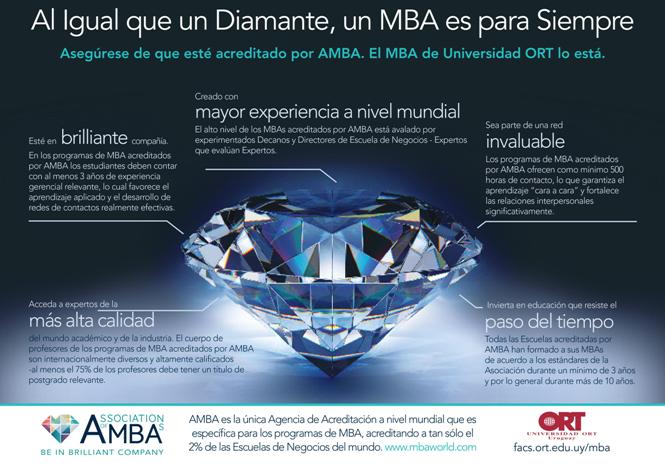
AMBA is one of the world’s three leading accrediting bodies, an institution that evaluates the quality of graduate education in business administration. This distinction serves as a guarantee of quality and places the Graduate School of the Faculty of Administration and Social Sciences among the highest international standards.
AMBA accreditation evaluates the caliber of MBA faculty, students, and graduates, as well as the program’s academic output, ties to the business community, institutional strength, independence, and infrastructure. An International Accreditation Council composed of academics with extensive experience and representatives from the business world designs the criteria by which accreditations are granted and monitors these standards, adjusting them to changes in business and management practices.
The Accreditation Committee that visited the school, composed of Professors Pedro Hidalgo-Campos, Director of the Department of Management at the School of Economics and Business at the University of Chile; Martyn Jones, Vice-Chancellor for External Relations at Kingston University; Andrew Lock, Professor Emeritus at the Leeds University Business School; and Carlos Ramos, AMBA International Advisor for Latin America, noted that in all major respects the MBA meets or exceeds the Association’s criteria.
This achievement represents significant recognition of our ongoing commitment to international quality standards. The School of Business and Social Sciences is the only Uruguayan school to be rated as an "Excellent Business School" in the Eduniversal ranking, which is determined by a vote of 1,000 deans from the world’s top business schools. The MBA is the only one in Uruguay that has been ranked among the best in the region for 17 years, according to América Economía, and among the top 20 by Eduniversal.
AMBA accreditation means that both the school and the MBA program consistently meet rigorous standards that ensure academic excellence. Today, there are approximately 14,000 MBA programs worldwide, but only about 6% achieve accreditation under such rigorous international standards.
"In turn, an accredited MBA program benefits the country, since 'to make progress, there must be people who are well-prepared in modern management,'" said Dr. José de la Torre, a member of the Advisory Board, adding: "In Uruguay, there are fewer than 10 percent of the MBA students there should be, given the country's population."
This AMBA accreditation represents a significant recognition of the academic quality of our graduate program, as well as the caliber of its students, graduates, and faculty; however, it also presents a major challenge for the future, as it is a periodic evaluation that motivates us to maintain the high standards that have always defined us.