The Entrepreneurship Act No. 19,820 regulates three main areas: the promotion of entrepreneurship, Simplified Joint-Stock Companies (SAS), and crowdfunding platforms.
“This law proposes a new, modern, and flexible corporate framework. It is a system based on the autonomy of the parties’ will, which allows for the customized self-regulation of corporate relationships,” said Dr. Luis Lapique—who holds a Master’s degree in Law, is a partner at Lapique & Santeugini Abogados, and a professor at ORT—during the conference “New Entrepreneurship Law.”
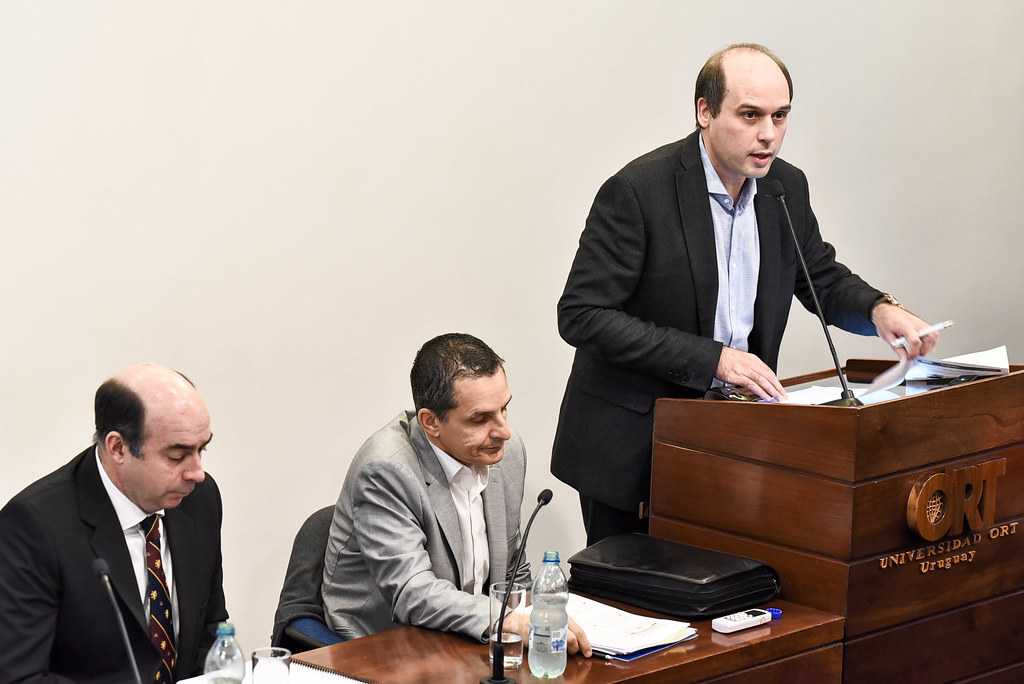
The event took place on Thursday, October 31, 2019, at the Pocitos Campus of Universidad ORT Uruguay. It was organized by the Graduate School of Business and the Center for Innovation and Entrepreneurship (CIE).
Joining Lapique on stage was Félix Abadi, Esq.—who holds advanced degrees in Tax Law and Forensic Legal Practice, is a co-founding partner of the law firms Rueda Abadi Pereira and SMS Uruguay, a faculty member at ORT, and a professor of taxation—.
Changes in corporate matters
This is a law that was passed unanimously by both the House of Representatives and the Senate. According to Lapique, “it pushes us out of our comfort zone.” In the expert’s view, two of the key features of this legislation are the streamlining of procedures and flexibility.
Regarding SASs, he noted that they are a new type of company: “They have existed in Colombia since 2008 and in Argentina since 2016. There are also companies of this type in Germany and France. This reflects a global trend toward greater flexibility.”
One of the main differences between corporations (SA) and SASs is that the latter are not subject to internal audit oversight, except as required by regulation or if their annual revenue exceeds approximately $4,500,000; however, this does not apply to incorporation or amendments. “Therefore, the SAS is more similar to the oversight structure of an LLC (Limited Liability Company) than to that of a corporation,” explained Lapique.
Tax and fiscal aspects of the law
“Finally, a solution—but more than anything, attention—is being given to entrepreneurship. I think it’s important to see that the political and legislative systems are addressing this issue,” said Abadi, who mentioned some of the law’s tax-related provisions.
For all tax purposes, including the distribution of profits, SASs will be subject to the same tax regime as “partnerships”—more specifically, according to Abadi, commercial partnerships.
The expert noted that the tax liability of SAS managers is strict liability for the Tax on Income from Economic Activities (IRAE) and general liability for other taxes. SAS shareholders, as such, have no tax liability (unlike partners in an SRL, who have strict liability for IRAE).
With regard to social security, the regime applicable to those who manage an SAS depends on the management structure chosen: if a board of directors is chosen, the regime is modeled after that of a director of a corporation (SA), but, unlike the latter, it involves standard enrollment and contributions to Fonasa, and the exemptions under Article 171 of Law No. 16,713 do not apply (no receipt of remuneration, subject to taxation on a notional income in the case of an SAS, foreign residency, and a company owning a residential property).
Otherwise, the regime applicable to partners in commercial partnerships applies.
When converting a sole proprietorship into an SAS, the rules governing the sale of a business do not apply. At the same time, the owner is jointly and severally liable with the SAS for obligations incurred prior to the conversion and arising from the sole proprietorship’s business activities.
With regard to taxation, certain special provisions are established, as well as specific tax exemptions in the event that such a conversion takes place within 12 months of the effective date of Law No. 19,820.
Lecture:
Image gallery: