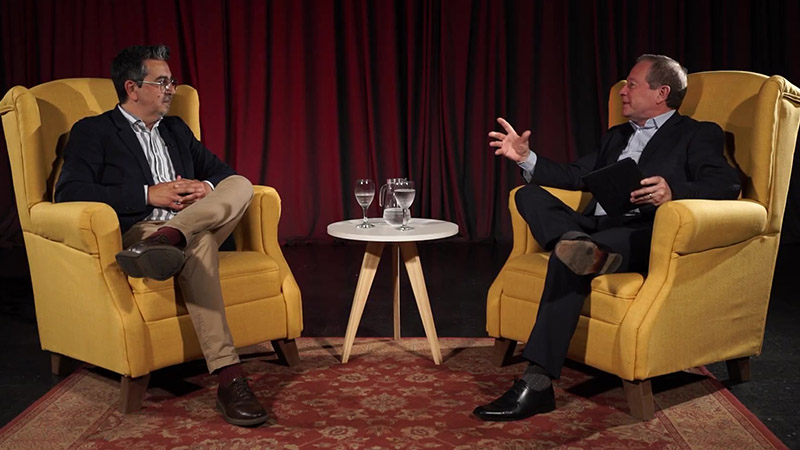
How does Uruguay compare to other countries in terms of educational technology? How are teachers using digital tools today? What are the key skills students need to develop to navigate a constantly changing world? What opportunities and challenges does the rise of artificial intelligence in the classroom bring?
Those were some of the questions raised by Dr. Martín Rebour, an academic assistant at the Institute of Education at the Universidad ORT Uruguay, addressed after being interviewed by journalist Daniel Castro.
As part of the "Outstanding" series, this summary highlights the eight key points from the conversation, in which the expert shares his most insightful reflections on the challenges and opportunities that technology presents in the field of education.
The Pandemic: A Turning Point in the Use of Technology
“The pandemic forced teachers to adopt technology,”said Rebour, noting that, in the early days of the health emergency, use of Ceibal’s educational platform grew “exponentially.” Although access to technology was widespread in Uruguay, its use had previously been limited: the resources were available, but they weren’t being utilized.
Teachers' beliefs: keys to technology adoption
Teachers’ subjective views and beliefs play a key role in how they embrace technology. These views can work for or against them: “It makes a difference whether a teacher believes that technology will replace them, or whether they see it as a tool for developing students’ skills and competencies.”
For him, the difference lies in how teachers view teaching and learning. Those who use a traditional model, based on the transmission of knowledge, tend to be “more reluctant to use technology.” In contrast, those who focus on student learning are “more inclined” to incorporate digital tools.
Young teachers vs. experienced teachers: Who is more likely to adopt technology?
Contrary to what one might think, younger teachers are not necessarily more open to incorporating technology. According to the literature and what the teaching assistant pointed out, teachers who have been in the profession for a number of years are the ones who use technology the most. And as they approach the end of their careers, they are not as willing to adopt it.
The same technological challenges in Uruguay and around the world
The challenges surrounding the use of technology by Uruguayan teachers are similar to those faced by educators around the world. Some countries are further along in these discussions, while others are not. Broadly speaking, as Rebour noted, they are grappling with the same questions: what it means to teach, what needs to be learned, and what knowledge and skills are essential for citizens today.
https://www.youtube.com/watch?v=CaIEFj7KTHM
Training... for what kind of students?
That is the big question, as Rebour put it. “Everything points to the fact that we need to educate citizens who are capable of adapting to rapidly changing contexts, ”he said. Resilient and able to cope with change, but—above all—the education system must ensure that “people can learn how to learn, ”so that they can successfully face future challenges.
Skills or content?
There is no need to pit them against each other, according to the academic assistant, who addressed the debate over whether to teach skills or content—an issue that has gained prominence in recent years. “Skills are developed through the learning of content,” he said.
From the Classroom to the Virtual World: Supporting Students
“There’s an author who says, ‘We’re used to asking our children how school went.’ We should start asking them,‘How did it go for you online today?’”Rebour said. During the interview, she emphasized that today the virtual world is part of children’s and teenagers’ lives, so it is essential to guide them along that path. “Learning to use technology in a responsible, creative, participatory, and safe way, ”she added.
The Challenge of Artificial Intelligence in Education
The advancement of artificial intelligence was also a topic of discussion with Daniel Castro. In Rebour’s view, it offers a “range of opportunities” that should not be “missed.” However, he cautioned that “not all technology serves the educational system.” For this reason, teachers play a crucial role in determining what works, in what context, and for what learning outcomes, without neglecting the ethical dimension —which is indispensable. “It is important for citizens to understand how artificial intelligence works, along with its algorithms and the biases they contain,” he concluded.