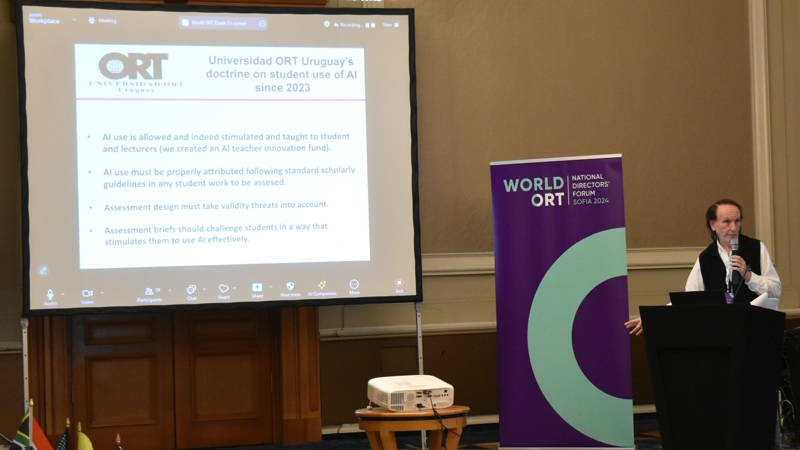
The rector that generative artificial intelligence—and language models such as ChatGPT in particular—are currently in an experimental phase, not yet fully implemented.
Dr. Grünberg noted that these technologies are evolving rapidly and, although they offer significant improvements—such as GPT-4—there are still challenges and limitations.
Artificial Intelligence and Education
The rector that educational institutions experiment with different approaches due to the technological uncertainty surrounding this technology, which changes almost weekly.
He also noted thatlanguage models, while useful, are not free from problems such as so-called "hallucinations" (false results) and should not be considered substitutes for obtaining accurate answers, but rather as tools for generating ideas.
Dr. Grünberg estimated that these models are constantly improving their scalability and that they will pose a significant challenge, among other things, due to their computational power requirements as well as copyright issues and the decreasing availability of training data.
"Google is still better at finding answers than ChatGPT and other language models," he noted, clarifying that language models "do not offer original ideas or concepts," but "can be good assistants."
The more information and context provided to language models, the better their responses, the rector indicated.
"We must encourage students to use artificial intelligence effectively" and provide them with a "catalog of prompts" they can use, he suggested.
Warnings
The artificial intelligence’s ability to automatically write, edit, summarize, and translate “may have a profound impact on the way we engage with knowledge,” he said.
He added that the fact that—thanks to artificial intelligence tools—it is no longer necessary to read entire texts will give us an “illusion of knowledge.”
"If our ability to think is weakened, what will happen to our originality and imagination?" the rector asked.
The risk is that machines will become "more sophisticated, but humans will become less intelligent," he reflected.
https://youtu.be/OEP6yx9k1Uk