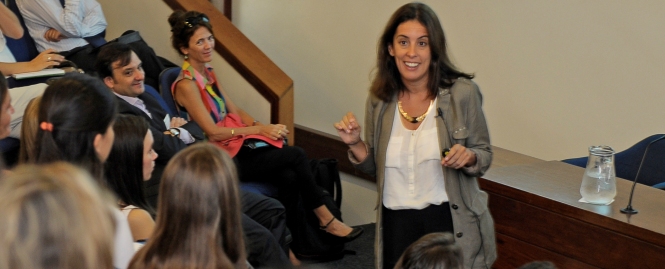
On Tuesday, February 11, 2014, the lecture “Talent Management: Identifying and Developing High-Potential Employees” was held in the Auditorium of the School of Business and Social Sciences.
The event, the first of the year in the Management and Business Lecture Series organized by the Graduate and Executive School, was led by Mariana Gattoni, who holds a bachelor’s degree in psychology.
Gattoni has 17 years of experience in Human Resources, having worked at multinational companies such as Korn/Ferry International (where he led the leadership and talent consulting division in Argentina), Philip Morris International, Spencer Stuart, and Accenture. He also holds a master’s degree in Strategic Human Resources Management from the University of Belgrano and Torcuato Di Tella University.
The expert spoke about how the concept of talent has evolved over the past 10 years, as well as talent acquisition strategies and headhunting.
In the 1990s, human resources struggled to gain a seat at the corporate boardroom table; today, it is a priority area, and although many companies maintain that HR should become a strategic partner to management, few organizations actually achieve this, Gattoni said. “They have a seat at the table alongside CEOs, but they must strive to become strategic partners and deliver value to stakeholders.”
The technological revolution is one of the factors that has driven the evolution of talent acquisition and made it more essential. “Today, if you can’t keep up with the pace of change, you’re left behind,” he said.
Added to this is globalization (which opens up the possibility of recruiting staff on a global scale) and, thirdly, the emergence of Generation Y, which came of age in the 1990s. This generation is more demanding when it comes to their work environment and seeks settings that strike a balance between their work and personal lives.
How to Attract Talent
In this context, companies are looking for employees who can innovate, which is why talent is essential. “The raw material of innovation is talent, driven by technology,” Gattoni explained. To attract talent, “it’s not just about retaining employees; it’s about building their loyalty through a sense of commitment,” he noted.
Quoting the Spanish talent expert Pilar Jericó, Gattoni explained that talent is ability combined with the ability to “deliver results using the tools at hand and a commitment to the organization.”
Gattoni shared some key insights about talent: “It’s not universal; we all have talent, but we don’t have talent for everything. Talent is about execution and achieving results. It can be developed and involves teamwork.”
“Attracting talent is key because it impacts business strategy,” said Gattoni. Generation Y seeks fun and informality, enjoys the work experience, values quality of life, and responds to a leader because that person is a valid partner, not because they are an authority figure, he noted.
“All of this must be taken into account when managing talent acquisition, but today we’re playing a new game with old rules to attract high-potential candidates,” Gattoni pointed out. “We need to be innovative and step outside our comfort zone.”
“How can we stand out to attract talent?” he asked himself. “By offering a strong intangible value proposition.” This refers to intangible values associated with the company, such as work-life balance; an “emotional salary” that keeps employees in their roles beyond their actual pay.
To develop a strong value proposition, a company must understand itself, know what it will expect from its employees, be aware of what the competition offers, exercise a healthy dose of self-criticism to be credible, invest in talent acquisition strategies, foster each employee’s creativity, treat them well, seek their commitment, welcome them with open arms, and support them during their first few months on the job, the expert explained.
Headhunting and potential
Gattoni also explained how the headhunting process works, which focuses on finding the best talent in the job market—people who are generally already employed by another organization and are not actively looking for work. They are enticed with a value proposition that justifies the move.
According to Gattoni, the reasons for changing jobs have more to do with intangible factors than with salary. People change jobs to get involved in a project, for a particular position, or because of the work environment.
A person must be a good fit; they must align with the organization’s culture and the company’s characteristics. Even so, “you have to step outside your comfort zone to seek out and develop talent. You have to overcome your fear.”
Regarding the development of potential, Gattoni noted that “while high-potential individuals generally perform very well—since they deliver superior results—not all high-performing individuals have high potential.”
Potential is the ability to learn from experiences, build on that knowledge, and then apply it to new situations. High-potential individuals are characterized by their strong ability to adapt to change and their self-awareness.
Regarding professional development, the speaker cited several examples of work assignments that facilitate the acquisition of new skills: participating in company turnarounds, working at startups, moving from line management to staff roles or vice versa, international assignments, scaling up, leading or participating in multidisciplinary projects, leading virtual teams, lateral and cross-functional moves, and influencing others without formal authority.