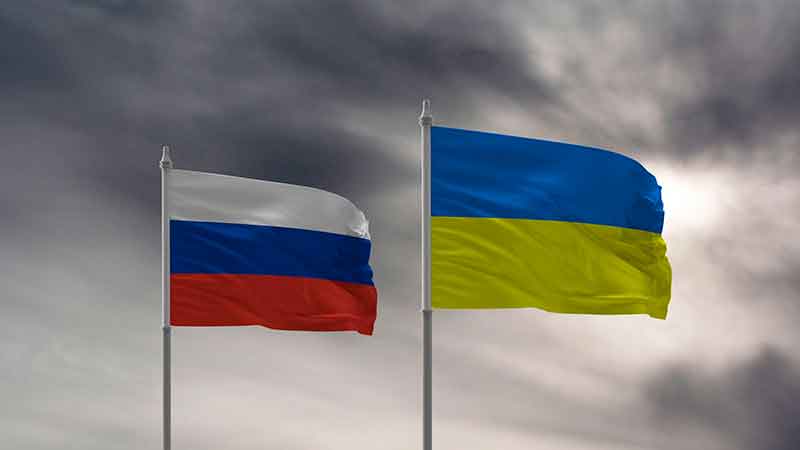
The situation is deteriorating by the day, and the thread holding peace between Russia and Ukraine is growing ever thinner.
At the time of this report (Tuesday, February 22, 2022), Russian President Vladimir Putin had announced his recognition of the independence of the pro-Russian separatist republics in the Ukrainian region of Donbas, Donetsk, and Luhansk. Not only that, but he also signed two decrees ordering that "his country’s armed forces assume peacekeeping duties" in the territories of those republics.
Immediately following Putin’s announcement, his Ukrainian counterpart, Volodymyr Zelenskyy, called for an emergency meeting of the United Nations (UN) Security Council in order to ensure his country’s security in the face of the threat of invasion by a Russian army that is drawing ever closer.
In addition, the President of Ukraine stated that he had discussed this issue with U.S. President Joe Biden. In this regard, the international community—led by the United States (U.S.), the European Union (EU), and the North Atlantic Treaty Organization (NATO)—condemned Putin’s remarks and actions.
Given these kinds of talks, it is clear that Ukraine aims to enter the West’s sphere of influence and distance itself from Russia’s, a move that has provoked a reaction from Putin.
Now then, why is Ukraine seeking closer ties with the West? What is bothering Russia? Why is the U.S. playing a secondary role in this situation?
Dr. Kaloyan Stanev, an instructor in the course “Contemporary Challenges in Eastern Europe and Russia” as part of the Bachelor’s Degree in International Studies at Universidad ORT Uruguay, addresses these and other questions to shed light on the key factors behind the conflict between Russia and Ukraine.
Why are there currently about 200,000 Russian troops stationed near the border with Ukraine? What is Russia’s explanation for this?
As we've seen so far, Russia has been claiming that nothing out of the ordinary is happening, that it's just conducting routine military exercises in Belarus. They say there's a threat that Ukraine is preparing to invade Russia or the regions within Ukraine controlled by Russian separatists. But honestly, I don't know if anyone believes that... It's clear that it's basically just propaganda.
What does the United States have to do with this? Why does it claim that Russia wants to invade Ukraine?
Ukraine itself is not that important to the United States. Ukraine is a country with great wealth: it is one of the world’s leading wheat producers, with very fertile land and natural resources... But it has faced many economic problems due to political instability, corruption, and Russia’s influence.
After many years of an expansionist policy—and what amounts to an undeclared war against the West waged by Putin— it seems to me that the U.S. is inviting Russia and its president to make a huge mistake: to present themselves as violent and to become an aggressor. It asserts that the whole world should realize that Russia is an aggressive country that does not recognize international treaties.
With this stance, Putin will find himself isolated and his popularity in the West will plummet, because there is no positive outcome to be gained from attacking another country.
Clearly, Ukraine wants to join the EU and NATO. It wants a future with the West, one marked by economic development and trade. And Russia doesn't want that, because it wants Ukraine within its sphere of influence.
Why is Putin concerned about Ukraine joining NATO?
It’s right next door; it’s very close. The Baltic states, Poland, Romania, and several of Russia’s neighbors are already there, but Ukraine is right in the heart of the region, close to Russia. Russia feels that Ukraine joining NATO is like having Russian military bases in Mexico, Cuba, or Canada. The Americans aren’t going to be very happy about this situation. Therefore, they don’t want military bases.
Furthermore, it has interests in Ukraine. If Ukraine joins the EU or NATO, it will be much better protected if it wants to reclaim—as Putin has said—Crimea. If Ukraine were part of NATO, it would have that right, and Russia would then have to fight against NATO.
To what extent does Russia's annexation of Crimea in 2014 play a role in this new conflict?
This is a continuation of that. It’s part of the crisis that began when Ukraine changed course after the revolution and the new elections—which led to a shift from a pro-Russian government to a pro-Western one—and Russia took advantage of the situation to annex Crimea… which, in fact, was populated mainly by Russians.
Since World War II, borders have, in theory, been respected, but when the West recognized Kosovo, it set a precedent for other countries—as seen with Crimea—and it seems that borders are no longer sacrosanct. As a result, republics within Ukraine and other countries are already being recognized today. Turkey, too, may eventually set its sights on territories belonging to other countries... The international landscape is becoming very complicated.
Why was Russia interested in Crimea at that time, and why did that lead to clashes in the Donbas region involving pro-Russian factions?
Historically, Crimea has been part of Russia for administrative reasons. During the Union of Soviet Socialist Republics (USSR), it remained within Ukraine, but since it was part of the same state, this did not seem to be a problem. However, when the USSR broke up in the early 1990s, the territories of its 15 republics were respected, and Crimea remained part of Ukraine.
It’s also the case that when an empire breaks up—like the USSR or any other—a portion of the dominant ethnic group remains in all the territories. So there are Russian minorities in the Baltic states, in Kazakhstan... In every country there is a significant percentage of the population that is Russian, and clearly in Ukraine as well. This is completely normal. And if Russia has interests in this region, it takes advantage of the Russian population there to stir up trouble in these territories.
Why, given that Ukraine has very strong cultural and historical ties with Russia, did Ukrainians oust their pro-Russian president in 2014 and seek to draw closer to the West?
For economic reasons—because within the USSR and later in its relations with Russia, Ukraine was not one of the most developed countries, despite all the economic potential it possesses, as I mentioned earlier.
That’s normal. Over the past 30 years, all Eastern European countries have transformed their trade and their relations with the West. There’s more development than with Russia. If you have ties with Russia, you get energy, investment, and tourism—at best. But with the West, you get developed markets, technology transfer, investment, access to financing, and so on. So people simply wanted a brighter future in that regard. And that’s why they sought pro-Western governments.
It remains to be seen whether this will actually come to pass, because many Eastern European countries believed they would quickly catch up to Western standards and ended up being disappointed.
But anyway, Ukraine had been facing major economic problems since before 2014, and starting that year—despite all the conflicts with Russia, the occupation of its territories, and the constant threat—it was beginning to recover economically. Ukraine had been growing quite a bit in recent years, but now, with this constant threat, it’s going to trigger another economic shock for the country, even if there is no direct military conflict.
Well, there are historical cultural ties, but, for example, many Latin American countries have cultural ties with Spain yet sought their independence. Uruguay and Argentina are very similar, but each country has its own interests. Ukrainians have historically suffered great trauma from the famine of the 1930s: they believe it was a plan by Joseph Stalin to destroy the Ukrainian people. And they have many reasons for not wanting to be within Russia’s sphere of influence, but this doesn’t mean they can’t maintain good relations. Many Ukrainians work in Russia. They could continue to have good relations and remain open to the West.
Is there any sign of an agreement on the horizon to prevent a new war from breaking out?
Honestly, I have no idea. I hope it can be avoided, but knowing Russian politicians and the military, and the way Putin’s inner circle thinks, I believe they only understand an assertive stance. So I’m actually quite pessimistic.
But surely the conflict can be avoided. They need to keep the negotiations open. It would be disastrous for everyone, including Russia itself, because while they may be far superior militarily, they will still suffer casualties. The Russian people would not be very happy about being at war with a brother nation. Many Russians would also suffer economically during the war. It would be a disaster for them, as well as for Europe and the rest of the world.
What I am almost certain of is that NATO forces will not be sent in to defend Ukraine. I have no doubt about this, because it would be the end of the world.