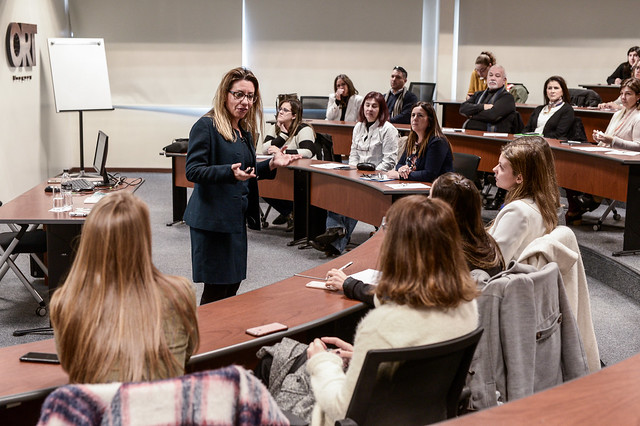
“We are currently witnessing a major revolution: the talent revolution,” said Amparo Díaz-Llairó, CEO of Global Human Capital Group, a company focused on providing human resources solutions.
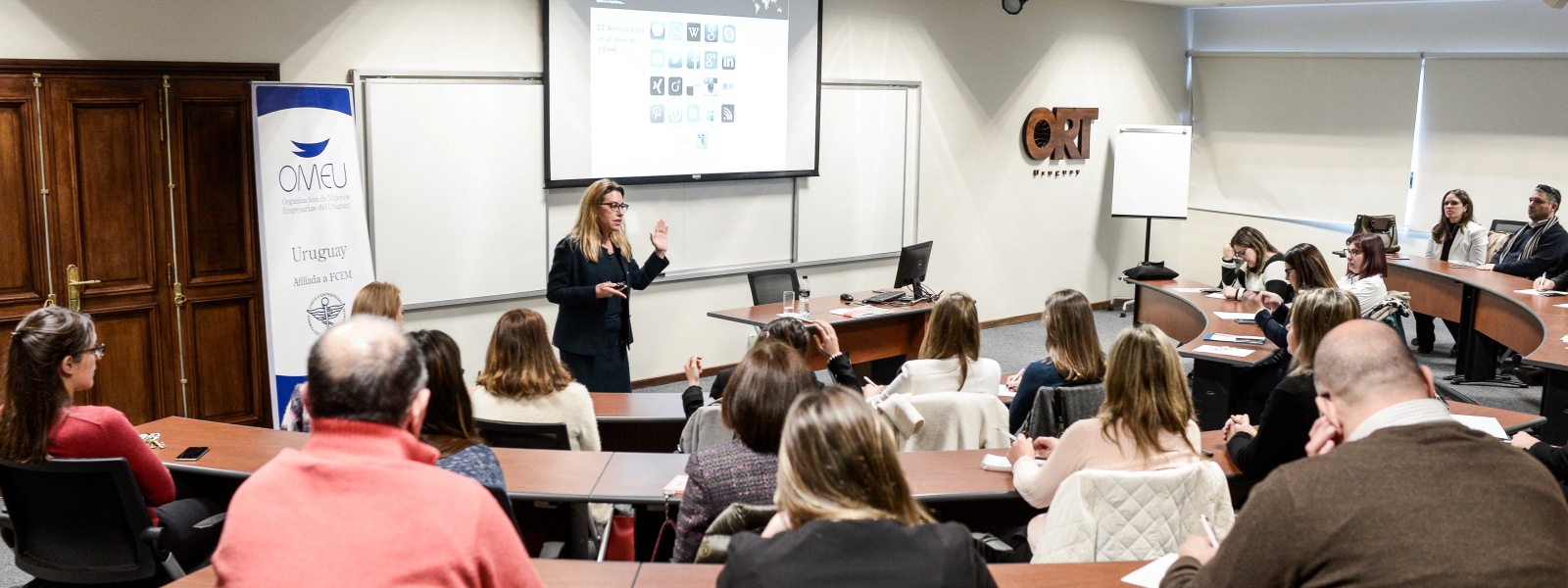
“We’ve moved away from simply filling positions and toward hiring talent—such as experts in various fields or individuals with specific skills or abilities,” said Díaz-Llairó at the conference “Recruitment 3.0: Talent and Job Search in the Digital Age,” which took place on July 9, 2018, in the Hemiciclo at the Pocitos Campus of Universidad ORT Uruguay was part of the Management and Business Lecture Series.
What are the current trends in human resources? What are the future predictions for this field? How should employees and employers go about building professional connections online? Díaz-Llairó, a visiting professor at the Graduate School of the Faculty of Administration and Social Sciences, offered a series of recommendations for both job seekers and employers.
The worker of the future
Vera was unveiled in 2017. She is a robot designed in Russia that, thanks to artificial intelligence, can interview up to 1,500 people in a single day. What challenges do inventions like Vera pose for the human resources field? What will the employee of the future look like?
The expert noted that it is essential for workers to have a collaborative spirit, the ability to tackle new challenges, and the capacity to build professional networks. At the same time, they should be versatile and self-confident.
According to the professor, ecology, healthcare, tourism, and information and communication technologies will be the fields of the future. In other words, these are the fields in which humans cannot be replaced by robots.
He explained that in the future, work will be more flexible and project-based. He predicted that there will be a “need for entrepreneurs,” as organizations will have leaner structures.
In addition, the trend of changing jobs frequently will continue: “We’re moving toward a more versatile workforce that’s increasingly mobile. We won’t be as afraid to make a move.”
How to Find a Job in the Digital Age?
Customer focus and results. Responsibility, flexibility, motivation, change management, and resilience. These were some of the skills most frequently cited by companies, according to a survey the speaker conducted in Spain.
In addition, the study concluded that, despite surveying companies from various sectors, 86% use social media for recruitment, and nearly 100% have a LinkedIn presence.
Díaz-Llairó listed 22 applications that are currently commonly used for recruiting talent and hiring staff. WhatsApp, Google, Skype, YouTube, Facebook, LinkedIn, and Instagram are just a few of them. According to the speaker, this is a “milestone”—something that would have been unimaginable just a few years ago.
The Perfect Resume
Including a summary is essential. It is a must-have element of any resume. In five to seven lines, you should summarize the candidate’s key information. The industry they work in, their years of experience, and the languages they speak are just a few examples.
To do this, it’s important to be clear about what aspects to highlight to “sell” yourself and who your target audience is. While he acknowledged that it takes effort, he emphasized that having a summary on LinkedIn, for example, makes your resume easier for employers or recruiters to find.
Díaz-Llairó—who is also a professor in the Master’s Program in Work, Organizational, and Human Resources Psychology at the University of Barcelona—recommended paying attention to the digital footprints left on social media, as employers often take this information into account. She also advised considering the keywords included in a resume.
He advised against sending a resume in JPG format, since no reader can process it: “Try to be as semantically precise as possible—grammatically speaking—since the new systems are analyzing that data.”
Human Resources Trends
“If your children know what they want to do, let them pursue whatever they enjoy most. If not, let them study technology,” he said, referring to the shortage of qualified personnel to meet the sector’s demand.
According to the professor, a recruiter must be “half psychologist and half artist.” The reason is that, when it comes to finding a candidate—especially in the tech field—creativity is key. She noted that IT professionals are in short supply and have job offers coming at them from all sides. In that context, being creative becomes particularly important.
According to the University of Oxford, 700 jobs will be replaced by machines over the next 20 years. Robots will be able to perform the tasks currently carried out by 47% of the workforce.
Díaz-Llairó also concluded that the skills gap is one of the greatest challenges facing the human resources field in the future. His assertion is backed by data: according to the consulting firm McKinsey, by 2020 there will be a shortage of 40 million people with higher education and a surplus of 100 million low-skilled workers.
Image gallery: