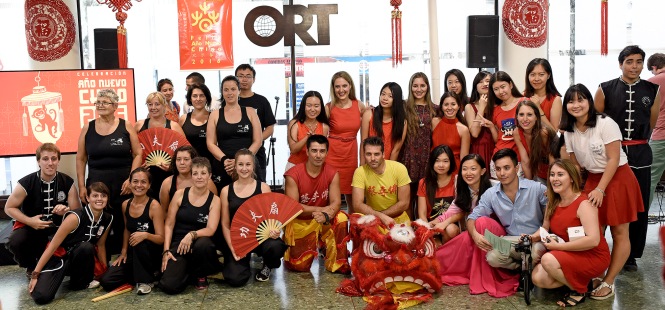
Universidad ORT Uruguay its first-ever Lantern Festival: an event that marks the culmination of the Chinese New Year celebrations and is one of the country’s most important traditional festivals.
The event, organized by the university's Language Center with the support of the Embassy of the People's Republic of China in Uruguay, took place on Monday, February 22, 2016, at the Downtown Campus.
Why celebrate?
Julio Fernández, the university’s vice president for academic affairs, opened the ceremony. Before an attentive audience—including students who inevitably had to cross the lobby on their way to other parts of the building—he expressed his gratitude for the decision to hold the festival, noting that it is part of the effort to “promote Chinese culture.”
“I am very pleased to be here, celebrating together the most important traditional festival in our country,” said Dong Xiaojun, China’s ambassador to Uruguay. In his remarks, he noted that festivities of this kind “provide an important platform for deepening mutual understanding and friendship between our two peoples,” given that “exchanges between Uruguayans and Chinese play a significant role in the friendship between our two countries.”
According to María Azpiroz, coordinator of the Language Center, the festival aimed to spark Uruguayan interest in Chinese culture “in a festive setting”: “It’s wonderful to be able to learn about Chinese culture through a fun event that combines artistic and recreational elements.” It also allows us to “learn about the traditions and customs of a culture that is geographically very distant, but which is of great importance to our country.”
New Year's Trivia
Santiago Patrón di Rende—a student in the Bachelor’s program in Corporate Communication—along with Sun Shiqi (Valentina)—a Chinese student in the university’s Master’s program in Education and a member of the second graduating class of the Joint Program between Universidad ORT Uruguay Harbin Normal University—served as the ceremony’s emcees. In addition, the student explained some of the unique aspects of the Chinese New Year to the audience and described the various traditions of her country.
Unlike the Western New Year, the Chinese New Year is based on the lunar calendar. In 2016, we are celebrating the year 4714, which corresponds to the Year of the Monkey according to the Chinese zodiac. The celebrations last approximately one month—until the Lantern Festival, which coincides with the full moon.
According to Shiqi, the festival has been celebrated for thousands of years. Although it originally had religious significance—since lanterns were lit to worship Buddha—he noted that, today, “this traditional festival is very important to the Chinese, and its religious significance no longer matters.”
During the New Year, people visit family and friends. Those who are married usually go to their in-laws’ home. In addition, Shiqi explained that parents typically give their children an envelope containing money. Another custom involves wearing red and avoiding both dark colors and sad words, to ensure good omens. Likewise, in some places, offerings are made to ancestors.
A little piece of China in Uruguay
The Lantern Festival featured a variety of performances. The Choy Lee Fut martial arts school delighted the audience with the Lion Dance—a traditional dance in which participants mimic the movements of the mythical animal—as well as a kung fu demonstration.
In addition, the Jiàn Dào School of Eastern Disciplines put on a demonstration of the martial art tai chi, and the Impetus School performed a tango and a milonga to entertain the Chinese audience at the event.
The students from Harbin Normal University performed a song. Then, together with their mentors—local students who help exchange students adjust to life in the country—they performed a traditional dance from the Xinjiang region.
Finally, good-luck gifts, courtesy of the Chinese Embassy in Uruguay, were raffled off.
The Experience of Exchanges Between China and Uruguay
Since 2010, Universidad ORT Uruguay a joint program with Harbin Normal University, through which students in the Bachelor’s program in Spanish Language spend their third year of study in Uruguay. The university also has cooperation agreements with five other Chinese universities.
According to Azpiroz, nearly 100 Chinese students have been hosted over the past four years. The coordinator of the Language Center emphasized that the importance of these exchanges “cannot be underestimated,” as it is likely that, in the future, these students will work in international trade or as translators for Chinese companies.
“Their knowledge of the region will help improve relations between the two countries,” said Azpiroz, adding, “This chance for them to get to know our country and share its advantages is a tremendous opportunity.”
He also explained how the university and Uruguayan students benefit from this: “From our perspective, we learn. The students have the opportunity to participate in academic and social activities with Chinese students and learn about their culture,” Azpiroz said. “The knowledge gained from this experience is immense and mutually enriching.”
Video:
https://youtu.be/Q6HLl-8WXFQ
Photo gallery: