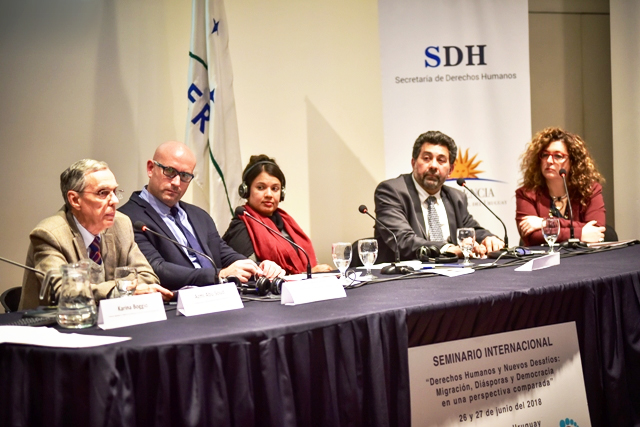
With the aim of exploring the challenges posed by addressing human rights issues related to human mobility, the Secretariat for Human Rights of the Office of the President of the Republic organized an international seminar titled “Human Rights and New Challenges: Migration, Diasporas, and Democracy from a Comparative Perspective” on June 26–27.
The event brought together experts and representatives from academic institutions and universities, including Universidad ORT Uruguay, represented by two faculty researchers, Roberto Cyjón, M.Eng., and Inés Pousadela, Ph.D., as well as the Vice President for Academic Affairs, Julio Fernández, M.Eng.
Fernández—who participated in the roundtable discussion “Prospects for Collaborative Research on Migration, Democracy, and Development”—explained that the central theme of the discussion was displacement or migration as a human right. “All the aspects necessary to fully integrate migrants into the societies they arrive in were mentioned, so that eventually, they can enjoy the same rights as native citizens of the countries they are heading to,” he said.
ORT’s Vice President for Academic Affairs sat at the table with representatives from the University of the Republic, the Catholic University of Uruguay, Al-Quds University (Palestine), Koç University and Bahçeşehir University (both in Turkey), The American University in Cairo (Egypt), The Hebrew University of Jerusalem (Israel), and the Royal Institute for Inter-Faith Studies (Jordan).
Fernández noted that migration and human rights are subjects of study, so it is natural for universities to be involved. But he pointed out that, in his opinion, these institutions are not places of government nor venues where one should attempt to manage migration policies. “What can be done is to study, compare, and analyze what works and what doesn’t in one place or another. Eventually, some departments may make public policy proposals, but I believe that the university’s role is not so much to act on reality as it is to work with the knowledge gained from it,” he added.
In particular, Universidad ORT Uruguay natural connection to migration, as it is part of its own history. “We are an institution founded by immigrants, and we are deeply committed to human rights and their protection through the concrete actions we undertake. We have organized many activities related to the Holocaust, issues specific to the Jewish community, and anti-Semitism. This is an ongoing area of focus. I believe that every institution must work on what it is best equipped to do or what its mission allows it to do,” Fernández concluded.