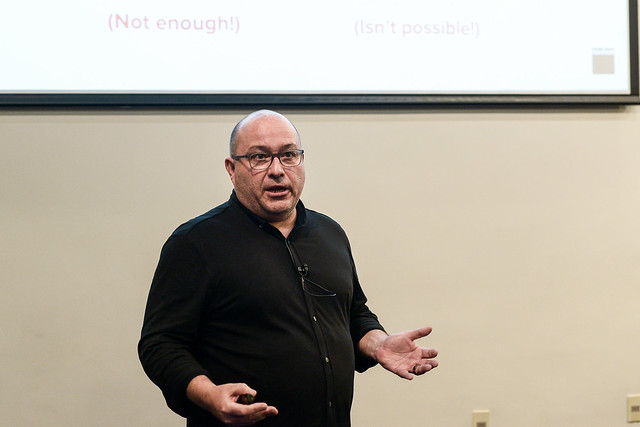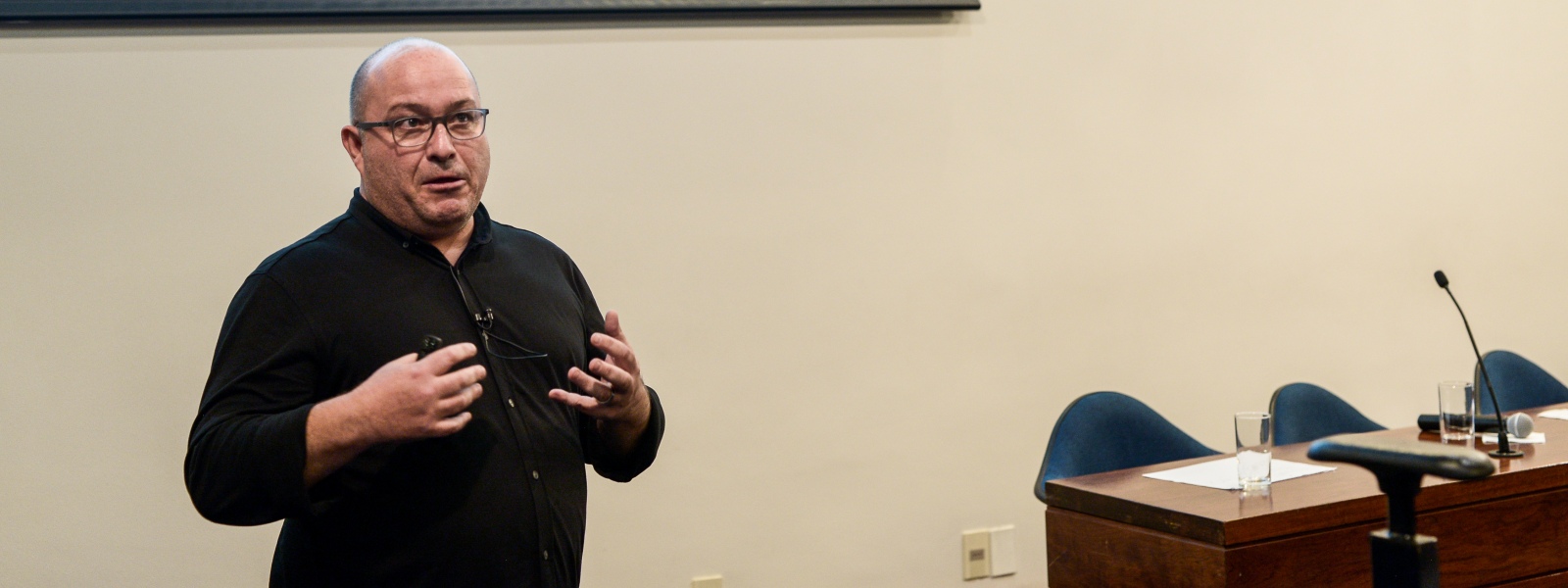
According to psychologist Andy Kitt, leaders continue to do what they’ve always done: push harder and harder to achieve increasingly distant goals. This work model is unhealthy, fragments individuals, and fosters fear.
“Having a formula that has worked isn’t enough,” Kitt said at the conference “Building Cultures of Innovation: Tuning into a Higher Creative Frequency.”
The event, organized by the academic coordination team for the graduate programs in Human Resources at the faculty’s Graduate School, took place on Monday, October 22, 2018, at the Pocitos Campus of Universidad ORT Uruguay.
"People in an organization may feel overwhelmed at a particular moment of high stress," the psychologist added. " If the feeling of being overburdened is constant, it's a sign of a problem within the company."
The expert asked those present to think about their first job. “Did taking that job hold you back or help you grow?” he asked. One man said it held him back, since he didn’t like the role he had at that company. A woman noted that she worked at the same place for 14 years; for the first seven years, she felt the job allowed her to grow, but not during the last seven.
Kitt believes that organizations should adopt a creative, fun model that fosters a culture of “jump, jump, jump” rather than “push, push, push.”
In this model, leaders stop hogging the spotlight and learn to manage it. They embrace collective intelligence, creative tension, and fluidity to boost productivity. In short, they strive to foster a co-creative dynamic.
We must move from an organizational model in which people are at the mercy of time, driven by rules, and tolerant of mediocrity, to a model in which time is managed effectively, people are driven by purpose, and they use risk to stay focused. Organizations must stop valuing similarities and start valuing differences.
Kitt recalled his first job as an occupational psychologist at a major organization. The first task he was assigned was to recruit creative people. He focused on finding socially bold individuals who had a revolutionary take on the rules—which was what he associated with a creative profile.
Three months after being hired, they would come into the office showing little enthusiasm for their work. This pattern continued over the following months. “What I realized,” the psychologist said, “is that there was an atmosphere in the workplace that drained these people’s energy and innovative spirit.”
The creative roller coaster
"There are no creative people, only creative contexts": for Kitt, people’s creative capacity depends on the energy around them. That is why the goal of Nowhere, the company where Kitt serves as director, is to understand how to change the way people work and the energy around them. Nowhere helps organizations become more creative, work with the invisible, and tap into innate abilities; “changing the energy to resonate differently.”
Its headquarters are in the United Kingdom, and it has offices in various countries, including Uruguay and Argentina. has in a range of fields, such as psychology, education, and design. “What defines us is our passion for discovery,” said Kitt.
"Nowhere helps some of the world's largest companies solve their most complex challenges," Kitt said. "It's about transforming the way organizations operate and lead." Nowhere works with a variety of industries, including agribusiness, food, biotechnology, media, mobile telecommunications, and health and beauty.
“This is the challenge we face,” said the psychologist, “we have to navigate between the conscious and the unconscious, the implicit and the explicit, what is known and what lies on the surface—the most intuitive ways of working. We call this back-and-forth between the known and the unknown ‘the creative roller coaster.’”
According to Kitt, there is often confusion surrounding the term “productivity.” Companies tend to hold meetings that don’t add any real value. In most cases, these meetings “get in the way and are a waste of time.”
The psychologist recommended that the meetings be aimed at “thinking together and coming up with new ideas.”
Finally, Kitt emphasized the importance of the ability to innovate and be open to new possibilities: “Don’t jump to conclusions too quickly; instead, wait for the moment when your heart and mind are in sync—that’s when solutions emerge.”
Full lecture:
Image gallery: