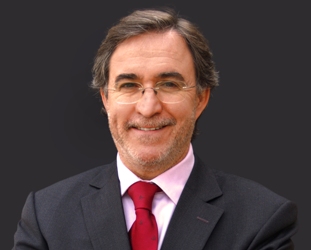
 Dr. Xavier Gimbert, director of ESADE Latam, visited the university for the start of the Management Development programme (PMD), an executive program designed to highlight management capabilities, develop leadership skills, and foster abilities in leadership and people development. The program is jointly offered by ESADE and Universidad ORT Uruguay.
Gimbert, who taught the “Competitive Strategy” module, spoke about the values of ESADE Business School, the institution’s development plans in the region, and the experience of collaboration between the two universities.
-Could you tell us what the values of ESADE Business School and what the relationship has been like with our university as a partner in Uruguay?
-ESADE is a business school founded by Jesuits and business leaders. As a result, it upholds strong values of integrity, respect, diversity, and contributing to the common good, as well as building a more just society—not merely creating and imparting knowledge.
Our partnership with ORT in Uruguay has been excellent from the very beginning. We have always worked very well together and sought out areas where our strengths complement each other, benefiting both of us. We have both always taken a long-term view of this collaboration.
-As Director of ESADE Latam (Latin America), could you give us a preview of the School’s development plans for the region?
-Until now, ESADE has had a campus in Buenos Aires and several partnership agreements with top-tier universities in Latin America, such as ORT in Uruguay. We now want to take things a step further while continuing to strengthen these ties with leading universities in key countries and maintaining our presence in Buenos Aires.
We want to expand our customized programs for Latin American companies, as well as further enhance the appeal of the programs we offer in Spain for people from this continent (ranging from executive programs to MBAs and undergraduate programs). We will invest in gaining a deeper understanding of Latin American countries, learning more about the major successes taking place on the continent, and increasing our presence there through additional staff and faculty. To this end, we will have full-time ESADE staff in four countries (Brazil, Colombia, Mexico, and Peru).
The world is moving inexorably toward globalization, and the field of executive education has long been global. We believe we must have a presence worldwide, but especially in regions where we share common language and culture. Our strength lies in being one of the top-ranked business schools in the world, with a European perspective, yet teaching in Spanish and striving to adapt to Latin American diversity.
-What has the experience been like teaching courses in collaboration with Universidad ORT Uruguay: student groups, profiles, receptiveness, organization?
-Theexperience has been very positive from the very beginning of our partnership. I have been fortunate enough to teach these courses for many years. We have always rated them very highly. The participants in the executive programs have an excellent profile; they are very interested in the course, actively engage in it, and the learning process is enriching on every level. ORT’s organization in terms of infrastructure (classrooms, breaks, meals, etc.) and the people involved in the entire process is also highly valued.
-What knowledge did you aim to impart to the students in the “Competitive Strategy” course?
-The purpose of my sessions was to introduce, discuss, and apply key aspects of strategic management in general, and the process of strategic formulation and decision-making in particular. Above all, I sought to help participants structure their thinking using strategic models, so that they could better conduct both the analysis and the strategic decision-making for their companies.
The company’s holistic and integrated vision was strengthened. Frameworks (models) for strategic decision-making were proposed. The essential concepts for strategic decision-making were put into practice. We reflected on the major challenges facing the company today. Ultimately, participants were encouraged to redefine the future of each of the organizations represented in the classroom in a reasoned and structured manner.
-What is the difference between teaching Competitive Strategy to executives and teaching it to graduate students?
-A basic yet fundamental one: experience. An executive has the great advantage that their many years of practical experience mean that, no matter what concept or analysis is explained—even if they are unfamiliar with it—they can immediately relate it to their company’s current situation. This allows them to grasp it very easily and put it into practice almost instantly. There is no better way to learn than by practicing, discovering, and developing skills through hands-on experience. This advantage allows for a reduction in the time needed to teach a given subject, depending on the profile of the program participants. Executive programs are shorter in duration than graduate programs, just as graduate programs are shorter than undergraduate programs.
A second major advantage of executive programs, stemming from the first, is the depth of insight that emerges during the discussion or application of each concept or analysis. Such programs will always be far more enriching for this very reason: the wealth and diversity of experience present in the classroom.