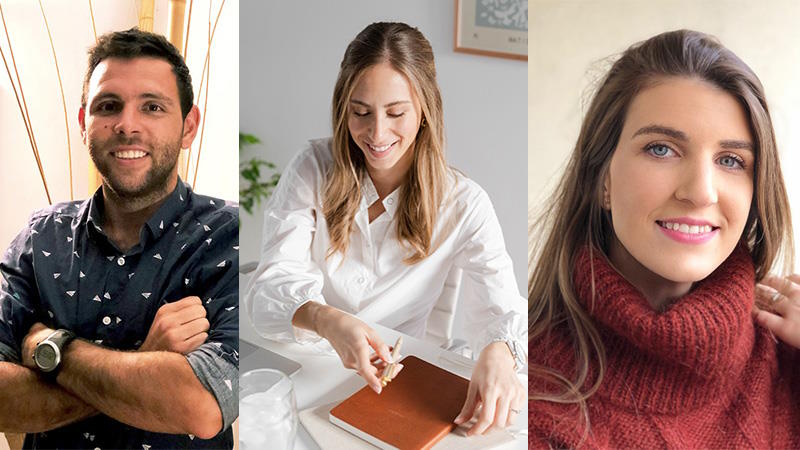
All three earned their bachelor’s degrees in Industrial Design from Universidad ORT Uruguay. After graduating, all three returned to the university as faculty members. Pablo Pirotto is a co-founder of Glucosee, a project funded by ANII for the development of Topsulin. Clarisa Bielawski is with áurea studio. Tatiana Zooby is an academic advisor at ORT’s School of Design. Each, in their own way, reflected on the profession during this back-and-forth discussion.
In Industrial Design, I found the versatility and flexibility that would allow me to branch out into other areas. These are fields that you discover as you delve deeper into each semester, so I chose to keep my options as open as possible. Industrial Design struck me as the most comprehensive and wide-ranging option.
Clarisa Bielawski, B.A.
Qualities of a good industrial designer
-
Clarisa: curiosity, flexibility, open-mindedness
“I believe that an industrial designer should be curious about their surroundings and observant. They should also be flexible enough to tackle diverse projects and adapt to the demands of a rapidly changing job market. It’s essential to have a desire to learn and an open mind, to be proactive and self-taught—though perhaps this applies to most professionals. Finally, they must be able to break free from preconceived notions in order to unleash their creativity and come up with truly out-of-the-box ideas.”
-
Pablo: empathy, creativity, and perseverance
“A good industrial designer must be empathetic, creative, and quick to identify problems and propose solutions. In addition, they must have well-developed management, decision-making, and communication skills.”
-
Tatiana: flexibility, organization, and a willingness to adapt
“Be meticulous, organized, persistent, creative, and above all, flexible and open to change.”
I've always been interested in creative and hands-on activities, looking, among other things, for tools that would allow me to turn my ideas into tangible objects.
Tatiana Zooby, B.A.
- You might also be interested in reading: “Industrial Design Day: Celebrating Creativity and Innovation”
A design that inspires
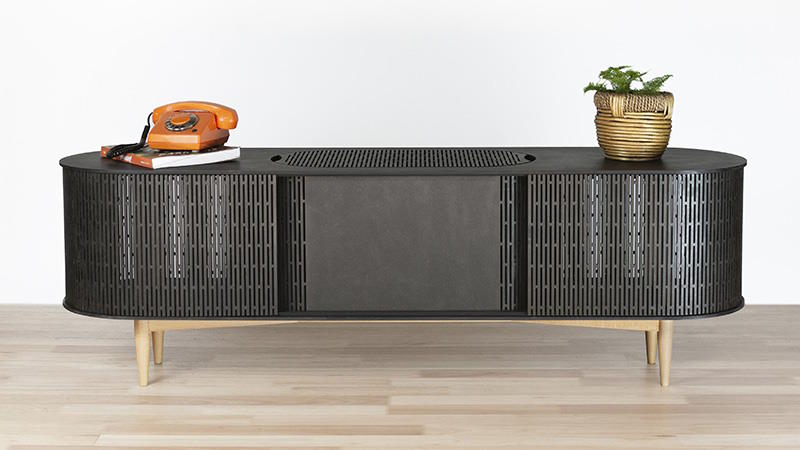
Clarisa mentioned the LAZO rack, a piece of furniture she designed at Sámago. “It was the first time I experimented with a material as innovative as Valchromat, a through-colored high-density fiberboard. Through the design, we sought to exploit all the possibilities the material offered, reducing it to its bare essentials: no hardware or ornamental additions. The grooved texture itself lends flexibility to the panel and guides the user in their interaction.”
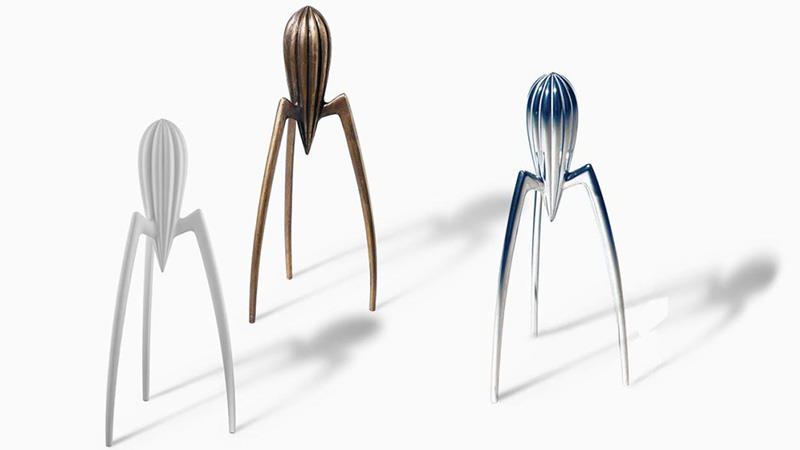
Pablo mentioned Philippe Starck’s Juicy Salif juicer, “a design that really speaks to me—the perfect blend of aesthetics and functionality.”
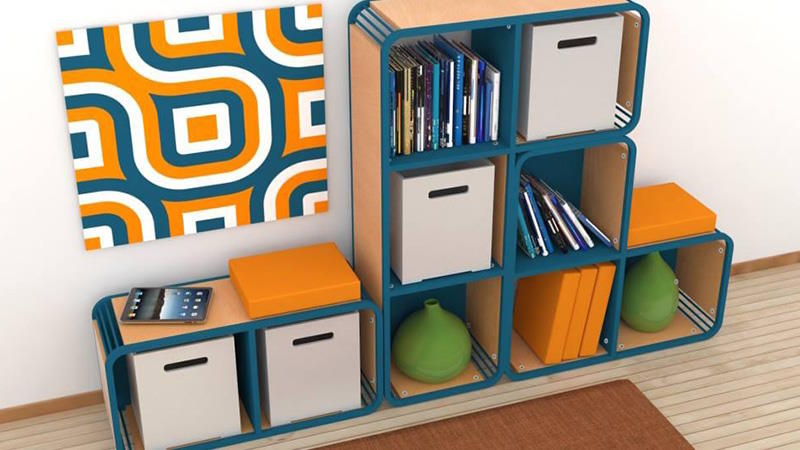
Tatiana described the furniture design she developed for the Integrative Project: “a modular system that, when combined with cushions and drawers, could be configured in different ways depending on the available space. Furthermore, the use of different color palettes and materials made it more versatile, allowing it to adapt to different uses or audiences.”
Where to Find Inspiration
-
Clarisa: The Experiences
“I think inspiration has a lot to do with experiences: everything we see and feel when interacting with different products stays with us somewhere in our minds.”
Often,an idea strikes us while we’re doing or thinking about something else; it can pop up at the most unexpected times and places. Whether it’s something we see, hear, touch, or feel, it can connect us to past experiences and spark a new idea. It’s as if, in that moment, all the pieces fall into place.
Of course, it’s essential to create and nurture those experiences: discovering new realities and meeting new people, being curious about our surroundings, connecting with nature, and opening our eyes to the real and digital worlds around us. Also, when embarking on any project, the research phase helps us establish a framework and a foundation for inspiration.
-
Pablo: Sports and Nature
“I find inspiration in sports and nature: I love going for a run on the beach or a bike ride while I think through solutions. I feel that the weaker ideas gradually fade away and fall by the wayside, while the most relevant ones linger in my mind, ready to be jotted down on paper immediately after the session.”
-
Tatiana: Nature and Human Connections
“In nature, in observing what’s happening around me, in human connections, and in the interactions between people.”
Something to work with
Clarisa replied that, for prototyping, she uses cardstock; Pablo mentioned 3D printing, and Tatiana mentioned wood, as it is a timeless material.
A work tool
For Clarisa, first paper and pencil, then straight to the computer. Pablo preferred to recommend Google Sheets because of “its collaborative capabilities.” Tatiana said a notepad.
I discovered my calling as an industrial designer by chance, without even knowing what the profession entailed. As I was finishing high school, I was being very realistic about my strengths and limitations while searching for “my calling,” when I came across the first “Design on Wheels” contest on ORT. For that contest, I created my first design with great passion and a strong commitment to my professional future.
Pablo Pirotto, Esq.
A teacher
Although she is convinced she had several throughout her career, Clarisa singled out Rafael Antía. She also recalledCarlos Devicenzi, the former coordinator of the Graphic Design program: “In addition to being my technical drawing teacher, he was the one who saw some potential in me to become a teacher and offered me the chance to be his assistant.”
“More than just a teacher, Daniel Domínguezis a great mentor and motivator,” says Pablo. “He was the first industrial designer I ever met, and he’s undoubtedly a major influence, with teachings and famous sayings like: ‘Industrial design is an activity for restless minds…’”
Tatiana also mentioned Daniel Domínguez and added Andrea Montedónico, Andrea Grossy, Oscar Aguirre, and Alejandro Trinidad.
A designer every designer should know
Clarisa recommended Benjamin Hubert, founder of LAYER; Pablo recommendedHoracio Pagani, noting that “his philosophy, creativity, passion, and conviction are a great source of inspiration”; while Tatiana mentioned Bruno Munari.