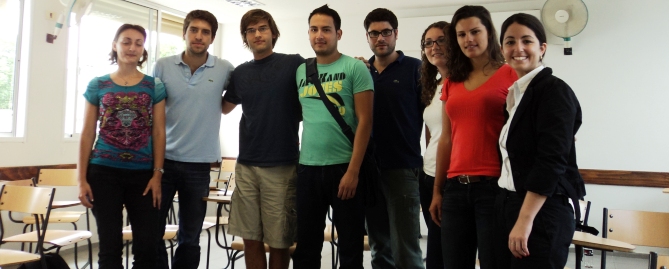
In the course “Business and the International Environment” offered by the School of Management and Social Sciences, a group was formed consisting of three students from Germany, one from Canada, five from France, and several from China who attended as auditors, providing a significant opportunity for cultural exchange between students from those countries and Uruguayan students.
Charlotte Haas, who comes from the Audencia Nantes School of Management in France, highlights how easy it was for her to adapt at Universidad ORT Uruguay. “Uruguayans have a mentor program (which guides university life and adaptation), which is a great feature of the university. Plus, the Uruguayans are very kind about everything—they lend you their car to look for an apartment, they show you around the country,” she says.
“The Uruguayans are very generous. It’s very easy to integrate into the city. There are programs and parties to socialize,” says Hugo Garros, also from the Audencia Nantes School of Management.
Regarding the differences between university life in Uruguay and France, Garros mentioned punctuality and the smaller class sizes. “The concept of punctuality in France is different. If you’re late for class, you can’t get in,” he says, somewhere between surprised and amused.
For her part, Marion Bazin, a student from France at Rouen Business School, said she learned a lot from the classroom atmosphere, which is very different from that in France. “In France, we can’t interact in class. We have to wait for the professor to call on us. Here, the relationship is more informal, more open, and on an equal footing,” she notes.
Why Uruguay?
The international students say that time and again their Uruguayan classmates ask them why they chose Uruguay for their exchange studies. At the same time, they believe that Uruguayans themselves often fail to notice the country’s virtues.
Nicolas Faydide, from Rouen Business School, explains: “I feel that it’s more peaceful here; people can go out at three or four in the morning without having to hide.”
“You learn about others’ cultures and tastes. And, often, you learn about your own culture,” he notes, adding: “In big cities, the stress level is much higher.”
Everyone highlights the richness of Uruguayan culture: its museums, bookstores, and artists. They even mentioned their love for cumbia, Fun Fun shows, and the works of Juan Manuel Blanes.
Camilo Lumaconi, a Uruguayan classmate in “Business and the International Environment,” highlighted the exchange students’ rich perspective. “Generally, they have a more global view of things. They tend to be a bit more independent and are more critical than a Uruguayan. They have a much broader view of certain topics. More comprehensive.”
He asserts that they provide insights that Uruguayan students—and even those from Latin America—lack. “They offer you an external perspective on yourself that you wouldn’t otherwise be able to gain.”
Participation of Students from China
In 2012, 42 Chinese students (33 women and nine men) arrived at the university on an exchange program as part of their studies in the Bachelor’s Degree in Spanish Language at Harbin Normal University.
Bai Yunzhao, whose Spanish name is Estrella—because all students in her program are given a Spanish name—says she doesn’t encounter any barriers when interacting with others. “Everyone can understand and accept cultural differences. And some classmates are actually interested in them.” Regarding her experience as an auditor in the course “Business and the International Environment,” she says, “I love it. Different classmates have different opinions on economic issues. It’s very interesting to hear foreigners’ views on China’s economic development.”
Zhang Tiany, known as Beatriz in Spanish, agrees that her relationship with classmates from other countries is very good, but she highlights how well the Uruguayans treat her. “They’re very friendly. They treat us very well; some are very interested in China, so we talk a lot about different cultures and customs,” she says. Beatriz highlighted the usefulness of having a mentor to guide her during her year in the country. She also says that she found it very easy to break down certain cultural barriers.
She notes certain differences between students from her country and those from other cultures. The main one is the independence Uruguayans have in choosing what to study, as well as the courses they take. “Some young people live alone or with friends, rent an apartment, and many college students work while they study. It’s great for gaining work experience, but in China not many people can work while studying.”
Beatriz’s main goal is to improve her Spanish, and she believes she is succeeding. She also says she has learned to set aside her shyness to understand the “Western” mindset. “My perspective is broader; it’s not limited to what I learn from books—social life teaches me so much more.”
Educational Perspective
The course “Business and the International Environment” is part of the fourth semester of the Bachelor’s Degree in International Studies. It is taught by Dr. Christian Keen and Cinthia Eliazer, B.A. The professors noted that “over the years, the university has seen an increase in the number of students coming from various countries. It is a great pleasure to have them participate in every class and share their experiences and knowledge with everyone.”
One of the few adjustments they must make with students of other nationalities, they explain, is to moderate the speed at which they speak so that everyone can understand.
“The contributions each student makes are extremely valuable, both for the professors and for their classmates,” they note. “They provide excellent theoretical and practical knowledge, as well as enriching insights into their experiences in each of their home countries.”