The closure of schools during the pandemic forced us to reevaluate current educational practices and encouraged us to try new formats. It was a unique opportunity to think outside the box. And, in that context, the first episode of TA, Time to Learn.
The interactive magazine, aimed at families with school-age children, seeks to foster the home as a learning environment and promote “learning by doing.”
This is a project in which Verónica Zorrilla de San Martín, M.A.—a doctoral student in education and publications editor at the Institute of Education at Universidad ORT Uruguayis involved in the production process.
***
“I am convinced that learning is everywhere. It happens everywhere: on social media, on websites, and in the mass media, such as television, radio, and newspapers,” said Zorrilla de San Martín, who currently serves as the head of Capacity Development for the Global Learning Network.
However, as she explained in the webinar titled“TA, Time to Learn: Synergies with the Classroom,”the foundation lies in interaction in the classroom, at home, and in the neighborhood: “The educational community and families are key to building and developing learning.”
With these principles in mind, the goal in developing the program was to bring these proposals together and foster synergies among the various learning environments.
***
However, as explained by Mariana Montaldo, M.A.—a member of the production team at TA and the Institutional Liaison for Plan Ceibal, who also participated in the webinar—it is not “traditional educational television,” but rather “educational television aimed at redefining the home as a space for learning.”
It’s not about replicating a class—a model that, in his words, is used in other countries and has “little impact.” It’s a place where classroom content is taken and approached in a different way, one that’s closer to the family and the home.
While the pandemic brought opportunities, it also created new challenges, such as gaps in access to content. For that reason, it was decided to use television as a medium to reach those areas where, for example, connectivity might be an issue.
“The idea is for television to serve as a catalyst, as a catalyst to encourage learning at home,” he explained, adding that the goal is “to inspire action.”
***
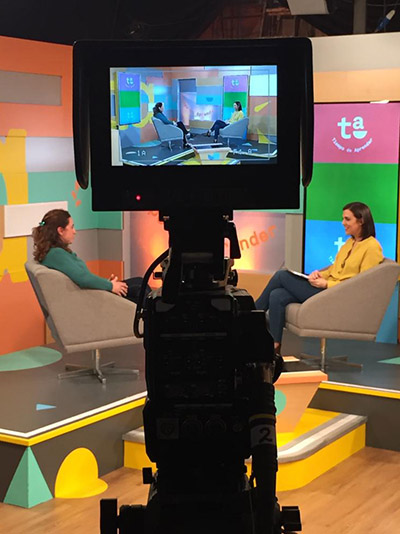
However, television alone is not a learning environment, said Zorrilla de San Martín, who is also a graduate of the Master's Degree in Education from Universidad ORT Uruguay.
“We need teachers to ensure that this truly becomes a meaningful, personalized initiative with educational value,” he emphasized.
That is why the concept behind TA is based on teachers playing a leading role in this television initiative. In fact, in addition to the content they cover each day—which they post in advance on Facebook, Twitter, and Instagram—they have daily Zoom calls with teachers.
In the “Presente” segment, they share insights into their school or classroom, thereby helping to shed light on the experiences taking place in public education.
The program aims to provide on-screen content to create increasingly meaningful educational experiences. It also encourages teachers to enrich this content and give it pedagogical meaning in the classroom—something that, according to Zorrilla de San Martín, “only they can do.”
“This is a contribution, a small part, toward finding meaning in those spaces that can help us build meaningful and profound learning experiences,” he concluded.
"TA, Time to Learn " is a daily one-hour program hosted by Florencia Infante and Diego Waisrub. It airs Monday through Friday at 10:00 a.m. on Televisión Nacional del Uruguay (TNU). It is rebroadcast at 4:30 p.m. and midnight, and is then available on YouTube. It is an initiative of ANEP, Plan Ceibal, and TNU.