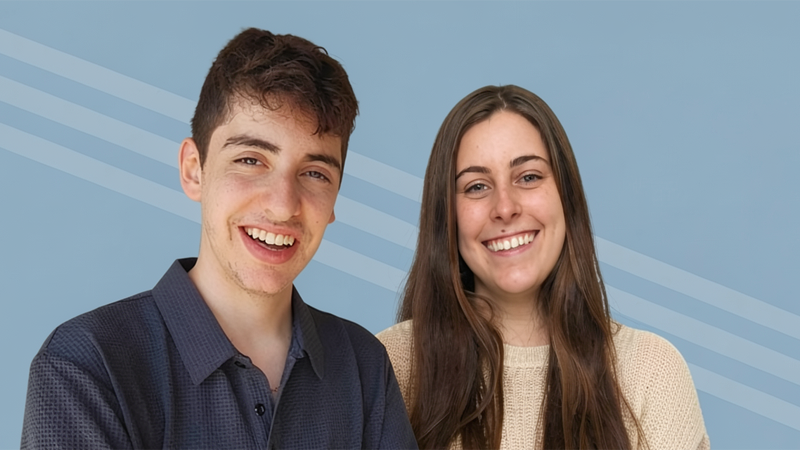
The ability to tailor elective courses to a specific field was key in both tracks. For Romina, the certificate was her first step into the world of graduate studies. “I was interested in the idea of taking graduate-level courses while I was still studying engineering. It’s a great way to get a feel for how that level of study works,” she explains.
In Santiago’s case, his motivation was more closely tied to building a professional profile. “Instead of taking unrelated electives, I wanted to focus on a specific area and build my expertise in artificial intelligence.”
The challenge of taking courses in the master's program
Taking classes alongside graduate students was an academic challenge, but also an enriching experience.
“There are people of all ages and from various fields, including areas such as medicine and economics, and that leads to some very interesting discussions, ”says Romina.
Santiago agrees and adds another point: “You share a classroom with people who are already working in the industry and have a lot of experience. That changes the dynamic, not only in class but also during breaks, which end up being opportunities for networking and learning.”
Subjects that connect to the real world
When it comes to identifying the most important content, everyone highlights different subjects, but they all share a common focus: practical application.
For Santiago, the Deep Learning Models course was a turning point. “That’s where you understand the mathematical foundations behind technologies we use every day, like chatbots or image generators. It takes what you learn in your degree program to a much more sophisticated level.”
Romina, on the other hand, highlights Machine Learning and Production, a course that allowed her to compare theory with practice. “It constantly contrasts the academic ideal with reality. It forces you to think about costs, available data, and decisions that aren’t always perfect in the real world.”
A shift in the way we think about systems
Both agree that incorporating artificial intelligence represents a paradigm shift from traditional software development.
“In AI, the expected outcome isn’t always clear from the start. It’s the data that guides the system,” explains Santiago.“Gaining a thorough understanding of the problem and working closely with the client becomes essential.”
Romina adds another perspective: “Training models requires preliminary research and a lot of data, which also involves costs. It’s not a matter of ‘just implementing it and that’s it.’ That more analytical, proactive approach can be applied to any field.”
A competitive edge for your professional profile
Beyond the technical content, the certificate had a lasting impact on both students’ professional confidence. Santiago sums it up as follows:
It gives you the confidence to make the transition from the classroom to real-world implementation in a company: knowing what data to request, how to define a problem, and how to talk to clients.
Romina sees it as opening up new possibilities:
You start to see processes and realize they can be optimized using artificial intelligence models. It gives you more tools to navigate a constantly changing environment.
A first step toward what's to come
Today, both are about to graduate and plan to continue their academic studies; they see the certificate as a solid foundation for further exploration in the field. For Santiago, the certificate provided three key benefits:
“Knowledge, industry connections, and an introduction to graduate-level coursework.”
Romina agrees and offers some advice to other students: “If you’re interested in artificial intelligence, the best thing to do is assess where you are in your degree program and how the certificate fits into your plan.”
"It's a real opportunity to delve deeper and earn a valuable certificate."
Learn more about the Certificate in Artificial Intelligence