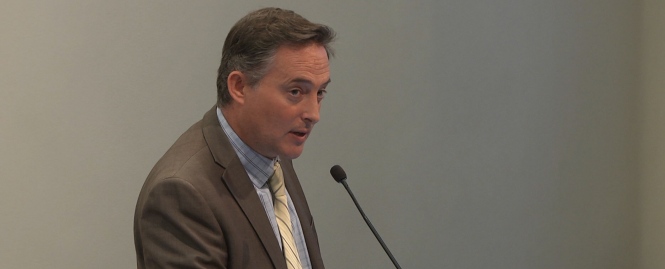
“To succeed in diplomacy, you have to work as a team,” said Ian Duddy, the United Kingdom’s ambassador to Uruguay, during the conference titled “How We Represent Our Country Abroad.” Organized by the Department of International Studies, the event took place on Thursday, July 6, 2017.
Ian Duddy served as a political advisor and director of policy, human rights, and media at the British Mission to the UN in Geneva. He also served as deputy director of the Intellectual Property Office within the Department for Business, Innovation, and Skills, and worked as a policy and trade officer at the British Embassy in Buenos Aires.
Limits, Stereotypes, and Learning
At the start of the event, Duddy recalled that twenty years ago he had been in the same place as the students in attendance and had never imagined he would become an ambassador. “We set limits for ourselves,” Duddy said as he shared his personal story.
He then addressed the stereotype surrounding British ambassadors, who are often seen as out of touch with everyday realities.
The ambassador recalled that as a child he was disappointed to discover just how small the United Kingdom was compared to other countries. He decided then that he wanted to travel and explore other places and experiences: so, after finishing his studies, he spent six months working in northern India at a school for Tibetan refugees.
“There was no WhatsApp, Skype, or Facebook,” he said, explaining that he called his mother once a month to let her know he was still alive. “You have a huge advantage,” he told the audience.
The ambassador recommended taking advantage of the opportunity to participate in an exchange program; in his case, it allowed him to learn a new language and meet students from all over Europe. After graduating from college, he taught English for two years in Japan, and upon returning to his home country, he was determined to work in fields related to international relations.
From the Hope of 2000 to Uruguay
“I never would have imagined that British politics could take the turn it has now,” he said, recalling his first experience at the Foreign and Commonwealth Office. The diplomat explained that in 2000, the British stance was one of promoting European expansion.
“There was an atmosphere of great hope; I felt that London was the center of the world,” he recalled. In 2003, he made an important decision when he chose Buenos Aires as his posting. In 2006, he moved to Australia to continue his training and considered leaving the diplomatic service, a possibility he ultimately ruled out.
A personal situation led him to begin working in Geneva, Switzerland, in 2011. “Sometimes your personal life has a bit of an impact on your work,” he explained. In 2016, he arrived in Uruguay to serve as ambassador for the first time. The choice of posting was based, among other reasons, on his comfort with the Spanish language and Uruguay’s presence on the UN Security Council.
Human relationships
“In multilateral negotiations, we’re human beings,” he said, adding that “words and the way we speak are very important.” “Personal connections are essential (…) it’s important to deepen and maintain personal relationships.” “Sometimes you have to work with unexpected allies,” he added.
“You’re more credible as a diplomat if you believe in your work,” he said, encouraging the students to seek out a job that motivates them once they finish their studies. “You’re much more effective if you truly believe in what you’re doing.”
On the subject of teamwork, he noted that there are many examples of individual innovators. “To succeed in diplomacy, you have to work as a team,” he said. He then added that it is necessary to trust in one’s colleagues’ ability to achieve successful results.
Being an ambassador: pros and cons
For Duddy, being an ambassador has its pros and cons. A beautiful residence, resources, a great team, and unique experiences were some of the advantages he highlighted about the role. He also emphasized the opportunity to gain an in-depth understanding of the country where he works.
The downsides aren’t so obvious when you first start your career. “Every three or four years you have to move, and sometimes that takes a toll on the family,” said Duddy, who doesn’t see his immediate family very often, though he doesn’t regret his career choice.
“Public service in England doesn’t pay well compared to the financial sector,” he noted. He also described what it’s like to be an ambassador in his own words. “You’re a jack-of-all-trades but a master of none. Sometimes you feel like you don’t have a specific skill or a well-planned career path, but you can do a little bit of everything,” he said.
In Duddy's view, a career diplomat must be able to separate his or her personal beliefs from the policies pursued by the current administration. In his opinion, this can be a disadvantage.
Notes on Brexit
“It wasn’t something we anticipated,” he said. He noted that the British public isn’t accustomed to referendums, which are a once-in-a-generation event, unlike in other countries. Regarding the public’s decision, he said, “It’s clear that the vote must be respected.”
“Our first priority is to negotiate our exit from the European Union by March 2019. It’s a huge challenge,” he said. “It’s the most important task at the Foreign Office” in many years. “I’m sure it will affect all British embassies around the world.”
He argued that the vote for Brexit was not a vote against free trade, but rather “against European control” and European laws. He also said that it is not possible to compare Brexit with Donald Trump’s election as U.S. president, as some analysts have suggested.
Uruguay, a shy country, and the Falkland Islands
Duddy said he has been involved in the negotiations between the European Union and Mercosur and admitted that he has not seen any significant progress in recent years. Nevertheless, he remains optimistic about the prospects for reaching agreements following the UK’s departure from the European Union.
“We import most of our food,” he said, referring to the United Kingdom, and emphasized that it needs “products like the ones made here in Uruguay.” “There is a great deal of compatibility between the British market and the Uruguayan market,” he noted.
“Uruguay plays a very important role at the UN, acting as a bridge,” he said regarding Uruguay’s presence on the Security Council. The diplomat described Uruguay as “a country that is a bit more reserved than its neighbors” and said it should “use the voice it has on the international stage” to promote its image.
He then turned to the Falkland Islands. “I fully understand Argentina’s position,” he said. “The British position is that we must respect the wishes of the islanders,” whose families have lived there for nine generations.
“The dispute we have over the islands does not affect our cooperation in other areas,” he said.
Technology and Optimism
“I’m optimistic. I believe technology has revolutionized human interaction,” Duddy said toward the end. “It’s much harder for corrupt officials, dictators, and criminals to hide their crimes,” he remarked, adding that social media has taken on a very important role in diplomacy.
“These days, I do a significant portion of my work through WhatsApp,” he admitted. “Nowadays, lobbying is done through WhatsApp,” he said, noting that this platform is faster and clearer than others, although one must be very clear in what one writes.
“Although there are plenty of problems in the world, we must also acknowledge the progress made in recent decades,” he said, pointing to advances in areas such as discrimination and minority rights.
Video:
https://youtu.be/ceTX0yDYCtc?si=HOxhZCYyu4ueUffS