Matías Nogueira studied Telecommunications Engineering at Universidad ORT Uruguay. After graduating, he traveled to Mexico to pursue a graduate degree in Applied Robotics; upon his return, he founded the company Teletipos Engineering, which specializes in engineering consulting, project design, and construction management. Matías asserts that the Uruguayan market is underutilized and that there is plenty of work to be done. 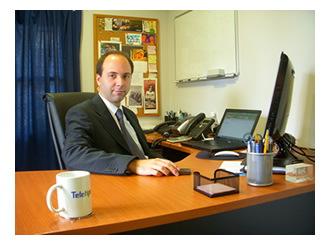
When did you start studying at Universidad ORT Uruguay?
I joined ORT in March 1998, right after graduating from high school. I still remember the informational session about the program given by Guillermo Langwagen—it was one of those defining moments in my life.
Why did you decide to study telecommunications engineering?
For as long as I can remember, I’ve always been drawn to studying and pursuing a career in engineering; the idea of studying telecommunications, in particular, was entirely my father’s suggestion. At the time, it had emerged as a new branch of engineering, and he had complete faith in it.
How did your degree benefit you both personally and professionally?
Information, friends, mentors, support, role models, consistency, high standards, clients, suppliers, relationships, colleagues—to name a few. In short: simply everything! I am infinitely grateful to my parents for the effort they put into my education.
When and how did Teletipos come about?
It all began in 2006, shortly after I completed a master’s degree in Applied Robotics in Mexico. I arrived full of drive and eager to work, without really knowing what I wanted to do or how to go about it. What I did know for sure was that I was excited by the idea of providing comprehensive solutions—whether that meant a project, a product, or a service. I wanted to create something that would offer everything needed to solve specific problems for clients.
Our website says: “…the idea arose to bring together people, technology, and efforts into a company that combines knowledge, enthusiasm, dedication, and hard work…” and that’s exactly what we did. A few months after I returned from Mexico, I rented our first office, where all I had was my laptop on a borrowed desk, a used printer, and a shared Internet connection. From then on, everything happened very quickly; within the first two years, we grew to eighteen professionals and three partners.
As part of our growth and efforts to consolidate certain areas of the company, I partnered with my sister Natalia Nogueira, a systems engineer who is now our IT manager, and with a lifelong friend, Federico Mangino, who is currently our technology manager. We then bought a house right in downtown, renovated it, and set up our headquarters there. We now have three floors and our own data center.
What services does the company offer?
We are a multidisciplinary team. We specialize in various fields of engineering: telecommunications, electronics, technology, information technology, electrical engineering, civil engineering, and industrial installation.
Among our services, I would highlight consulting, project design, and construction management. It is through these three areas that we strive to guide our clients both in finding solutions and in implementing them.
We take on any project, product, or service related to technology. We strive every day to excel in everything we do and to delight our clients with the solutions we provide. We are the engineering department that our clients don’t have.
How many people work at Teletipos? How do you manage a team made up of people from different fields?
We have significantly reduced our workforce; at one point we had as many as 30 employees, but currently we have 11, plus some outsourced services.
After college, I had to learn a lot of things, mainly how to manage and lead—not just people, but also time and goals. The key is to be patient and think ahead. Problems and mistakes will always happen; you have to solve them with the customer in mind and, above all, learn from them so you don’t make the same mistakes again.
My wife and the mother of my daughter, María José Villamil, who is the Human Resources and Administration Manager, has been a tremendous help to me in this particular area. Without the support of my family, this journey would have been impossible. Starting a business takes a lot of time and energy, and the entire family must be on the same page to make it happen.
What kind of work do you do most often?
It depends on the year. We live in an unstable world, and to mitigate that instability, we need to diversify. With this philosophy in mind, there have been years when we’ve sold more in the utilities sector, others in telecommunications, and still others in IT. We adapt to the current market conditions and to those of our clients.
Did you focus on all these areas from the start, or did you expand into them over time?
We’re a “unique” company; we took the opposite approach and gradually scaled back our departments and services. At first, we were a company that did whatever the client asked; now we have areas of specialization and know which businesses are profitable and which aren’t.
In addition, the products and services we sell change over time based on our own interests and those of our colleagues. Mauricio Sum, an electrical and electronics technician at ORT, a business administration major, and currently the head of electrical operations, has played a key role in revamping several of the company’s products and services.
Teletipos currently operates nationwide. Do you have plans to expand regionally or internationally at some point?
We currently operate nationwide and have made very few inroads into international markets. We have strategic partnerships with international suppliers. We have traveled to Italy and Argentina for training, but selling abroad is a major goal that is part of our long-term plans.
Contrary to what many people think, I believe the Uruguayan market is huge and largely untapped. The number of companies dissatisfied with the services or products currently available is immense; for us, all of those companies represent opportunities for tremendous growth. We still have plenty of room for growth within the country.
What advice would you give to someone who wants to start a business and make it on their own?
Everyone has to find their own path; it’s hard to recommend anything specific, but I’d still like to share three things: I guarantee it’s worth it—and then some; surround yourself with people who add value, and don’t settle for anything less than their full commitment; and finally, what are you waiting for? The longer you wait, the harder it gets—there’s never a perfect time. It doesn’t matter when you start; what matters is taking that first step and taking the plunge.
Interview published in June 2013.