“There is agreement on the importance of teaching entrepreneurial skills for today’s and tomorrow’s society, but there is disagreement regarding how to define them and how to teach them.”
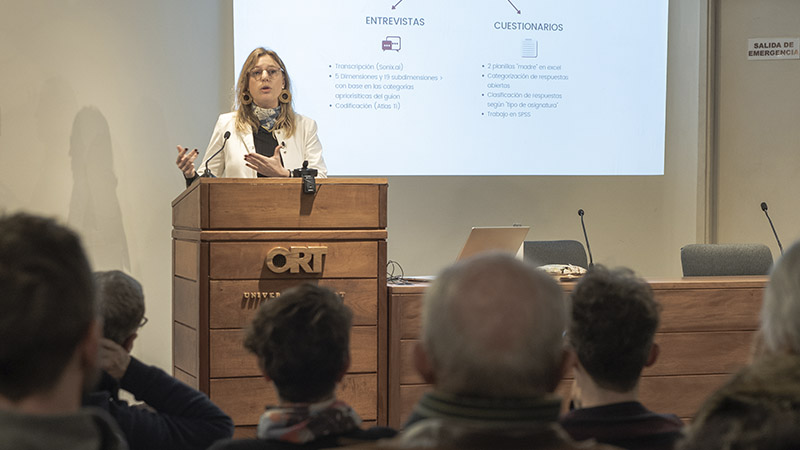
That was the assertion made by Marina Melani, a graduate of the Doctor of Education Universidad ORT Uruguay at Universidad ORT Uruguay, during the defense of her dissertation titled An Approach to the Perceptions of Teachers and Students Regarding Entrepreneurial Education and the Teaching of Entrepreneurship at Two Uruguayan Universities.
More specifically, the doctoral research examined the perceptions of faculty and students regarding entrepreneurial education, as well as the teaching of entrepreneurship at the university level.
Why is it important to talk about entrepreneurship education?
“This is an issue that has been under discussion for more than a decade now. Various international organizations recognize the importance of fostering an entrepreneurial attitude, mindset, and behavior,” explained Melani, who added that, in Uruguay, efforts have also been made to promote entrepreneurship and its teaching.
Although there are different interpretations of what entrepreneurial education entails, there is agreement on the role of fostering entrepreneurial competence as a “key element of lifelong learning.”
However, as Melani explained, there is a disconnect between education and the job market when it comes to the skills and competencies needed to succeed in the professional world. In fact, the need for people who are flexible, agile, innovative, capable of solving problems, and open to change and continuous learning has become—in her view—“even more evident in the post-pandemic landscape.”
In that regard, why did the graduate believe there was an opportunity for research? On the one hand, because the literature did not provide conclusive findings regarding the effects of entrepreneurship courses on students’ skills. On the other hand, because there was “little existing research” focusing on how entrepreneurship is taught, as well as on the teacher’s role in fostering an entrepreneurial mindset.
https://youtu.be/lVewMmGreIA
For her research, Melani used a mixed-methods approach. She administered 331 online questionnaires to students and conducted 12 interviews with faculty members at public and private universities in the fields of business administration and engineering. She also analyzed the graduate profiles and curricula of approximately 180 courses related to entrepreneurship education and students’ professional practice.
Teachers' perspective
“What is entrepreneurship?” was the first question Melani posed to the teachers, in order to uncover the meanings that individuals attributed to key concepts. One of the responses that emerged most strongly and frequently concerned the link between that concept and people’s attitudes.
Likewise, all the teachers interviewed viewed entrepreneurship in its broadest sense—as a process—rather than strictly as a business idea. Consequently, in their responses, the graduate observed the same diversity of interpretations that is also evident in the literature on the subject.
“What skills should an entrepreneur have?” was another question that was asked. Interpersonal and communication skills, along with resilience, were the characteristics most frequently mentioned by the teachers.
“Teachers in the private sector have a positive view of the role universities play. Teachers at public universities, on the other hand, have a negative view and believe that not enough importance is placed on it,” said Melani, referring to the question she posed to the teachers: “What role should universities play in teaching entrepreneurship?”
Finally,“What challenges exist in relation to teaching entrepreneurship?” Staying up to date in a rapidly evolving field, the lack of funding for teaching this subject, the difficulty of integrating entrepreneurship into other academic disciplines, and the challenge of finding qualified faculty were some of the issues highlighted by the teachers.
What do teachers teach? How do they do it? How do they think their colleagues approach teaching entrepreneurship?
“All the teachers who teach courses related to entrepreneurship education mentioned the business idea, ”Melani emphasized. “It’s striking because there had been no reference to the concept of a business when they thought about entrepreneurship. When we start talking specifically about entrepreneurship education, this begins to emerge,” she added.
With regard to teaching strategies, the doctoral dissertation revealed a discrepancy between the ideal, the actual, and the perceived. The ideal strategy to be implemented was the project-based approach in general; the actual strategy employed was experiential learning; however, the perceived strategy —based on how colleagues taught—was the traditional method, that is, the lecture-style class.
“These differences, according to the teachers, stem mainly from a lack of time, the prioritization of other learning objectives or content, and previous unsuccessful experiences,” Melani said.
“The most effective way to learn entrepreneurship is to start a business. It’s like swimming: I can explain the theory behind the stroke and how to float, but it’s not until you jump in and start trying to swim that all those pieces of knowledge come together,” explained a professor at a public university in an interview with Melani.
Entrepreneurship, According to Students
How did the courses students took influence their understanding of entrepreneurship? “A large number of students felt that the courses they took had a positive influence on their perception of the benefits of entrepreneurship,” said Melani.
However, he noted that, although they felt that “what they learned had a positive impact” on their planning skills, it did not have as much of an effect on flexibility, their ability to adapt to unforeseen circumstances, or their management of resources and people.
At the same time, according to the data collected, the students felt they lacked knowledge about the entrepreneurial ecosystem, financial and legal matters, networking skills, as well as ways to secure support and adapt to unforeseen circumstances.
Nor did they believe they were prepared to “successfully” start a business. “The students who are most drawn to the idea of entrepreneurship and who also feel best prepared to do so are those who took courses explicitly focused on entrepreneurship and are from the private sector,” he noted.
Regarding perceptions of the strategies teachers used to teach entrepreneurship, the most commonly cited were the traditional method, teamwork on academic projects, and case studies.
The least valued aspects were hands-on training, the development of a real-world business venture, and company visits. “Among the three most highly valued strategies, what stands out is the lack of ties to the industry and the lack of real-world applicability of what was learned,” the graduate explained.
“Most entrepreneurship courses are electives and are mainly offered in the private sector,” Melani noted.
In his words, there is already an “underlying problem” there, which stems from the fact that“not all students have the opportunity to engage with” the subject. “There is already a preliminary filter, which is that the student has already chosen it; they already had that intention, that interest,” he added.
So, what are the keys to improving entrepreneurship education? Research, first and foremost. The graduate noted that in Uruguay, there is “very little” research that “validates entrepreneurship education.” In contrast, at leading universities around the world, there is a strong research foundation, as well as collaboration among various stakeholders, starting with the design of degree programs.
“We are dealing with a system that relies heavily on the teacher’s initiative. Specifically, it depends on whether the teacher has chosen to pursue professional development and has taken an interest in the subject. However, teaching students entrepreneurial skills is not a one-time effort. It is an ongoing process that cuts across different disciplines,” he concluded.

On Tuesday, August 30, Melani defended her doctoral dissertation in person in the auditorium of Universidad ORT Uruguay Downtown Campus. The examining committee consisted of Dr. Javier Lasida, president of the Executive Board of the National Institute for Educational Evaluation (INEEd); Dr. Andrea Tejera, academic coordinator ofthe Master’s in Educational Managementand theMaster’s in Teacher Training; and Dr. Wellington Mazzotti, professor and graduate advisor at the Institute of Education at Universidad ORT Uruguay.
Dr. Eduardo Rodríguez Zidán, a professor and researcher at the Institute of Education, served as Melani’s thesis advisor.