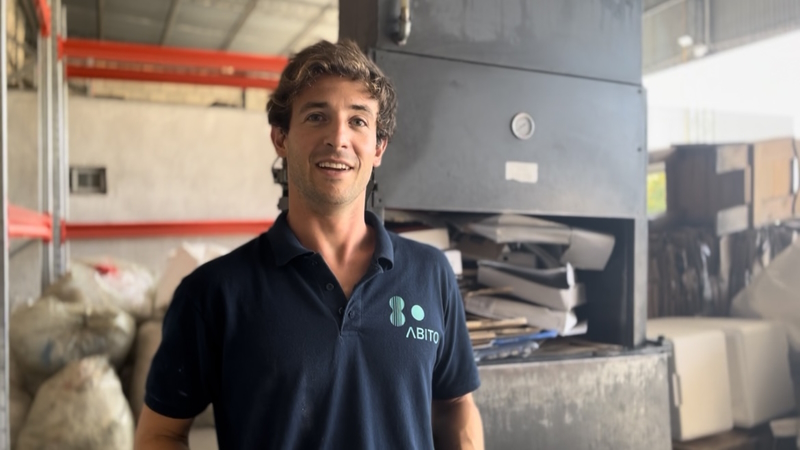
We spoke with Francisco Voulminot, founder and director of ABITO, one of 16 Uruguayan companies certified as a B Corporation for its triple impact: social, economic, and environmental.
How did ABITO come about?
It all started in 2018 after I told my cousin Soledad Chiarino about my thesis project; I ended up partnering with her to bring the project to life. I graduated from ORT with a Bachelor’s degree in Management and Administration, and during my final semester, we had to write a thesis based on a business plan. I spent a semester as an exchange student in San Sebastián, Spain, and came back fascinated by how they managed waste.
When I returned to Montevideo, I remember being struck by the contrast between how easy it was to do things right there (recycling and composting) and how difficult or complicated it was to properly manage waste at home back then. It motivated me to devote time and effort to researching and thinking about ways I could help address this issue and, in turn, contribute to protecting the environment.
Together with Gastón Soria and Mauricio Succetti, we developed a sustainable waste management system for neighborhoods in Canelones, which aimed to connect households directly with state-run sorting facilities and the BioTerra composting plant (with which we currently work), in order to minimize what is misnamed “trash” and maximize recycling and composting.
Of my thesis partners, one moved to the United States and the other took a different path after a job opportunity came up, so we decided to make it happen with my cousin. In 2018, we started with very little capital, just getting by. Then, as we validated our service and the market, we secured two major grants from the National Agency for Research and Innovation (ANII) that helped us innovate and improve our brand and service, and professionalize as a company. The National Development Agency (ANDE) also supported us with consulting services and facilitated access to very low-interest loans during the pandemic, when we nearly went under. Today, we have over 200 clients and a team of 25 people to provide our service and take action for the greater good.
What is ABITO, and what does it do?
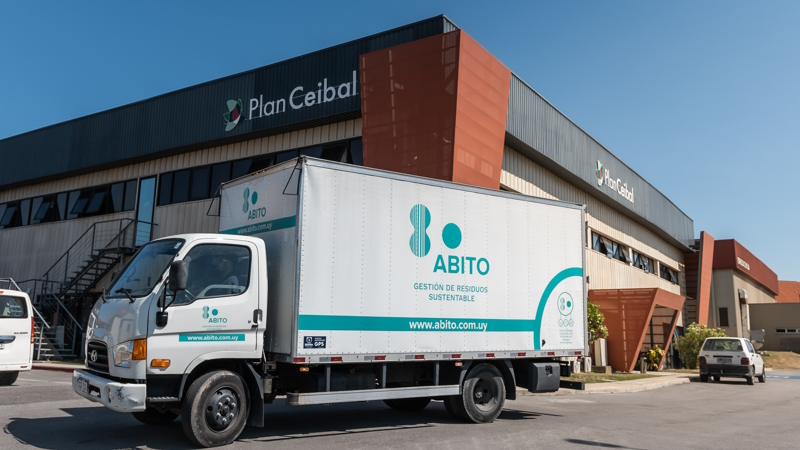
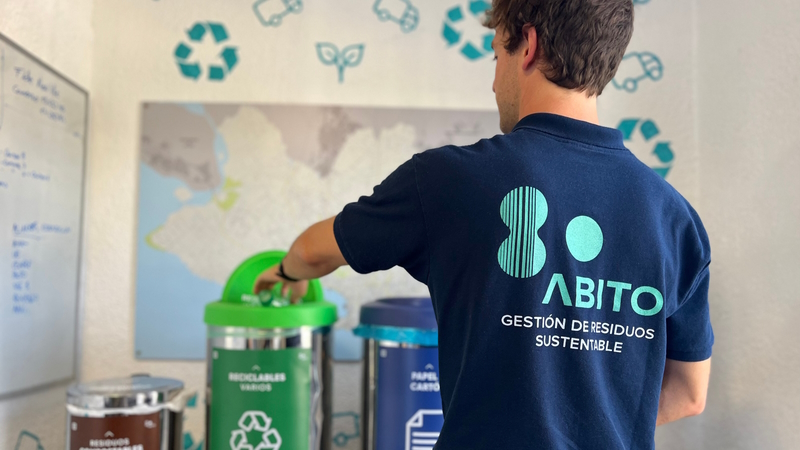
ABITO is a company that provides waste management services to other businesses, educational institutions, supermarkets, industrial facilities, neighborhoods, buildings, and private homes, with the aim of connecting them to recycling and composting facilities across the country and the region; this helps minimize the waste they generate that would otherwise end up in landfills and dumps. First and foremost, we facilitate source separation. We have a design team that provides our clients with everything they need to sort waste (colored bins, signage, guidance, etc.).
We also offer training sessions and workshops to empower people by providing them with access to information, so they can sort and manage their waste more effectively. Finally, we provide a selective waste collection service, with trucks that pick up waste sorted at the source and transport each type to the appropriate disposal site.
Recyclable waste is processed at our facility, where it is sorted and prepared for shipment to recycling plants. Compostable waste is sent to BioTerra’s industrial composting facility, where it is turned into organic compost that we then return to our customers for use in their gardens, vegetable patches, and flower pots. At the end of each month, we send all companies and educational institutions a report detailing everything they were able to recycle and compost, along with metrics on the positive environmental impact they achieved through their actions.
Why do you think it’s important for companies to be environmentally friendly these days?
Fortunately, environmental awareness is growing, but there is still a long way to go and a lot of cultural change to be made. In addition, consumers are increasingly valuing good practices.
It is important for us (both individuals and businesses) to realize that 75% of what we call trash can be recycled and composted. In turn, it can be repurposed and returned to the raw material production cycle—materials that, otherwise, we would have to extract from natural resources.
We also need to realize that recycling is more than just an obligation—it’s a necessity. It’s up to each of us to decide whether we want to be part of the problem or part of the solution.
We must adopt good waste management practices to ensure that our waste has the least possible impact on the environment.
You have a bachelor’s degree in Management and Administration from ORT. What do you think was the most important aspect of the program, and how much did it influence your decision to start your own business?
The program had a huge impact; it’s very focused on entrepreneurship and gives you all the tools you need to understand the key aspects of running a business, from accounting and legal matters to administrative and leadership issues.
You come away with a solid foundation for running a business. The most important aspect was the faculty—beyond the course content itself, which became increasingly interesting as I progressed through the program. Being able to think in terms of business models to move a project forward is essential.
What does it take to take the plunge into entrepreneurship, and what advice would you give to someone just starting out on this path?
The key is to be clear about two things: your purpose and where you want to go. If you’re convinced of that purpose and direction, whatever happens along the way can always be overcome. Setbacks and failures are inevitable; the important thing is to use them as lessons. Thanks to these lessons, you’ll be able to improve yourself and better handle future challenges. You have to understand that failure is part of success. When you lose your fear of it and learn from it, things start to go better for you and the path becomes clearer.
It’s also essential to have a clear understanding of your business model and value proposition, and to start building a strong team as your idea gains traction and your business begins to grow.
You need flexibility and resilience. We live in a changing world, so we must cultivate the ability to adapt (flexibility), innovate, and stand out. Resilience is the ability to keep going, even when things get tough. When life throws challenges our way, we must demonstrate the ability and discipline to persevere, even when motivation is low.
What was ABITO's environmental impact in 2022? What are your goals for this year?
Last year, the company processed 22,750 kg of various recyclables (glass, cartons, polystyrene, and cans), 30,470 kg of plastic containers, 42,300 kg of nylon, a total of 491,600 kg of compostable waste, and 544,169 kg of cardboard and paper.
When it comes to our environmental and recyclability goals, we aim to triple our numbers every year. We’ve been meeting those goals for the past five years, and obviously, the more we grow, the more challenging it becomes, but we’re confident that through large-scale projects, we’ll be able to reach our goal.
How does it make you feel to contribute to a more sustainable planet through this venture?
It’s a wonderful feeling to be making a difference—especially when it’s for nature, which gives us so much and to which we owe everything. It makes getting up every day to go to work feel like a privilege rather than an obligation. I’m really motivated by creating jobs and having a positive impact on people’s lives and their families. This also gives me the sense that I’m contributing to the country, the circular economy, and the creation of green jobs (new positions that arise from new ways of managing waste and other aspects of the circular economy).
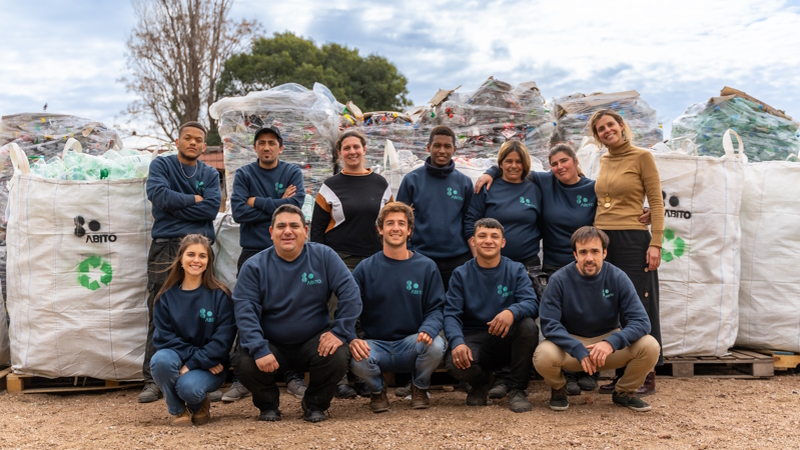
At ABITO, we provide employment opportunities to people who were already working in the waste sector, but in the informal sector.
Was becoming a B Corporation in the early years one of your goals? What does this milestone—becoming part of a global network of 5,000 certified companies worldwide—mean for ABITO?
Yes! I first learned about "B Corporations" at ORT, while taking a class on triple-impact companies and the circular economy. It blew my mind. That's when I realized I wanted to head in that direction.
B Corporations are a new type of business that balances purpose and profit, taking into account the impact of their decisions on their employees, customers, suppliers, community, and the environment. They are companies that strive to make the world a better place, not just to be the best in the world.
In May of this year, we achieved certification, and we are very pleased to have received this global recognition for our triple impact: social, environmental, and economic.
What are ABITO's future goals?
Over the next three years, we aim to expand our presence nationwide and become the leading company in sustainable waste management. We want to continue contributing to this paradigm shift and make recycling and composting as accessible as possible to all waste generators, in order to minimize the environmental impact of their waste. We currently operate in Montevideo, Canelones, and Maldonado.