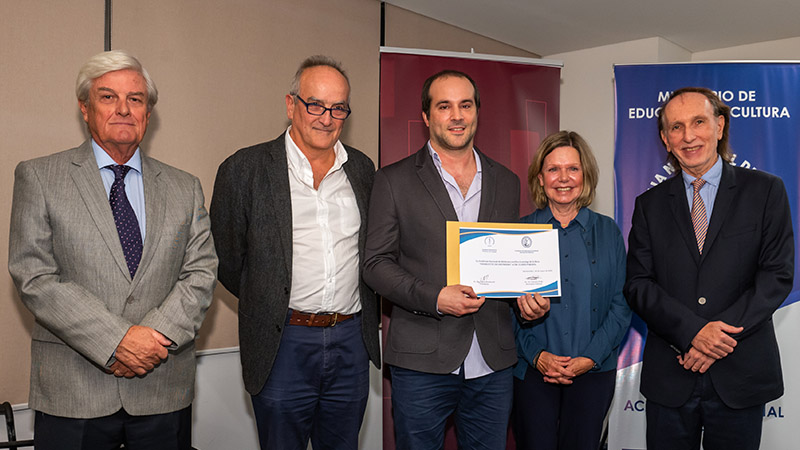
Why would a doctor want to pursue a master’s degree in education? Why, after many years of study, specialization, and clinical experience, would someone decide to return to the classroom to study education? What motivates them to pursue a graduate degree that, at first glance, does not seem directly related to their medical practice?
In the case of Ulises Parada—a surgeon and professor at the School of Medicine of the University of the Republic (Uruguay)—the decision to apply for the Master’s in Education was neither impulsive nor circumstantial. It stemmed from a deep-seated concern: the need to better prepare new generations of healthcare professionals in a context where being a skilled technician is no longer enough.
The Challenge of Teaching Medicine
One thing that Ulises identifies as a major shortcoming is the lack of specific training in pedagogy and teaching methods for those who teach in the field of medicine.
For years, he has been supervising residents specializing in surgery, as well as advanced medical students. “You do it partly out of a love for the craft, because you enjoy it,” he noted. However, he acknowledged that his teaching practice is based primarily on technical knowledge rather than formal training in pedagogy.

“Above all, students have to learn by teaching themselves and by copying what we do,” he explained. He immediately added, “I know more about pancreatitis, for example, so I’ll go and teach you about pancreatitis. But I do it without a set methodology.”
In fact, he said he doesn’t know how many of those pursuing a career in teaching “really want to be professors” at the university. Some want to do research or focus on administrative work. The point is that, once they take on the position, the duties of teaching, research, and administration “go hand in hand.” And for Ulises, that shouldn’t be the case: there has to be a calling.
Being a good doctor isn't just about being a skilled technician or performing surgeries well. That's a prerequisite, but it's much more than that.
Education: Much More Than Just Imparting Knowledge
For some time now, Ulises has been convinced that education is about much more than just imparting technical knowledge. “We have to realize that we need to be not only skilled technicians, but also good professionals,” he added.
And among the many factors that come into play, he believes there are two key aspects. First, building relationships based on trust and respect within the medical team. Second, focusing on patient care.
“There are people who come from different social backgrounds, with different upbringings and beliefs. That’s why it’s essential to take the time to talk to people, because that’s what brings you closer and helps them have a good time,” he said.
“Often, the treatment lies in talking with patients,” he added, because understanding people’s issues helps in providing better care. But for Ulises, it is crucial “to convey these ideas to students, because we are training people who will care for us and who are part of the future.”
A toolbox
“I’mreally doing what I want to do, ”Ulises said about his master’s degree in education. In fact, after the first few classes, he’s “absolutely loving it.”
Doctors tend to get together and end up talking about medicine, he said. Pursuing his graduate studies, therefore, is allowing him to meet different people with different perspectives , but who share a common concern: education.
View this post on Instagram
Starting the master's program gave her the opportunity to gain a new perspective on learning, as well as to realize that many of the tasks she performs on a daily basis—almost intuitively—are underpinned by a theoretical framework. And she is not only acquiring new tools and resources, but also rethinking the practical aspects of her teaching experience.
Another thing she discovered during these first few graduate classes is to view teaching methods as “a toolbox” to be applied at specific times and in specific situations. “Being able to choose what I use is one of the most important things I’m learning at ORT,” she noted.
Ultimately, it “broadened his horizons” to new perspectives: “These different aspects of education that I’m learning about are one of the things I like the most.” Ulises was concerned about teaching college students—that is, the students he addresses in his classes. However, during this initial stage of his master’s program, he came to realize the depth of educational issues, that there are other challenges, and how important it is to reflect on “how complex” education is.
I want to apply everything I’m learning in the master’s program to my medical practice and to my students.
What are Ulises’s expectations as the months go by? “Many,” he said. From “personal growth” to gaining more knowledge that he can apply in the classroom so his students can learn “more and better about medicine.”
Robotic surgery: the focus of his research
During his Master’s degree in Education, Ulises will be conducting research on the teaching of robotic surgery. In particular, he will focus on how to make this training more effective for young surgeons—who have experience in laparoscopic surgery—through simulation.
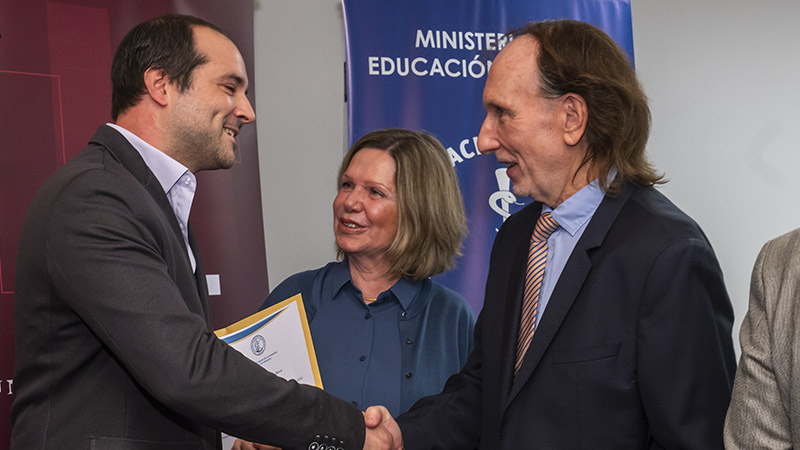
“Until just a few years ago, surgery was learned directly on patients. It was even said that a surgeon learned this way: today I watch you perform a procedure, tomorrow I do it myself, and the day after that I teach it to someone else,” he said, adding that “that kind of trainingis unacceptable today.”
As Ulises explained, simulation is a key tool that allows students to acquire about 80 to 90 percent of the necessary knowledge. “Advances in the field have been so significant that we can now simulate most situations, so the majority of skills are learned and practiced beforehand,” he summarized.
Commitment: to me, that is one of the keys to education.
The story behind the scholarship
Ulises was interested in pursuing a master’s degree in education, particularly in the field of teaching. Why? He was very curious to understand what it would be like to be a teacher in 2025, in an era shaped by artificial intelligence.
When she received a message announcing the launch of the Charlotte de Grünberg Scholarship, she didn’t hesitate to apply. “It was a perfect fit,” she said. She immediately began gathering the documents listed in the guidelines and working on the research project she had to submit.
“I had a hunch: something told me I might get in, but I didn’t know how many people had applied, and that made me pretty anxious,” she recalled, so hearing the news that she had won the scholarship was a moment filled with anticipation and emotion.
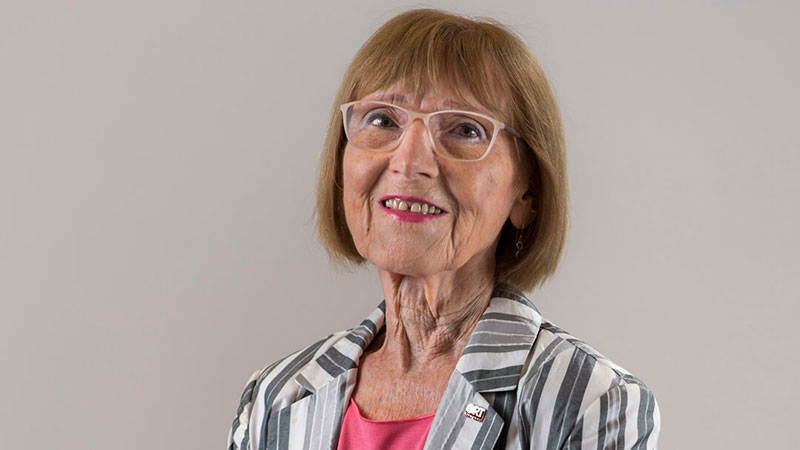
During the process, Ulises decided to delve into the life of Charlotte de Grünberg, the president of Universidad ORT Uruguay 1977 to 2024, whose legacy gives its name to the scholarship he received.
What he discovered had a profound impact on him. “I didn’t know her, but when I started reading her story, I found it truly inspiring. She was a person of immense greatness, without bitterness or anger, and with a genuine commitment to others,” he emphasized.
One thing she said that he heard particularly moved him: “She said that no one was indifferent to her. And that’s what needs to happen in education: we can’t be indifferent to others, to their lives, to their suffering.”
For the surgeon, that idea captures the true meaning of education: committing to others, integrating, including, and nurturing through respect for diversity. “Education is also that: a form of family, a gentle touch, a way of not being indifferent so that we can nurture more and better, ”he concluded.