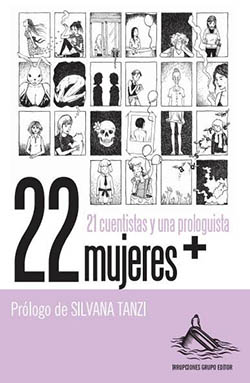
 22 women + “It brings together stories by female writers who are very diverse in terms of age, background, and professional and literary experience. They range in age from twenty to eighty; some have published their own books or contributed to anthologies, while for others this is their first time being published,” writes Silvana Tanzi in the foreword. “Given this wide variety of styles and narrative approaches, it would be futile to attempt any classification of these stories.”
One of the new writers is Brunella Tedesco, a 23-year-old with a degree in Journalism.
When did you start writing?
I started writing when I was very young—to be honest, I don't even remember how old I was. I wrote short stories, always fiction, in which I told some of those silly stories that come to mind when you're a kid. I also wrote a lot of poems.
Did studying journalism go hand in hand with this love of storytelling?
When I was 11 or 12, I decided I wanted to be a writer, and journalism seemed like a good career choice that would let me do what I loved every day. In the years that followed, there were times when I lost enthusiasm for it and considered other professions, but by the time I graduated from high school, journalism was still my first choice.
Many professors in the program have criticized that kind of choice, based almost entirely on a love of writing, but for me, that was what came first. There are people who are passionate about reporting, about investigating, probing, exposing, and clarifying, and who decide to become journalists because of all these impulses. Although I consider myself a curious person, I have to admit that all those motivations came later, once I began to better understand the role of a journalist.
When did you write *Lázaro*?
I wrote it the first summer after I started college, in the summer of 2009.
When I was writing it, I stopped before reaching the end. I knew how I wanted it to end, but I wasn't sure how to achieve that from a narrative standpoint. I revised it many times, always with that ending in mind, but I never knew how to put it into words.
Finally, last year, Andrés Alsina (a journalism professor) told me that his editor was planning to put together a new collection of *22 Mujeres* and was accepting submissions. That very night, I got home, opened Lázaro’s Word document, and figured out how to achieve what I wanted: it seems the possibility of getting the story published was the motivation I needed.
I sent the story to Gabriel Sosa, the editor, and he told me he liked it but wasn’t sure whether to include it because he already had a story with a similar theme—about the relationship between a mother and her son. He asked me if I had any other stories, and I said yes; I sent him another one that wasn’t as polished as *Lázaro*, but I insisted that this was the one I liked best. And Gabriel finally chose *Lázaro*.
What can you tell us about the plot?
*Lázaro* is essentially about memory. The story is about a boy who witnesses his mother’s suicide; years later, he leaves home, returns as an adult, and reunites with his father, who has remained in the same place all along.
The story is told in the first person, from the boy's perspective.
How How do you thinkLázarofits into the group of 22+ women?
I think the appeal of *22 Mujeres* and *22 Mujeres +* is that, as the authors of the forewords so aptly put it, this is a book whose purpose is to bring together stories by women. Not as “women’s literature,” not as a particular form of “sensitivity,” but as a space, a platform for the voices of female authors. If you look at it from that perspective, I think all the stories work, even though they don’t follow a single overarching theme or genre.
22 Women +: 21 Short Story Writers and One Prologue Author, published by Irrupciones Grupo Editor, brings together texts by Rosario Beisso, Ángeles Blanco, Sonia Calcagno, Estefanía Canalda (who is studying Communication at Universidad ORT Uruguay), Mónica Cardoso, Dina Díaz, Katia Engler, Cecilia Fernández Costa, Mariana Font, Ana Fornaro, Laura Fumagalli, Laura Gandolfo, Mariana Olivera, Gabriela Onetto, Lucía Piñeyrúa, Daniela Silva, Elena Solís, Elián Stolarsky, Alejandra Suárez, Yael Szajnholc, and Brunella Tedesco.