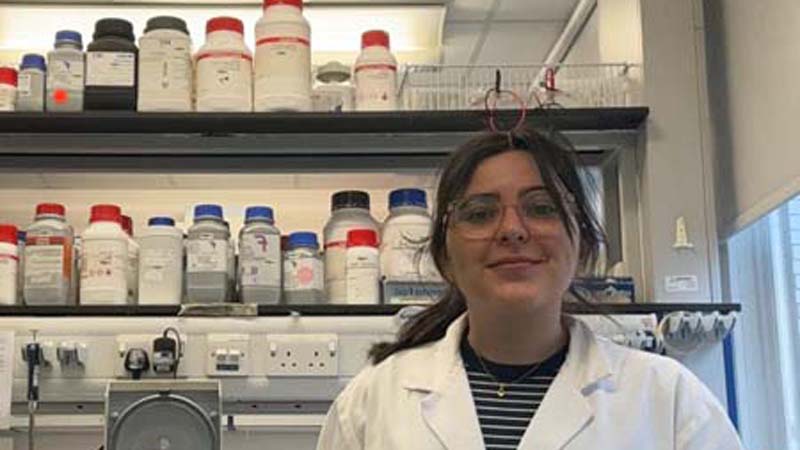
Dr. Cecilia Ortiz, associate professor of Protein Technology at Universidad ORT Uruguay, has also been involved in this project since its inception.
In this interview, she talks about her undergraduate experience, what motivated her to pursue a master’s degree, and offers some advice for students interested in pursuing graduate studies abroad.
You're pursuing a master's degree. What is the topic, and what is it about?
I am pursuing a master’s degree in chemistry, and my final project is titled “Glycosyltransferases for the Biocatalytic Synthesis of Glycosylated Phospholipids.” What does all this mean? It involves using certain enzymes, called glycosyltransferases, to biologically produce compounds of pharmacological interest, such as glycosylated phospholipids.
In the initial phase, I am observing the behavior of these enzymes to determine how they might function as “factories” for producing substances of interest.
These glycosylated phospholipids are of interest because they can be used as intermediates in drug production, and they are also involved in the antibiotic resistance of certain microorganisms—an issue that is becoming increasingly important in the context of human health.
What aspects of your undergraduate degree in Biotechnology motivated you to pursue a master’s degree?
My main motivation for deciding to pursue a master’s degree was to stay involved with the team at the Biotechnology Laboratory. I love teaching both theory and lab classes in the undergraduate program, and I feel that continuing my professional education will give me new tools as an instructor. Plus, I feel very comfortable in the research group where I completed my undergraduate thesis. Obviously, the idea of doing an internship abroad was the final factor that convinced me.
What was it like to spend three months at the University of Warwick? What new knowledge did you gain?
It was excellent. On the one hand, in England I had access to lab equipment I had never used before, such as mass spectrometers and NMR machines. On the other hand, much of what I learned relates to day-to-day life—that is, learning to work with new people, communicating in another language, observing how things are done differently, and exchanging strategies and problem-solving techniques.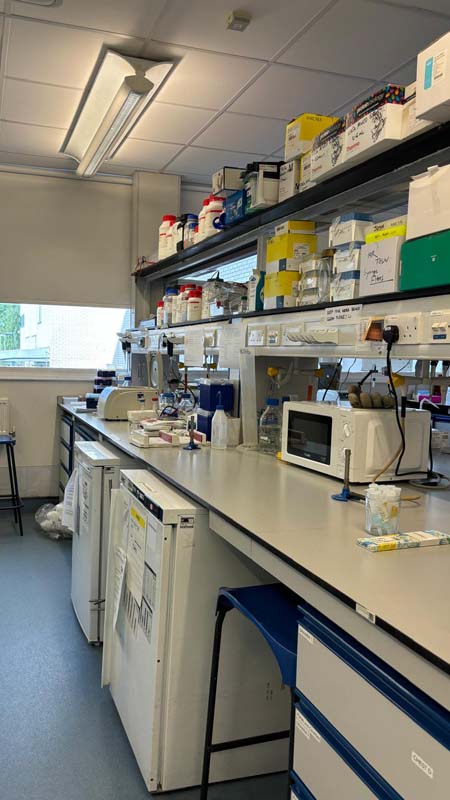
What is it like working in a lab at a university like that? Did you notice any differences compared to the Biotechnology Lab?
Yes and no. The university is huge, and so is the lab. While I was impressed by the size, as well as the amount of state-of-the-art equipment and how easy it was to quickly get any reagent, everything operates on a larger scale and moves faster. That said, the facilities were very similar to what we have here. For example, the lab benches, pipettes, infrastructure, reagents, and equipment from the same brands, among other things. In fact, sometimes when I showed my friends what I was doing, they’d say, “Oh, but you could do that in Uruguay.”
What would you highlight from your undergraduate studies, and what skills did they give you that helped you with your master’s degree?
Without a doubt, working on my thesis. In the Biotechnology Engineering program, we spend a year working in the lab as part of our thesis, during which we conduct experiments practically every day. At the University of Warwick, people were surprised by how independent I was in the lab. In fact, at first they had a hard time letting me work on my own, because undergraduate programs there don’t involve much lab work. Luckily, they quickly saw that I was comfortable and gave me more freedom to work on my own.
What advice would you give to someone who is considering studying biotechnology or studying abroad?
First of all, give it a try. I think in biotechnology you quickly realize whether you like the program or not, because you’re in the lab from the very first week of classes. Obviously, as the program progresses, things get more interesting and specialized, but I think if you try it, you’ll get a sense of how you feel when you’re inside a lab. For those who want to study abroad, know that we’re lucky to have several options, whether it’s going on an exchange during your undergraduate studies or eventually in graduate school, and in a variety of countries. I think it’s important to take your time, choose a moment and a destination that you really like. I always knew I wanted to study in England, and although it didn’t work out during my undergraduate studies, I kept looking until I found an opportunity during my graduate studies.