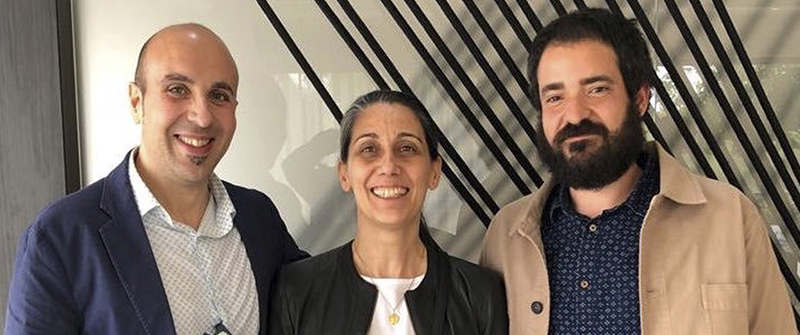
Mariela Questa Torterolo with her thesis advisors: David Rodríguez Gómez—visiting professor at the Institute of Education and faculty member at the Autonomous University of Barcelona—and Julio Meneses—faculty member and researcher at the Open University of Catalonia. Photo: Mario Maneyro.
For Mariela Questa Torterolo, the “journey metaphor” is one of the best ways to describe the process of earning a Ph.D. But hers was a literal journey, both in terms of the miles traveled and the path she took.
Throughout 2016, Questa Torterolo traveled the length and breadth of the department of Colonia to conduct fieldwork. In October 2018, she flew to defend her doctoral dissertation, titled: “Teacher Collaboration and the Use of ICT in Uruguayan Schools: A Multiple-Case Study in the Context of the Ceibal Plan.”
It was a long and exhausting journey, one that had its share of obstacles. It wasn’t a “smooth” ride, and often “the backpack felt too heavy.” He mentioned this in the acknowledgments of his thesis. However, after four years of hard work and dedication, he succeeded.
The journey has come to an end: the professor and graduate of the Universidad ORT Uruguay Institute of Education Universidad ORT Uruguay her Doctorate in Education from the Autonomous University of Barcelona with the distinction of summa cum laude.
What is teacher collaboration?
Do Uruguayan teachers collaborate with one another? In what ways? Do they use technology for this purpose? These were some of the questions Questa Torterolo addressed in her doctoral dissertation. The study explored forms of technology-mediated teacher collaboration in four elementary schools and four secondary schools in the department of Colonia, Uruguay.
“Just as research cannot be conceived of as a solitary endeavor, teaching can only be thought of as a team effort.”
“The most striking finding of this study is that teachers aren’t clear on what collaboration means. Nor is the academic community,” said Questa Torterolo. Although the study participants told her they were collaborating, when she analyzed their practices, each teacher assigned a different meaning to the term.
Conducting research on a topic where there is no consensus was a major challenge for the professor. “That lack of agreement, that conceptual vagueness on the part of academia, rubs off on teachers,” she emphasized.
There is no clear, unambiguous definition. Based on a review of 40 years of literature, the study concluded that collaboration can be considered a “meaningful interaction” in which teachers establish common goals and objectives focused on teaching.
It is not merely about sharing materials. It is a way of working, the key to which lies in keeping proper records of teaching practices, in team-level reflection, and in organizing the knowledge generated for dissemination.
“The professional development of teachers is an essential prerequisite for transforming education. By leveraging technology, Uruguayan teachers can foster collaboration among schools. They can also build a body of knowledge that supports student learning across all educational settings.”
Technology, an “indispensable” tool
“In the schools studied, technology is rarely used for teacher collaboration,” said Questa Torterolo. In fact, she added that, in most cases, the use of technology is viewed as “a personal choice.”
According to the data he collected, instant messaging apps are the tools most commonly used by teachers, primarily for coordinating administrative matters.
The reason, in her view, is that teachers use the apps they are most familiar with and find most practical—such as WhatsApp—since learning to use new tools requires extra time, which many of them simply don’t have.
Some schools also use cloud-based shared documents for projects. In high schools, in addition to instant messaging, they use email.
“Working in isolation doesn’t help teachers or schools. Learning from one another must be the foundation for a new educational and technological revolution.”
In the teacher’s view, technology is “an indispensable tool” that should enhance teachers’ work: “It’s not enough to take attendance on a device or administer an online assessment. We need to take advantage of the countless apps available and the knowledge out there.”
The Role of Faculty Collaboration
While Questa Torterolo explained that it is important for teachers to feel encouraged to use technology to collaborate, she admitted that it is not easy. She found few examples of effective collaboration, and even fewer cases where it was achieved through technology, which—in her words—was “a shame.”
“Recent studies conducted in places that are experiencing an ‘educational boom’—such as Finland, Singapore, and Shanghai—show that the key lies in collaboration among teachers,” he noted. Teachers who collaborate report greater job satisfaction, as well as a high sense of efficacy.
“There is a wide range of possible measures to improve collaboration and enhance it through the use of technology, but ultimately, we need to change teachers’ mindsets—an aspect that can be addressed primarily through initial training.”
Although he noted that his research is “exploratory, descriptive, and geographically limited,” in his view, the most important findings “are those yet to be discovered.” “The research leaves the door open for future studies on the topic because, in general, there isn’t much research on teacher collaboration and technology,” he explained.
Learning as a way of life
“Continuing to study is inevitable,” said Questa Torterolo, adding that, for her, learning itself has been “a motivation both to gain new knowledge and to develop new skills.”
“I love the idea of seeking out information, reading, and challenging the status quo. I enjoy trying to understand why certain things in education are done a certain way and exploring explanations to identify what works well. But above all, I want to propose new ideas to bring about change where it’s needed.”
But what motivated her to pursue a graduate degree? The teacher felt it was “interesting and necessary” to expand her knowledge in the field of educational management. So she decided to pursue a Master’s degree in Educational Management at Universidad ORT Uruguay, which introduced her to “tools and learning models she had not previously explored.”
“During my master’s program—and thanks to all the professors who shared their knowledge—I became interested in the field of research methodology and began to focus on those aspects of education that are often under-researched,” he said.
When she was invited to work as a teacher at the Institute of Education in 2014, she had a sort of “epiphany”: “That opportunity was a turning point for me; it made me decide to pursue a Ph.D. in Education at the Autonomous University of Barcelona, which I began that same year.” “At ORT, I truly understood where I wanted to go professionally,” she added.
“Embarking on a doctoral program is a major challenge that must be sustained over three or four years without losing one’s enthusiasm. It involves confronting oneself, pushing the limits of performance, reflection, and the ability to commit to one’s studies.”
Pursuing his Ph.D. allowed him to gain a deeper understanding of research methodology, data management and literature review tools, as well as open-access resources.
Skills that, in his words, enable rigorous, high-quality research: “Ultimately, this is one of the most important issues: conducting thorough research on topics that are crucial to education.”
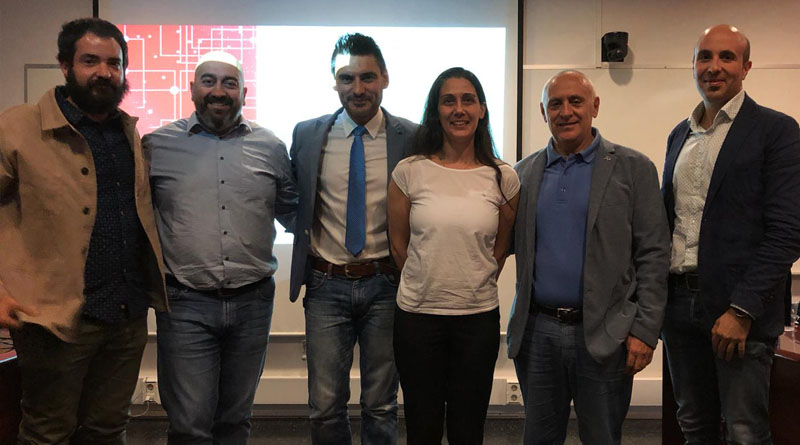 After the defense, with their thesis advisors and the members of the committee. From left to right: Julio Meneses –thesis advisor–, Guillermo Bautista –professor at the Open University of Catalonia–, Juan Torres Gordillo –professor and researcher at the University of Seville–, Mariela Questa Torterolo, Joaquín Gairín—professor of Didactics and School Organization at the Autonomous University of Barcelona and visiting professor at the Institute of Education at Universidad ORT Uruguayand David Rodríguez Gómez—thesis advisor—. Photo: Mario Maneyro.