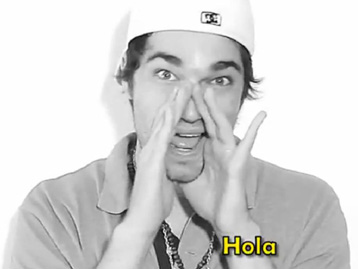
 “The truth is, this is incredible,” says Rodrigo Couto when asked about the video’s impact.
Carolina Curbelo, the Advertising Language instructor, assigned a class exercise. “Last week we assigned a project in which we asked students to create a viral ad—specifically, a testimonial—to understand how online media works today,” the professor explained.
“Almost all of my classmates posted videos without subtitles,” the student recalled. “And I didn’t understand a thing.” That’s when he came up with the idea of making a video without sound “so people could realize what was going on.”
“I’m not criticizing,” he clarified. “I just imagine they never feel that way.”
The video is less than two minutes long. In black and white, Rodrigo, alongside his girlfriend Camila Ramírez and his friend Federico Franchini—all three of whom are deaf—ask the viewers, the vast majority of whom are hearing, how they feel about content without sound.
“How does it feel not to be able to hear? Some people can’t read lips on a small screen, and others speak very quickly,” they say. “If you didn’t understand what we were saying, then do you understand how we feel when we can’t understand you?”
Before showing the video in class, Rodrigo decided to post it on social media. “Within two hours, I received messages telling me it had been shared over 1,000 times. I couldn’t believe it! I was speechless. In less than 24 hours, 5,000 people had already shared it.” Now, two days after its release, it has been shared more than 8,000 times on Facebook and has nearly 10,000 views on YouTube.
“Little by little, those numbers keep going up… I’ve heard from people in Mexico, Venezuela, Argentina, the United States, Chile, Spain…”
Rodrigo Couto explained to In situ why it’s important to have access to audiovisual content with subtitles. He said that, for example, in movies dubbed into Spanish, there’s no way to read the actors’ lips. “How am I supposed to understand?” he asked.
“It’s also important for all channels to use captions so people know how we feel. Many channels don’t have captions—not even the news programs. How are deaf people supposed to understand?”
In an interview with the newspaper El Observador, he was asked if he felt discriminated against. He replied, “We live in a society where we’re not taken into account. That’s exactly what the video is about: being taken into account.”
To watch, not listen, and share
The video uploaded by Rodrigo Couto contains some spelling mistakes that caught the attention of some viewers. He explained to In situ that he put the subtitles together very quickly and didn’t notice the errors. “I’m so sorry for the grammar and spelling mistakes; I was planning to show it to my teacher so she could correct it,” he clarified.
In fact, a YouTube user praised the initiative but criticized the errors in the text, to which Camila Ramírez—Rodrigo Couto’s girlfriend, who appeared in the video—pointed out that writing is the second language of the deaf: “This is the reality we face,” she said.
It is important to note that sign language is the first language of deaf people, since Spanish is their second language: “Deaf people approach Spanish from another language that differs significantly from it; the key distinction between the two languages lies in the mode of communication—oral versus gestural—and the mode of reception—auditory versus visual.”
In short, for deaf people, Spanish is a foreign language, even though it is the language of the majority community: this places them in a situation of developmental bilingualism (individual bilingualism) and societal bilingualism.
Sign language is the natural language of deaf people, and Spanish serves as their second language. “For this reason, deaf people must learn to write in a second language, rather than learning a system to represent the units of their own language,” as Leonardo Peluso, M.A., explains in his book *Psychosocial and Linguistic Considerations Regarding the Uruguayan Deaf Community*.
This sense of “otherness” (a term Peluso uses in his text) between sign language and writing leads to errors when expressing certain elements in writing, such as agreement in number and gender, as well as the incorrect use of prepositions.
In any case, Rodrigo wanted to improve his first video.
https://www.youtube.com/watch?v=1CtVEI1sDAA
Here is the original video:
https://www.youtube.com/watch?v=2-uPZeyCIcU