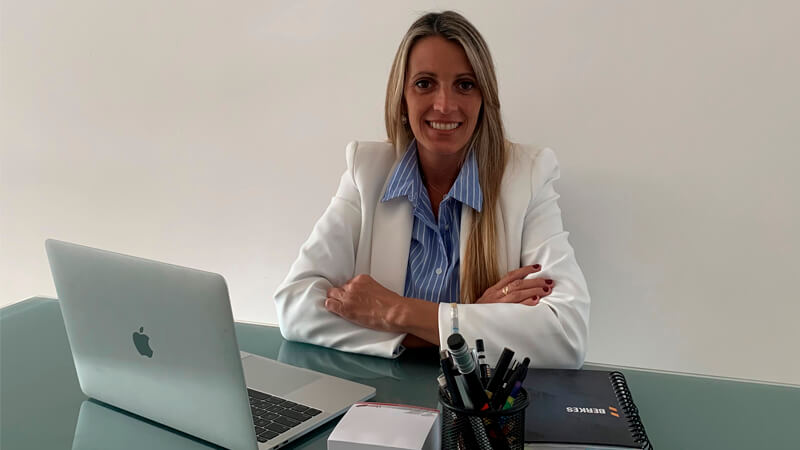
Mercedes Silva graduated with a degree in Architecture at Universidad ORT Uruguay 2008. That was the starting point for a professional career marked by challenges and changes: “College degrees are the first step toward making future decisions,” she says.
Today, Silva serves as the Business Development Manager at Berkes, an interdisciplinary company that provides global solutions for construction and engineering.
In this interview, the ORT graduate shares her journey in the business world, how the knowledge she gained at university has shaped her career over time, and her outlook for the future.
"College majors are the first step toward making future decisions without limiting your options."
What does your role at Berkes entail?
Broadly speaking, this is a position directly linked to the sales department. The role involves staying attuned to and addressing the needs of both current and potential clients. In addition, I must stay up to date on industry trends, build relationships, and support clients through the early stages of their projects.
The company's board of directors proposes projects that contribute to our country's infrastructure development. This requires analysis, research, and study, in which I participate. Another responsibility associated with this position is assisting the sales director with contractual formalities, bidding processes, and commercial negotiations.
I am also involved in our institutional communication strategy, which is developed in collaboration with our advertising agency, to ensure that we effectively convey the message we want to share as an organization.
Berkes is a company with a technical team known for its outstanding professionalism and up-to-date academic training. We have developed the capability to support the processes our clients are currently undergoing or planning in Uruguay and abroad. Berkes offers services in the development and execution of various engineering disciplines. This is the added value that sets us apart in the market; therefore, my focus as a business developer is on communicating this clearly and efficiently.
What challenges and opportunities does a company like Berkes face on a day-to-day basis?
Berkes is an engineering firm that operates across various sectors, including construction, industry, electrical engineering, and energy. We take an interdisciplinary approach, ensuring a comprehensive service. We are capable of providing Engineering, Procurement, and Construction (EPC) services and tailoring our solutions to meet our clients' needs.
Opportunities for professional growth are always available. Berkes is a Uruguayan company with more than 80 years of continuous development and constant improvement. The challenges involved stem from being part of the various stages of a project’s development and subsequent execution. This experience nourishes and enriches professionals. The scale of the projects Berkes manages allows for constant learning and the development of technical expertise, enabling us to overcome every challenge.
How do you remember deciding to study architecture at ORT?
My father suggested it to me. He understood that the ORT training program would teach me the specific skills required for my major and would also help me develop organizational and self-discipline skills—qualities necessary for achieving any goal, including graduating. And he was right.
The well-rounded education I received during my undergraduate studies serves as the foundation for developing the professional skills that enable me to excel in any role I undertake.
Universidad ORT Uruguay my time studying at the School of Architecture at Universidad ORT Uruguay with great fondness—a period marked by hard work and dedication, and above all, a sense of fulfillment.
"My father suggested that I study architecture at ORT. He understood that the curriculum at ORT would teach me the specific skills required for the field and would also help me develop skills related to organization and discipline."
Which of the skills you acquired during your architecture degree at ORT do you currently use?
I believe that an undergraduate degree provides general tools that enable one to handle a wide range of work situations. I believe that the practical application of these tools is enhanced through ongoing dialogue with the experience one gains over time.
The School of Architecture at ORT has always been committed to providing its students with cutting-edge technology. As early as the first year of the program, we were required to complete our design courses using the latest design software. This meant we were immediately immersed in the world of technology, kept up to date year after year, and also increased our chances of finding employment.
On the other hand, college also equipped me with other skills that I value and have incorporated into my professional life. While these aren’t strictly academic, they are just as important. For example, organization, punctuality, adherence to formal deadlines, the ability to express myself clearly both verbally and in writing, respect for others’ time, and teamwork—which involves learning how to engage in dialogue and taking the first steps in negotiation.
These skills, which are essential for professionals in any field, were a key component of my professional profile.
In 2019, you took a course on negotiation skills at Harvard University. What was that experience like, and what did you gain from it?
After completing my Master of Business Administration (MBA), I began to discover a professional world that was new to me and that I found incredibly interesting. I was excited by the idea of exploring new career and educational opportunities to channel this curiosity and embark on a new path in my professional journey.
I attended a workshop focused on negotiation theory and tools, based on Harvard studies.
The purpose of the negotiation workshop is to help participants improve their individual negotiation skills by focusing specifically on handling situations in which both the outcome and the relationship are important.
It was an extraordinary experience in every way, during which I gained new practical skills and joined a network of professionals from around the world.
"The challenge lies in continuing to explore and strengthen our calling. I didn't stop being an architect just because I work in the business sector."
What are your career plans for the coming years?
I intend to continue my professional development in the fields of sales and business, learning tools that will allow me to solidify existing concepts and incorporate new ones. We have the advantage of living in a globalized world, where it is easy to find answers to my professional questions.
I believe that choosing a college major should not limit one’s learning or hinder the development of skills needed to practice a profession. College majors are the first step toward making future decisions, without limiting them.
The challenge lies in continuing to explore and strengthen our calling. I didn’t stop being an architect just because I work in the business sector. I have a strong passion for my profession and a keen interest in the business world, and I bring both of those to my work every day.