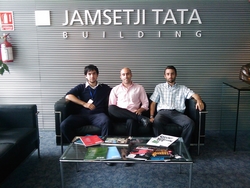
Studying and working at the same time requires a significant effort, but it also brings the satisfaction of knowing that the power to move forward lies within oneself. This is the experience of Fabián Edelsztejn and Federico Martinez, students in the Web Application Analyst and Programmer program, and Víctor Flores, a student in the Analyst and Programmer program, who have been working at Tata Consultancy Services (TCS) since last year.
Federico, 25, has two courses left to complete his fourth semester of the program. He believes it’s possible to work and study at the same time: “It’s a decision you have to make because if you wait until you graduate, it might be too late. The sooner you start working, the better.”
“It’s a great opportunity” to balance studying with work, says Fabián, also 25. “You make different use of the subjects you study in the program, and when you see other things as soon as you start working, new questions come up.” He thinks the course load is manageable, since it’s three hours a day, and that the program “is accessible,” as long as the student completes the assignments given in class.
According to Víctor, 20, working and studying “is complicated”; the job requires you to “learn a lot of things, especially at the beginning,” but the program “is designed to allow you to balance studying and working at the same time.” The student praised the professors in his program, who “are very understanding and will explain the concepts again whenever you don’t understand them.”
“When you graduate, if you’ve already worked, you have an advantage over others. Sometimes during the program, when you’re studying a topic, you wonder if it will be useful, but when you put it into practice and start working, you realize just how useful it is,” explains Federico. Even in his class, there are classmates who share their work experiences and discuss the challenges they face when completing certain tasks.
For Fabián, who works in Support, TCS is his first experience in the field of Information and Communication Technologies. “Everything I know about the technical side, I learned at ORT.” Federico is also part of the Support team. This is how he describes his tasks: “I provide support to those who test services to verify that they are functioning as they should, with the goal of moving to a production stage where the end user can work with that service.” Víctor started working in Support, though he currently develops web services. In his specific case, he works on the logical structure of a complex application that is presented to the user in the format of a web page.
Fabián explained that knowledge of the English language is essential for his work because he interacts with people from different parts of the world; “we couldn’t be working in this position if we didn’t know English (…) the company works with international firms, and this is how we communicate and sell our services from Uruguay.”
Víctor mentioned that he recently had an interview in English with a company representative who came from abroad. “You have to master the language so that you can understand the pronunciation of people from different parts of the world.”
The three students noted that they plan to continue their studies after completing their degree. In Víctor’s case, he would opt for the Bachelor’s degree in Systems offered by the Faculty of Engineering at ORT University. Their faces show the exhaustion and joy of those who, happy with what they have, yearn to better themselves.
Interview published in March 2011
News
A winning combination: studying and working
March 17, 2011
Studying and working at the same time requires a significant effort, but it also brings the satisfaction of knowing that the potential for growth lies within oneself. This is the experience of Fabián Edelsztejn and Federico Martinez, students in the Web Application Analyst and Programmer program, and Víctor Flores, a student in the Analyst and Programmer program, who have been working at Tata Consultancy Services (TCS) since last year.