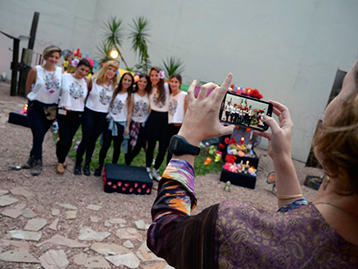
Eloísa Blitzer, Florencia González, Katherine Sonderegger, Agustina Speranza, Angie Szterman, Andrea Torterolo, Bruna Valenti, and Gabriela Vera are the seven fashion producers who organized the Festival de Colecciones on Tuesday, March 25.
First, there was a fashion show, and then the event moved to the hall of the School of Design, where the brands Angelina Martínez, Emili Toy, Matrioska, Ramona, and Tissora were in attendance.
The event served as the final project for the course "Fashion Event Production," taught by Professor Magdalena Ponce de León.
“This was the first event of its kind held as part of the program, since this group is the first class to graduate with a degree in Fashion Design,” the professor explained. “It’s a new experience, so the students had to venture into a field with no precedents,” she noted.
Ponce de León said that the event brought together female designers who are graduates of our university, who presented their collections in a very unique way: “It was a mix of seasonal collections, combined with pieces that are distinctive to each designer.”
Finally, the instructor summarized that a fashion producer is expected “to be someone who knows how to work as part of a team, since this is a collaborative effort where what matters is the final result, not individual contributions.” They must be familiar with basic communication tools in both traditional and Web 2.0 formats; although they are not clothing designers, they must understand the process and know about materials, textures, and colors; they must stay up to date with contemporary trends in production, consumption, and creation; and must navigate the complex process of brand creation—that is, be capable of adding value to a product so that it stands out and distinguishes itself from the rest.”
Organization and Responsibility
Gabriela Vera, one of the seven students who organized the Collections Festival, described the process.
“The project began during the final workshop of the program, in February, where the first and most important step was to decide on the theme we would be working on.”
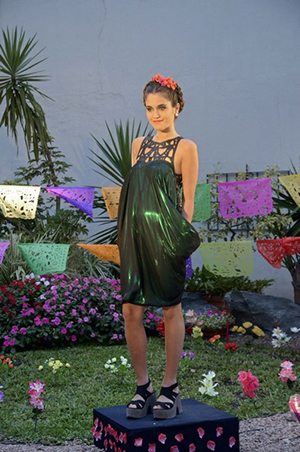
They chose the Day of the Dead celebration in Mexico. It’s “a vibrant and fascinating celebration that inspired us to decorate the venue, since this holiday symbolizes both new beginnings and the end of a cycle—something we can really relate to.”
Regarding the name, she said they wanted to link it to a celebration, “just like the theme”; “the idea was to showcase different types of garments that reflected the individual styles of the designers—each one features different styles: party wear, knitwear, wedding dresses, etc.—which we found interesting because what we wanted to present was precisely a festival, with completely different and timeless pieces.”
The work continued with the search for images and the planning of the venue’s decoration—which took place in the courtyard of the university’s main building. “The Mexican celebration we chose centers on the altar. It is set up with offerings, where color serves as an ideal symbol, and is adorned with papel picado, creating a colorful and festive atmosphere. There is a variety of flowers, and candles play a very important role. What each altar contains is unique. Setting it up was a major challenge: we had to find the papel picado they use (openwork paper streamers), typical of this celebration, as well as clay skulls, flowers of all types and colors, garlands, fruits, paper pom-poms, candles… We had to recreate the atmosphere, adding the touch we wanted for our event and conveying the spirit of celebration in the face of change, a new chapter.”
Vera felt there were several challenges: creating the event from scratch, learning to work as a team, dividing up the tasks, and making sure the entire organization ran smoothly, “since everything depended on us as the event’s producers and organizers.”
“Organizing an entire event was a great experience. I really got a taste of what it’s like to be in charge of a thousand things and stay on top of everything so I could respond and find solutions in the most creative way possible; that’s what this career is all about. This experience helped me realize that being in charge of so many things is a huge responsibility, but it’s doable. A fashion producer has to be prepared for anything and know how to solve problems quickly and effectively.”
In short, the professional explained that the work of a fashion producer spans various areas. “You can take on a variety of tasks: from editing a magazine, to developing a brand’s visual identity, creating campaigns and lookbooks, and organizing events… You have a lot of responsibilities since you’re in charge of several things at once, and you have to stay on top of everything to ensure it all goes perfectly.”
“A producer’s goal is to ensure customer satisfaction in every way, to understand their ideas and deliver a successful project in any field, and, above all, to know how to work as a team in order to pull off a successful event,” he said. “It’s the ability to see what’s happening in the world and convey that to others through visuals: it’s a practical way of communicating.”
Watch the video summary of the event:
https://youtu.be/x9Dz_gtqeok?si=15gpQS1Gmq_DYp15