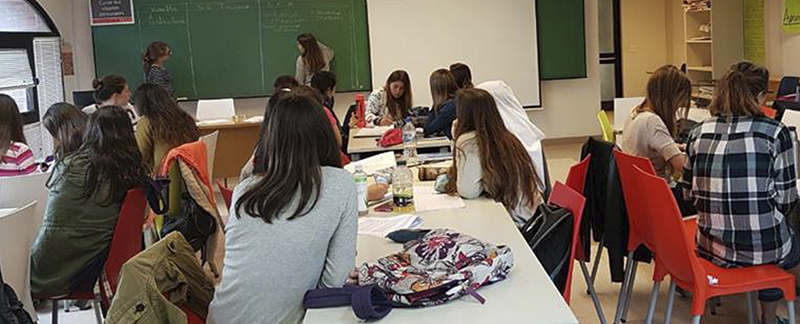
“Today’s teachers are unable to teach the most disadvantaged groups,” said Inés Aguerrondo, a visiting professor at the Institute of Education at Universidad ORT Uruguay Innovation Coordinator in the Department of Education at the Catholic University of Argentina (UCA).
"It's not that they aren't capable," he said. In his view, the reason is that when teacher training programs were designed, they were based on the characteristics of middle-class students, since the school systems did not serve the entire population. Not everyone went to school: many children were in the countryside, and just as many needed to work.
“In the mid-20th century, when the working classes began attending school, the disaster began,” he noted. But he pointed out that the problem isn’t that children lack certain skills, but rather the training of teachers: “In Latin America, teachers don’t graduate with the necessary skills to teach all students.”
Aguerrondo is convinced that university teacher-training programs in early childhood and elementary education will enable “more children to learn more.”
Training for the teachers of the future
“Teacher training programs are unique in that they are not purely theoretical courses where students just sit and take notes,” Aguerrondo pointed out. “We say that we train teachers with the skills necessary to teach,” he added.
The university teacher-training programs in early childhood and elementary education are undergraduate degree programs. They last four years and are offered at the Catholic University of Argentina.
They are based on a competency-based training model called Inclusive and Effective Learning (AIE). In other words, it is a model in which students develop the ability to solve complex problems based on knowledge, skills, and competencies.
To illustrate this point, Aguerrondo explained that an exam in evolutionary psychology does not ask, “What are Jean Piaget’s ideas?” Instead, students might be asked to have lunch with a child, observe the child’s behavior in light of Piaget’s theories, and determine which stage of development the child is in.
They do not assess students in the traditional way, through written exams; instead, they base their evaluations on student performance in relation to the learning objectives set out in the course units.
They don't assign grades either; instead, they rely on feedback. First, the student self-assesses, then their peers provide feedback, and finally, the teacher does so. All feedback is stored in a digital portfolio.
“We give students a non-traditional classroom experience so they can teach in a non-traditional way and, in the future, structure their own classes differently,” Aguerrondo explained.
Inclusive learning
“These days, the school situation is dire for all kids,” Aguerrondo stated, adding that “even students at good schools aren’t learning the way we think they should.”
According to the professor, one of the strengths of these teacher-training programs is that they promote “inclusive and effective” learning: “The idea is that all students should be able to teach in all types of schools: in upper-class and lower-class schools, in the slums, and in underserved areas.”
“We believe that all children are capable of learning and that all teachers can teach in all sectors, regardless of where the teachers come from or where the children come from,” he added.
In fact, Aguerrondo noted that the student body is very diverse, given that the university provides scholarships to 30% of the student body from the most disadvantaged sectors.
According to him, the response has been “excellent.” The university teacher-training programs in early childhood and elementary education began in 2017 with 54 students. In 2018, there were 49. In 2019, UCA will begin training the third cohort.
The inspiration: the Alverno College model
The UCA initiative is based on the model implemented by Alverno College, an educational institution located in Milwaukee, Wisconsin.
More than 10 years ago, in a magazine issue dedicated to teacher training, Aguerrondo came across Alverno’s program and found it “interesting and unique.” A mutual friend knew the dean of the institution and arranged a meeting for her to see how they worked.
It took them eight years to prepare for the opening: from 2008 to 2016. The UCA faculty knew how to teach a traditional class, but the new model called for a different approach to teaching.
They received training from professionals at Alverno College and explored how they could implement the program in Argentina and at their university. They also established a Network of Innovative Schools—which currently has participating schools—where teacher-training students complete their practicums.
“We embarked on this initiative because there is a global crisis in teacher training, and we believe this is a very good alternative,” Aguerrondo said.
The Importance of Innovation in Education
In Aguerrondo’s words, Latin American education is “far behind.” This is reflected in the response of young people, who get bored in class. “The best thing that could happen to us is that the kids in high school don’t want to stay and leave,” he said. “If we had a youth that puts up with what we give them and stays quiet, what kind of future do we have?” he asked.
The teacher noted that those same students later enjoy “solving extremely difficult problems on the computer, working on projects with friends, or going to camp.”
For this reason, he believes that the older generation “has failed to create opportunities that would encourage young people to pursue a path of knowledge, professionalism, and learning.” Why has this not been achieved? According to Aguerrondo, it can be explained by a “web of mental models, vested interests, and a lack of long-term vision.”
That is why the teacher emphasized the role of innovation, as well as the importance of making improvements to the education system.
“Changes are happening everywhere: from Uber to robots. And people complain a little, but they adapt. We in education, however, just say, ‘We have to go back to the old-fashioned school.’ And it doesn’t occur to us that students might be able to learn in a different way and in a different context,” he concluded.