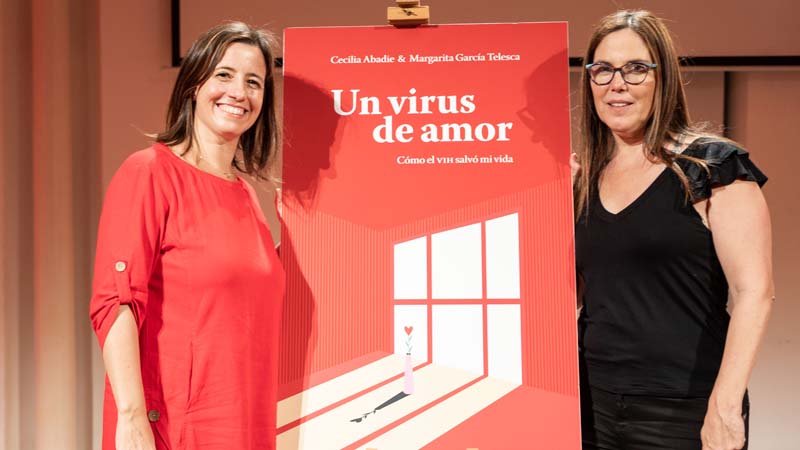
To do that, he needed a writer and editor who could help him shape the book he had started but hadn't finished. That's how he got in touch with Margarita García, also a systems analyst from ORT, who at the time was leaving the tech field to pursue a career in writing.
How are writing and technology connected? What is the link between two fields that seem so different?
For both Cecilia and Margarita, they don't seem so different; rather, one reinforces the other.
Margarita: They stem from creativity and the power of abstraction that technology provides. Mathematically, you think differently; you’re always looking for the best solution, the best algorithm, and that automatically puts your mind into an abstract mode. That helped me see the bigger picture, prioritize, find meaning, and synthesize information.
Cecilia: I started programming when I was 13; I don’t know who I am without technology. You have to realize that technology isn’t just a computer—you need to understand the real world and translate it, and then explain to people how to use it—but it all starts with identifying the problem we want to solve. At the end of the day, we can’t ignore the human side of technology, since everything we do is in service of humanity.
Camila Gómez García, Margarita’s daughter and a senior graphic design student at ORT, also contributed to the design of this book. She was responsible for the layout, typesetting, and cover design.
What was the process of designing the book cover like?
It was difficult, especially with this one, which had so many messages and so many interesting points to highlight. It’s hard to know where to focus or how to express what I was feeling. At the studio where I work, we tried out different ideas: love, growth, enlightenment, among others. We used many techniques even though the final result was digital: from watercolor and colored pencils to charcoal.
What aspect of your degree program do you think has helped you the most in this process?
During my studies, I took a specific course called Technical Drawing. I’ll admit that at the time I didn’t know how it would be useful to me, but it turned out to be a crucial foundation for the cover of this book. In addition to Editorial Design.
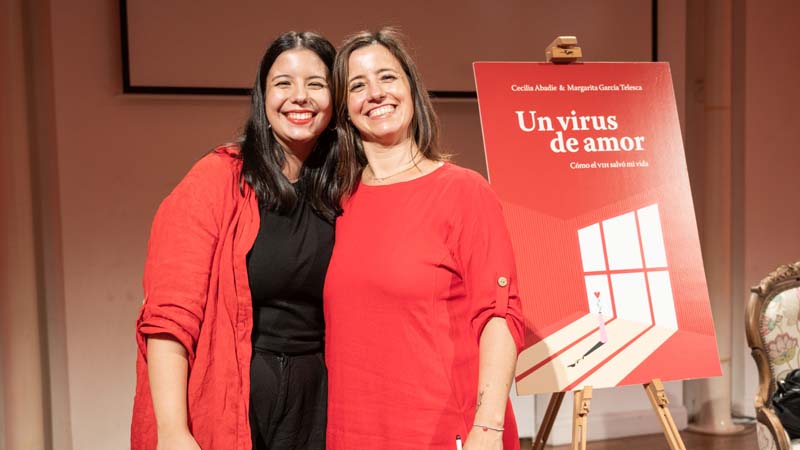
For both Margarita and Cecilia, their time in college was a wonderful adventure that they look back on fondly today.
“The degree has opened so many doors for me, and I’m still friends with people from my college days. Because it’s hands-on, it allowed me to adapt easily to different jobs and learn new languages. It’s a great tool for this ever-changing world,” says Margarita.
Meanwhile, Cecilia says that her degree is what gave her independence: “When I finished my degree, my addiction began, but I have to admit that I landed on my feet thanks to the education I had received, and thanks to my degree, I never completely fell apart.” She adds: “It gave me a well-rounded education—teaching me how to learn about everything and how to learn on my own. You become a professional who is engaged and curious, which allows you to stay up to date.”
As for the book’s reception, all three emphasize that it was incredible, exceeding all their expectations. “There was a genuine interest—one rooted in compassion, curiosity, and a desire to connect with others,” says Margarita.
“I felt that it’s possible to be brave, that it’s possible to be vulnerable, that it’s possible to connect with people if we truly intend to help, to inspire, and to speak as genuine human beings,” Cecilia concludes.