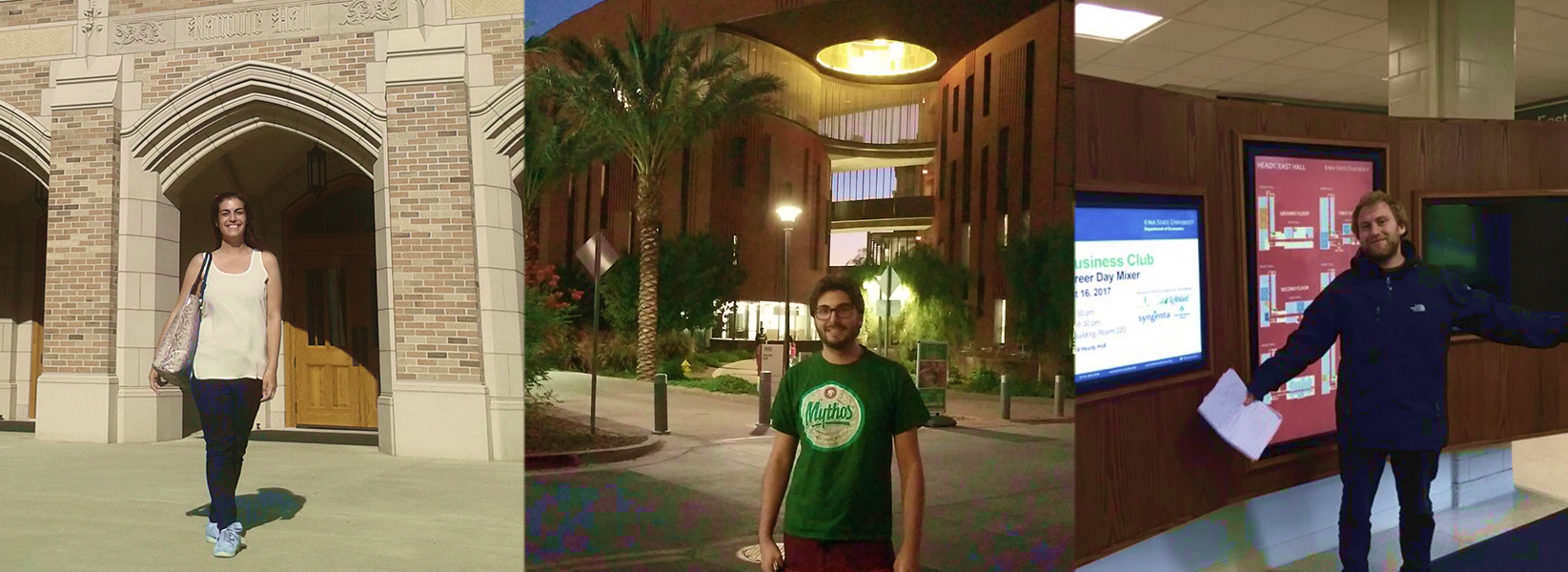
Three graduates of theBachelor of Economics program at Universidad ORT Uruguay their doctoral studies at top-tier universities in the United States, all on full scholarships. This is one of the career paths offered by the program, although it is not usually the most popular one.
Santiago Acerenza, Martina Cha, and Juan Odriozola shared their thoughts on topics such as the selection process, their experiences during the first few weeks, what conducting economic research entails, and the importance of continuing their studies.
The application: a difficult process
All three students agreed that the application process was long and difficult. Martina Cha said she took two exams—one in English and another in reading comprehension, math, and writing—and also filled out several applications.
In any case, he saw it as an investment in his future and eventually secured a scholarship to the University of Notre Dame. The support of Dr. Néstor Gandelman—coordinator of the Economics Department—and several faculty members in the program was essential. They advised him on which universities to apply to, how to present himself, and what aspects to highlight, and they even wrote letters of recommendation for him.
Santiago Acerenza—who is studying at Iowa State University—said that the support he received from ORT’s Department of Economics was “unwavering.”
Members of the department gave him the opportunity to write academic papers, which put him in a stronger position when it came time to apply. “They didn’t just provide me with information; they also supported me emotionally throughout the entire process,” he said.
Juan Odriozola spent four months studying for the entrance exams and improving his English. He was eventually awarded a scholarship from Arizona State University.
“I can devote myself entirely to my studies without worrying about financial matters. The scholarship covers all tuition, and I also receive a bi-monthly stipend throughout the five years of my degree program,” he said.
In return, you must pass all your courses, conduct high-quality research starting in your third year—the doctoral dissertation—and fulfill duties as a teaching assistant.
The University City
Pursuing a Ph.D. at a university in the United States offers the opportunity to share a classroom with students from all over the world, along with the cultural enrichment that this brings. Odriozola, for example, has classmates from the United States, China, Greece, and Sweden.
He mentioned that he has regular classes from Tuesday through Thursday, in the morning and at noon. In the evenings, he spends his time working through the problems that came up during the week. In particular, he focuses on how to avoid making the same mistakes.
Cha explained that his college town is exactly that: a town. He can find everything he needs right on campus, so he hardly ever has to go out. “It’s a huge place with a football stadium bigger than the Estadio Centenario,” he described.
As for the classes, he explained that they are very dynamic and progress is usually quite rapid. At the end of the first year, students must pass all their exams to continue in the program. In subsequent years, each student chooses the courses that interest them most.
Conduct research in economics
“Coming up with new ideas is no easy task in and of itself,” Acerenza pointed out, adding that coming up with an idea that is useful, interesting, worthy of publication, and worth paying attention to is the main challenge of economic research.
For Cha, the importance of research lies in the fact that it is the tool that allows us to explain social phenomena and trends. Odriozola believes that the potential topics for research in economics are endless, and that opens up a very promising outlook.
“Research is the source of growth in economic thought,” said Odriozola, adding, “It is also what drives our professional development, enabling us to analyze more complex and diverse issues, and allowing our work to become increasingly rigorous.”
Unlike an MBA, which is a professional graduate program where students develop the skills needed to work in business, the doctoral programs these students are pursuing are academic in nature: the emphasis is on research and the generation of knowledge.
Upon completing their doctorate, they will have developed the skills needed to work as social scientists. They will be able to do so at universities, research centers, multilateral organizations, or government agencies.
Currently, Uruguay has ,700 researchers, according todata from the National Agency for Research and Innovation (ANII). "It's an achievement, but it's not enough," Fernando Brum—the agency's president—told El País. “Uruguay has researchers per million inhabitants, whereas, according to global standards, it should have more than 2,000 to gain international recognition.”
The path that university graduates are on contributes to improving the country's research capabilities.
The Importance of Continuing Your Education
According to Cha, having all the necessary technical tools is essential for conducting economic research. That is why he felt it was necessary to pursue a doctorate.
“What I appreciate most is the opportunity to be surrounded by people dedicated to research and by colleagues from all over the world, with perspectives that are completely different from my own.”
“As you progress through your doctoral program, opportunities arise to submit papers, apply for other grants, attend conferences, and take advantage of countless training opportunities,” he added.
Acerenza decided to pursue a Ph.D. because, throughout his undergraduate studies, he realized that if he wanted to be at the forefront of his field, a Ph.D. was the way to go.
Odriozola always believed that to truly understand economics, he needed to pursue that graduate degree. That belief was reinforced when he began working as a researcher at the Central Bank of Uruguay: “I realized I didn’t have a complete picture of what I needed to conduct research.”
“It’s always important to keep learning. Knowledge in economics is constantly evolving, and new research opens up new avenues, but above all, it’s a matter of personal growth,” he reflected.
The Future
“Even though I’m pursuing a doctoral degree that takes about five years, paradoxically, I don’t think about the long term,” Acerenza explained. His current plan is to return to Uruguay, but he doesn’t know what will happen down the road.
Cha feels the same way. Her goal is to pass her courses, although she also dreams of returning home to apply her knowledge to research and teaching in her country.
Odriozola's plans are uncertain. For now, he plans to finish his studies and apply for a research position, though he doesn't yet know where. He may decide to return to Uruguay to work in academia, but he isn't sure if he'll do so right after graduation or after working abroad for a while.
He recommended that students interested in economics and research apply for a Ph.D. “Universities in the United States have funding for scholarships, and many of them are committed to diversity.”
For him, having a doctorate “opens many doors.” When the time comes, he’ll have to figure out where they lead.