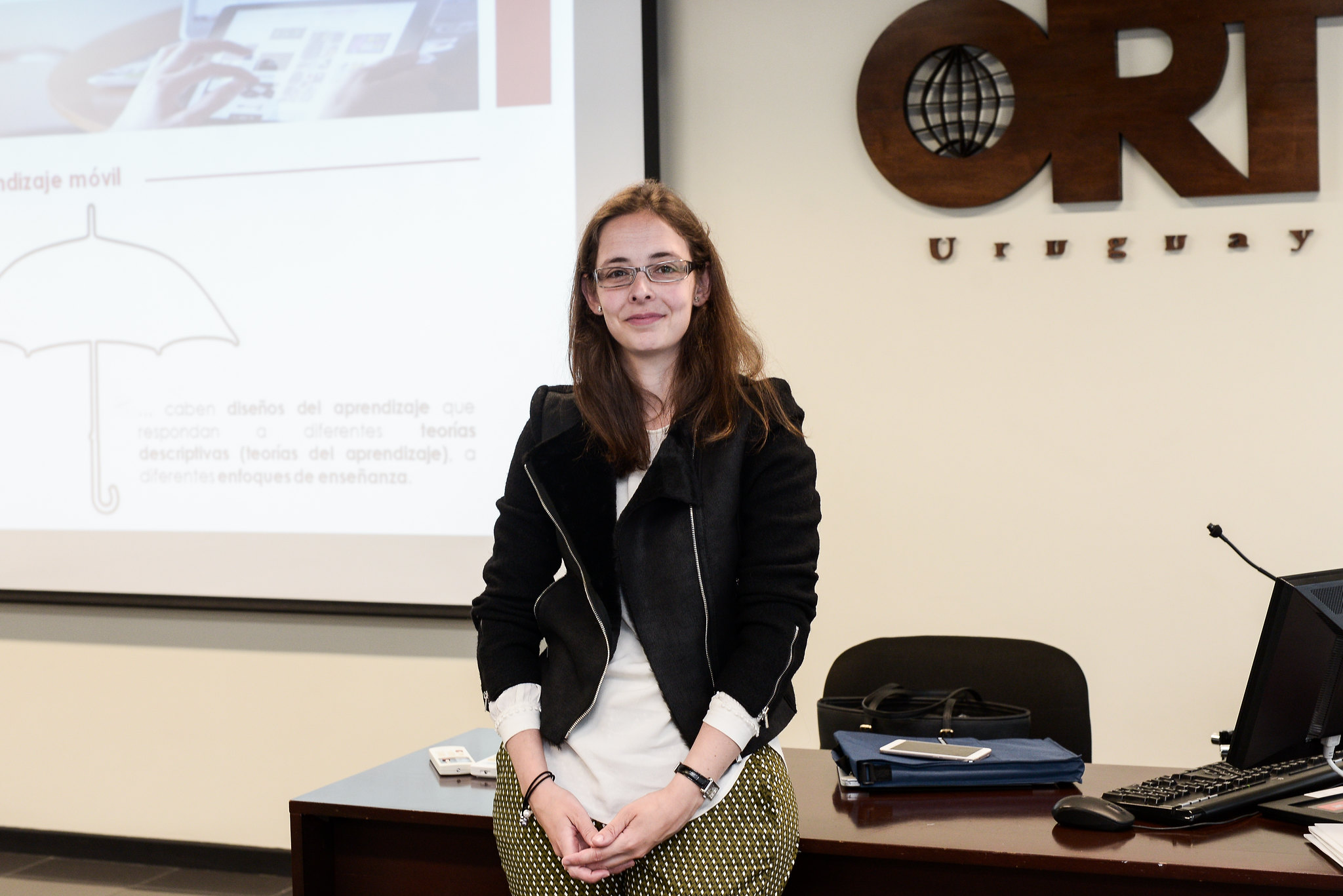
Designing mobile learning experiences and implementing them within the framework of a flipped classroom. That was the objective of the in-person workshop titled “Flipping the Classroom and Facilitating Mobile Learning,” which took place as part of the project “Ubiquitous Learning: Mobile Devices and Learning Ecologies in the Initial Training of Secondary School Teachers in Uruguay.”
From Monday, April 16, to Wednesday, April 18, 2018, 21 teachers from across the country learned how to use various digital tools and mobile apps to incorporate into their lessons.
The in-person session served as a follow-up to the online training, which participants took from Friday, March 2, to Friday, April 13, 2018.
The workshop was led by Dr. Carmen Yot, a professor and researcher at the University of Seville. Through an interactive and largely hands-on session, she addressed the participants’ questions and comments.
During the first part of Monday the 16th, Yot reviewed the most important concepts related to mobile learning. He also reflected on the current challenges in this field.
Over the following days, sessions were held to work with specific tools. Guided and supported by the instructor, the participants learned how to use the technology and got involved in creating digital content.
How can we make mobile learning easier?
“If there’s no educational purpose or pedagogical use behind it, a mobile device is just a nuisance and an unnecessary item,” Yot said.
During the in-person session, he emphasized that teachers must be familiar with technology and be competent in its use. This does not simply mean knowing how to turn on a computer or how to access a platform: “It means knowing how to conduct educational activities and use technology to teach the curriculum.”
“The fact that I know a lot about my subject makes me an expert, but not a teacher,” he added, explaining that it is important to have knowledge of teaching methods in order to turn information into educational content. Only in this way can it reach students and be understood by them.
At the same time, he recommended that teachers ensure mobile-based learning is sustainable and carried out on an ongoing basis. He also encouraged them to get involved in creating digital content and to familiarize themselves with how students use technology. “If they use a social media platform or an app—and it’s useful for class—why not use it?” Yot asked.
Why and for what purpose should we flip the classroom?
According to the teacher, the importance of flipping the classroom lies in the opportunity to make the most of time spent outside of school. She pointed out that “learning doesn’t happen only at school or college”: “Any setting can foster learning, whether it’s the supermarket or the bus.”
But what does “flipping the classroom” mean? In Yot’s words, it means using class time for students to engage in meaningful learning activities—rather than having the teacher spend class time lecturing. For example, to guide their work or answer their questions.
“Mobile devices allow us to implement different teaching models—or carry out similar activities while making the most of them,” he noted.
Although some teachers and schools are incorporating mobile devices into their classrooms, according to the researcher, “things are still being done the same way as before, only now with technology.”
He noted that university professors often post lecture notes on the platform instead of leaving them at the office. However, they still conduct lectures in which students listen, take notes, and then study from those notes or from textbooks.
“There have been no changes,” he said. If mobile devices are used to do the same kinds of exercises found in a textbook, what is the benefit? “Really none,” he concluded.