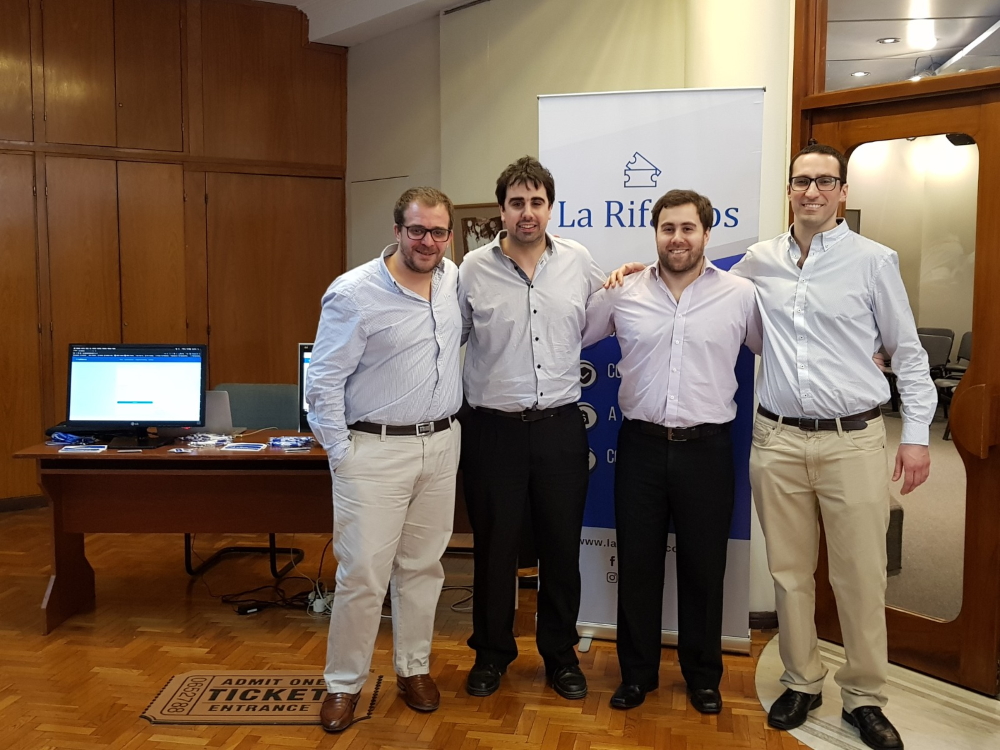
It all started with a news story in the newspaper: in 2018, a French woman had decided to raffle off her castle after failing to find anyone willing to pay the price she was asking for the property. That unusual story turned out to be the inspiration for the final thesis project of Universidad ORT Uruguay Bouchaton, Rodrigo Stratta, and Luis Introini—now graduates of the Systems Engineering program at Universidad ORT Uruguay —and student Nicolás Pontet.
LaRifamos—that’s the name they gave to the project, which consists of a platform where people can create a raffle—the prize is the item they want to sell—so that users can buy tickets—with a high chance of winning—and the seller receives the money they wanted from the sale. “After reading the news, we thought about creating a similar model here and building a platform where people could do the same thing. We began the market validation process, met with the National Lottery and Betting Authority, and saw that there was an opportunity, that it was viable, and that people were willing to buy,” Stratta said.
Better odds of winning than in a game of chance
So far, they have held five raffles: a trip to Buenos Aires, an iPhone 8, a smartwatch, an electric motorcycle, and a PlayStation. According to Stratta, the amount users have had to pay for each ticket has not exceeded $200.
“The chance to invest $200 and win a prize of $700 or $800 is appealing. There isn’t much risk, since the investment isn’t large, and the probability of winning is high: the first raffles didn’t exceed 250 numbers,” the engineer said. He also added that LaRifamos aims to create a raffle model in which the probability of winning is higher than in any other game of chance.
According to Stratta, by the end of the first half of this year, they plan to raffle off the first used car, which, he says, was the central idea behind the project.
They intend to do the same, for example, with a two-year apartment lease. In that case, the property owner sets a rental price for that period, which must not exceed 2,000 Adjustable Units—the maximum amount for which a raffle can be held, or about $60,000.
The goal of the platform is to sell a minimum number of tickets to cover the amount set by the property owner. So, with this type of raffle, “people could end up living in that property for two years by paying just $10, for example—the amount they paid for the ticket,” explained the ORT graduate.
How does it work?
When someone requests to raffle off an item—such as a car or a property—there is a validation process involving mechanics and notaries who determine the current market value of the item in question and verify its legal status. If that validation is approved, negotiations proceed with the beneficiary regarding how to conduct the raffle, the level of advertising they wish to undertake, and the amount of LaRifamos’ commission, which is set at 15% of the sale. This makes it possible to determine the minimum number of tickets that must be sold.
Once the sales framework has been approved, the raffle is published. From that point on, users reserve the number they want and enter their card details, but the payment is not processed yet. The raffle ticket is issued only when the required number of entries—which guarantees the minimum amount the seller is willing to accept for their product—has been reached.
It is then registered with the National Lottery and Betting Office, and the raffle ticket sales process continues until the day of the drawing. “That way, we can ensure that you won’t sell your car or product for less than it’s worth, and you might even end up getting more than you expected for it,” Stratta explained.
In addition, the systems engineer noted that among the technologies they used is blockchain, which ensures that the number assigned to each person cannot be altered. They also employ encryption for sensitive data, which provides security for the user.
“A path that’s open to anyone who sets their mind to it”
According to Stratta, they haven’t found any similar ventures in the region. “In Europe—specifically in London—there were some attempts to do something similar, but it didn’t work out, partly because of the legal framework. Culture and the country’s situation also play a big role: if I were to raffle off cars in the United States, where buying a brand-new car is very cheap, it wouldn’t work. It does work for Uruguayans, though; we have a hard time accessing those things, and the goal is to make that easier,” explained the co-founder of LaRifamos.
Stratta also pointed out that the university always made them feel that entrepreneurship was a viable path. “It’s up to you to seize the opportunity. It’s not just the gifted few who choose that path. Sometimes you don’t need to invent anything; sometimes you just need to change the way things are being done,” he said.
He concluded by saying, “College shaped me and also made me realize that anyone who sets their mind to it can become an entrepreneur.”