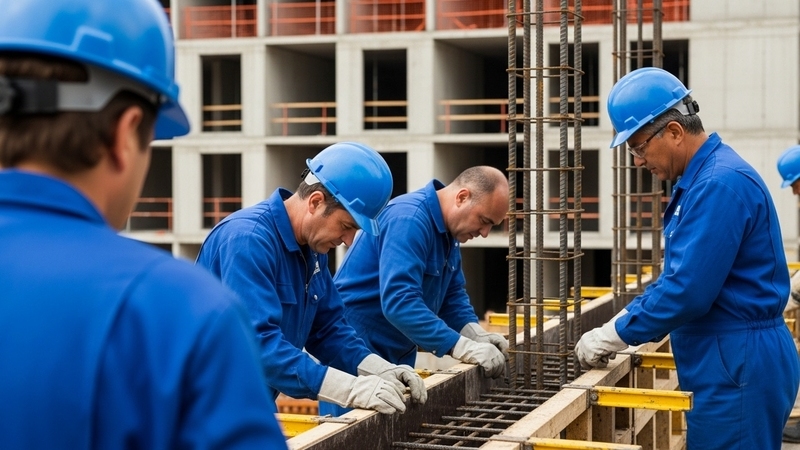
The Formwork Technology Update Conference, held on May 8, 2025 at the School of Architecture of Universidad ORT Uruguay, brought together architects, engineers, students, and industry professionals. The goal: to present the most advanced technologies in formwork systems and demonstrate their potential to transform local and international construction projects.
This event, organized by the faculty in collaboration with MAQSSA and MEVA, was notable for its technical and practical focus, with the participation of Agustín Aitcin Pollio, Engineer (MAQSSA), Architect Cristhian Garzón (MEVA’s Regional Director for Latin America), and Architect Andrés Pignata (MAQSSA), who provided a comprehensive overview of these innovative construction solutions.
Why Stay Up to Date on Formwork Systems
Agustín Aitcin Pollio opened the conference by highlighting the importance of technology in today’s context: “MAQSSA is a Chilean company with over 12 years of experience in the construction sector and is part of the AVAX Group. We specialize in machinery rental, sales, consulting, and technical support.” “We recently formed a strategic partnership with MEVA, a German leader with 55 years of international experience,” he added.
Along those lines, architect Cristhian Garzón emphasized the point: “Innovation plays an important role in achieving efficiency and quality in construction,” adding that:
“Today we face greater demand for infrastructure and housing, along with increased pressure on costs and deadlines. This calls for secure, sustainable, and optimized processes.”
- You might also be interested in reading: “How to Increase Efficiency in Construction with Lean Construction: A Hands-On Workshop”
Key systems presented at the conference
During the presentation, Garzón provided a detailed overview of the systems that MEVA currently offers in the local market:
- AluFix: modular aluminum system with Alkus plastic sheeting, with a strength of 50 kN/m² and a weight of 22 kg/m² that allows for crane-free installation.
- EcoFix: specially designed for Latin America, it allows for the construction of columns of various sizes without external corner pieces, thanks to its multipurpose holes.
- MonoFix, MonoWall, and MonoDeck: monolithic systems that allow walls and slabs to be built in a single pour, reducing the number of steps in the construction process. According to Garzón, these systems “result in a 50% direct reduction in construction time.”
Alkus plastic sheet: superior quality and longer service life
Garzón explained the advantages of Alkus plastic sheet, highlighting its unique composition and superior performance compared to traditional phenolic panels. In this regard, Garzón explained that the Alkus panel “consists of two types of polypropylene: higher density on the outside and lower density on the inside, internally reinforced with aluminum to prevent warping.” “This panel delivers premium concrete quality and comes with a minimum seven-year warranty,” Garzón noted.
For his part, architect Andrés Pignata illustrated its cost-effectiveness in the Uruguayan context: “Alkus panels have approximately 1,500 uses, compared to just 10 for standard phenolic panels. Although their initial cost is higher, they pay for themselves after about 80 uses, subsequently generating more than 1,400 additional uses compared to phenolic panels.” This, as Pignata explained, translates to savings of over 90% on both panels and labor.
- You might also be interested in reading: “Digital Architecture at ORT: Designing with AI, AR, and VR Starting in the First Year of College”
International examples: MEVA technology in landmark projects
Architect Garzón shared international case studies in which MEVA technology has made a difference:
Torres Roche in Switzerland
They used MAC climbing systems for the core and MGS screens for perimeter protection.
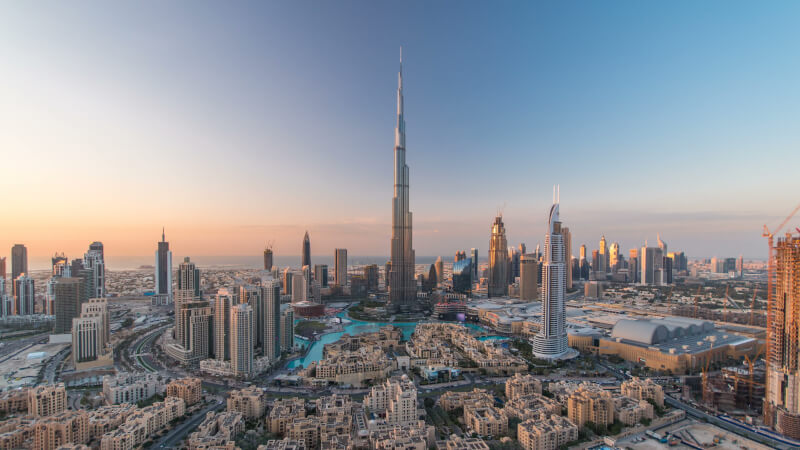
Museum of the Future in Dubai
Built using MGS and MGCH climbing systems adapted to complex geometries.
Burj Khalifa in Dubai
Constructed using MEVA formwork with aluminum panels and Alkus sheets for slabs covering approximately 815 m² per pour.
- You might also be interested in reading: “Contemporary Architecture: Exploring 21st-Century Architectural Design and Its Characteristics”
The Importance of Expertise in Construction Technology from the Design Phase
Garzón emphasized that early training in technology for architects is essential to optimizing projects from the initial design phase. In this regard, the architect noted that it is necessary for us “to learn about cutting-edge construction processes while still in school, to avoid creating bottlenecks during project development,” adding that:
“The solutions presented make it possible to create any type of architectural design without significant technical limitations.”
Economic impact measured in the local context
The conference also highlighted the actual economic impact as measured by Uruguayan construction projects, which Pignata presented with specific figures:
- With the AluFixsystem, the assembly and disassembly of a standard 40-meter wall is reduced from 7 days (with traditional systems) to just 4 days, resulting in a 40% savings in total time, in addition to a 65% reduction in labor costs and the complete elimination of crane hours.
- Monolithic systems (MonoFix and MonoWall) allow walls and slabs to be constructed in a single cycle, reducing construction time per floor by 50%. The initial investment pays for itself in approximately 15 to 25 projects.
Rethinking Formwork: A Technical and Strategic Decision
The conference concluded by emphasizing the importance of strategically analyzing formwork systems not only from a technical perspective, but also from economic and operational perspectives. In this regard, Architect Cristhian Garzón noted that:
“Innovation enables efficiency, quality, and safety—core values in today’s construction projects.”
Watch the conference:
https://www.youtube.com/watch?v=IYdlP_O6QuA
The adoption of these technologies requires careful analysis to ensure long-term benefits and better position companies to meet the current challenges of the construction market.
- You might also be interested in reading: “EPICA: Artificial Intelligence to Boost Creativity in Architectural Research”