"Uruguay has excellent conditions to become a financial center and logistics hub for the South American region," said Sun Yanfeng, deputy director and researcher in the Latin America Department of the China Institutes of Contemporary International Relations (CICIR), during the "New Silk Road" video conference.
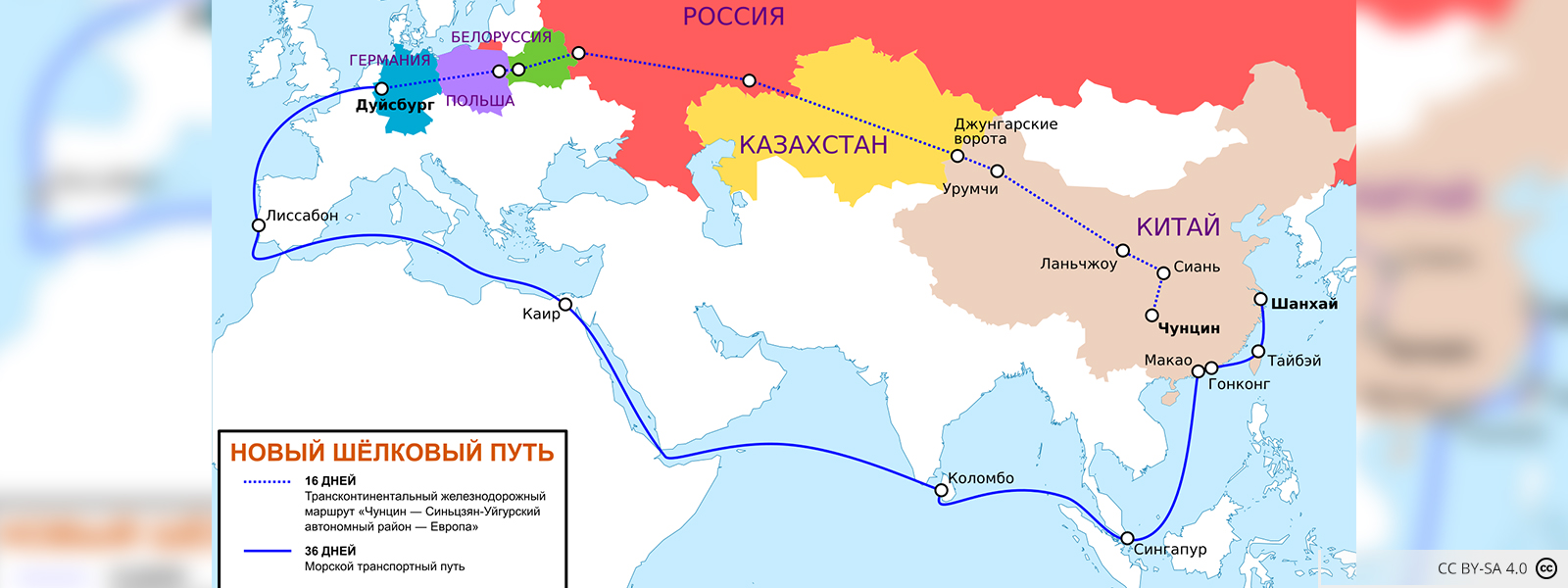
China has embarked on a global infrastructure project unprecedented in modern history. In 2013, President Xi Jinping proposed reviving the ancient Silk Road. That proposal has become the greatest challenge facing the global economy—a complete revolution in the infrastructure for the transport of passengers, goods, hydrocarbons, and high-tech products.
The videoconference, organized by the Department of International Studies at Universidad ORT Uruguay the University of International Business and Economics (UIBE) in Beijing, took place on Wednesday, December 12, 2018.
The role of Uruguay
Yanfeng noted that Uruguay, despite facing challenges such as a high cost of living, has advantages, including a history marked by free trade, abundant livestock and agricultural resources, and “political stability.”
Yanfeng noted that Uruguay “could be an important partner for China in establishing the route.” He also said that Uruguay could play a key role in cultural and tourism exchanges. “Geopolitically, it is not a large country, but strategically it could play a very important role,” he concluded.
Friendship among peoples
Andrés Bancalari, academic coordinator of ORT’s Bachelor’s Degree in International Studies, noted that it is encouraging that Uruguay and China have a deep understanding of each other’s realities, despite the distance and the time difference.
Bancalari recalled that Uruguay’s first embassy in Beijing was inaugurated in 1988 : “That marks 30 years of a solid friendship.” Over the past 40 years, the scholar added, China has undergone a transformation: “It has entered a new phase, one that is very interesting from a development perspective.” We are now 40 years into the opening-up process that China has been pursuing, which began in 1978 under the leadership of Deng Xiaoping. It is within this context that the New Silk Road initiative has emerged.”
Bancalari also noted that “China had the foresight to realize that without infrastructure there is no growth, and without growth there is no development.” As a result, “infrastructure came before development” in that Asian country.
The academic coordinator highlighted certain aspects that Uruguay shares with China, such as the importance of connectivity in infrastructure, information technology, and the financial sector.
Finally, regarding the challenges, he stated that “infrastructure cannot be developed at any cost; its growth must go hand in hand with environmental protection.”
Uruguay as a bridge
“Uruguay’s greatest strength is its political system,” said Gao Bo, a researcher at the Institute of Latin American Studies at the Chinese Academy of Social Sciences (CASS). He noted that Uruguay has a highly efficient political system, as there is a positive relationship between the political system and civil society.
The expert noted that Uruguay could serve as a bridge between China and Latin America. In that regard, it would serve as a technological and financial hub for Chinese companies.
The link to the future
“When we talk about the New Silk Road, we’re talking about geopolitics,” said diplomat Guillermo Valles, Uruguay’s first ambassador to China.
The expert added that there are differences between the Silk Road originally proposed in 2013 and the New Silk Road of 2018: “The world has changed very quickly; geopolitics carries more weight than ever.” In that regard, he sees it as a positive that the plan “is not based solely on nostalgia.” It blends ideas from the past with a vision for the future.
Valles, for his part, took a critical view of the international political situation and noted that, in order to avoid conflicts, “the project must always be viewed within the broader context in which it exists.”
Uruguay as a pioneer
Li Han, a research assistant at CASS, visited Uruguay for the first time seven years ago. Since then, “the relationship between China and Uruguay has undergone many changes. The South is no longer on the periphery of the global economy.”
Regarding the establishment of the New Silk Road, she noted that Uruguay “is a pioneer in Latin America, ” which “reflects Uruguay’s strategic vision regarding its relationship with China.”