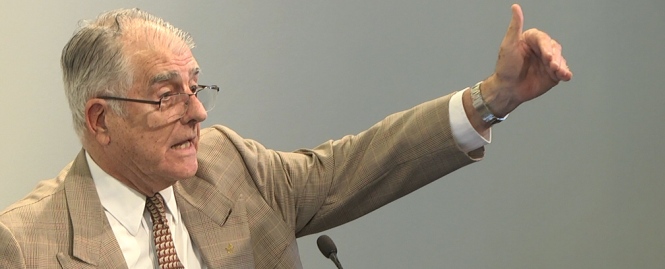
On Wednesday, September 17, 2014, the lecture “Uruguay’s River, Maritime, and Port Interests” was held at the Pocitos Auditorium of Universidad ORT Uruguay. The event was part of the annual lecture series organized by the Bachelor’s Program in International Studies within the School of Management and Social Sciences.
The speaker was Dr. Edison González Lapeyre, professor of diplomatic and international law at the University of the Republic and former Uruguayan representative to the CARP (Administrative Commission of the River Plate) and the CARU (Administrative Commission of the Uruguay River).
González Lapeyre is also a lawyer specializing in international law and an advisor on issues related to territorial, maritime, and river boundaries, as well as fisheries. He was a member of the Uruguayan delegation that successfully negotiated the final text of the 1973 Treaty of the Río de la Plata and its Maritime Front with Argentina.
Historical Background
In 1828, with the signing of the Preliminary Peace Convention, the Eastern Republic of Uruguay was founded. It was therefore essential to determine the borders of the new country. Establishing those borders was a lengthy process, and some of them have still not been definitively established.
In 1851, the treaties that Andrés Lamas had negotiated with Brazil were signed, at a time when Uruguay was facing serious political and economic difficulties, according to González Lapeyre. Brazil, leveraging its power, imposed very harsh conditions that sparked debates, controversies, and objections, ultimately delaying the resolution of border disputes.
In 1961, the “Treaty on the Boundaries of the Uruguay River” was adopted; after being duly codified, it came to be known as the “Uruguay River Statute” of 1975, “in which the speaker played a very modest role,” clarified González Lapeyre.
As for the border with Argentina, the so-called Ramírez-Sáenz Peña Protocol remained in effect until 1974; however, because it left a number of border issues unresolved, it continued to be a source of controversy.
The purpose of the protocol was to establish a shared maritime zone, but this raised a number of specific issues, such as the status of Martín García Island and Timoteo Domínguez Islet, as well as the operation and maintenance of the various channels that facilitate navigation on the Río de la Plata.
News
The canals of the Río de la Plata have also long been a source of debate. Today, two canals stand out:
- The Emilio Mitre Canal stretches from kilometer 12 of the Punta Indio Canal to the mouth of the Paraná de las Palmas River. Its construction in 1976 allowed ships with greater draft to enter the Paraná River.
- The Martín García Channel extends from kilometer 37 of the access channel to Buenos Aires to kilometer 0 of the Uruguay River and provides access to the Port of Nueva Palmira. It expanded significantly in 1979. In this area, the Uruguay and Paraguay rivers deposit a huge amount of sediment.
The speaker then focused on the importance of three areas: maritime and river transport, fisheries, and hydrocarbons.
Regarding transportation, he noted that it has grown over the past decade, as has international trade. Last year, 13 billion tons of cargo were transported. China accounted for one-third of that total (and 50% of Asia’s share), demonstrating its importance to international trade.
As for fishing, he mentioned that in 1973 the country was self-sufficient in fish. Today, however, has sector with great potential for job creation.
“As far as hydrocarbons are concerned, we are in a very important exploration phase. Everything seems to indicate that there is a possibility of hydrocarbons being present. However, until they are detected and final exploration is completed, it will not be possible to quantify their volume.”
Finally, González Lapeyre analyzed the negotiations that led to the Treaty of the Río de la Plata and its key features. He emphasized the difficulties involved in this process and the time it took to overcome them.
“The problems were frequent and very difficult to resolve over time,” he said. Furthermore, regarding diplomatic negotiations, he said, “It requires preparation; you can’t just wing it.”
https://youtu.be/RnngaLRKdKE