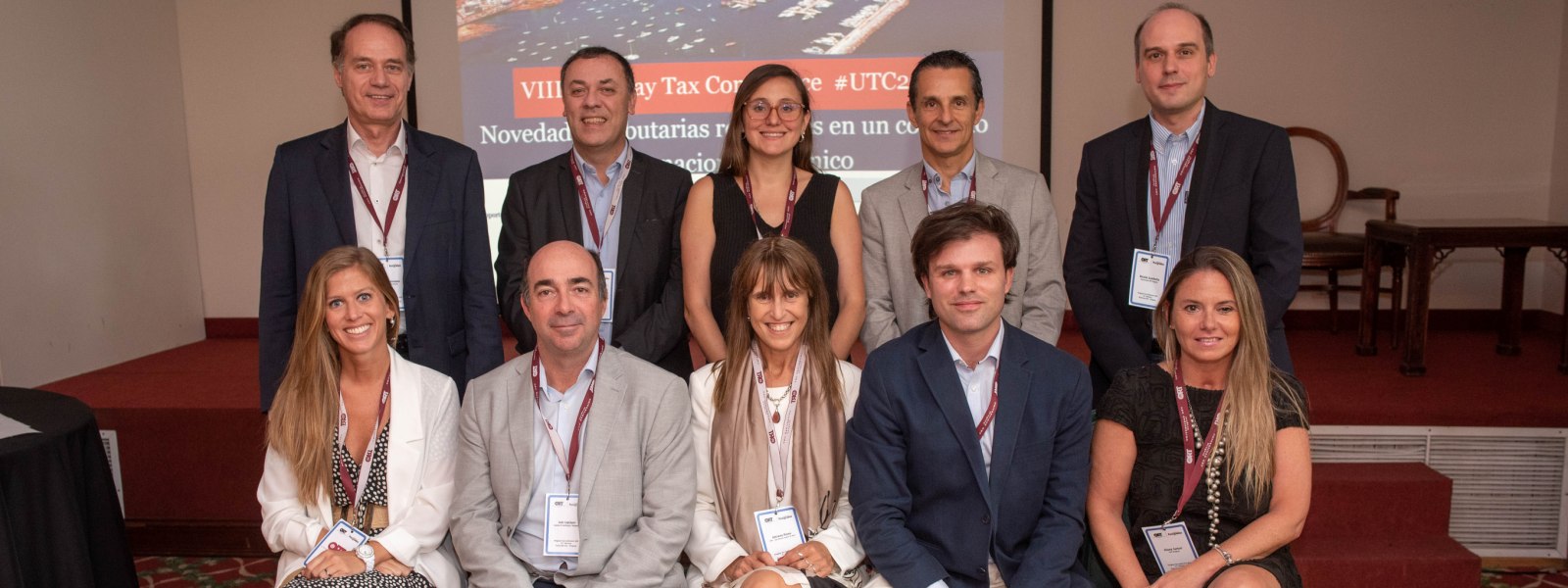
The main focus of this edition was on significant tax developments in a dynamic international context. The event took place on Friday, February 21, 2020, at the Barradas Parque Hotel in Punta del Este.
The conference was organized for the eighth consecutive year by the Academic Coordination Office for the graduate programs in accounting and taxation at Universidad ORT Uruguay. The Graduate School of Business has graduate programs in taxation: the Master’s in Taxation and Accounting Standards—IFRS and the Specialization Diploma in Taxation. Through elective courses, students can give their graduate program a significant focus on international taxation.
The conference was once again sponsored by PwC Uruguay and SMS Latin America, professional firms that provide tax, audit, accounting, economic, and financial services.
The event was opened by Dr. Nicolás Gambetta, academic coordinator of the graduate programs in accounting and taxation at the Graduate School of the Faculty of Administration and Social Sciences.
Gambetta highlighted the importance of this annual event, which has become a staple for tax professionals and drew a record-breaking turnout this year.
Agenda
The agenda began with a joint presentation by Félix Abadi, a tax professor and instructor in ORT’s graduate tax programs, as well as a partner at SMS Uruguay and the Rueda Abadi Pereira Law Firm, and Adriana Piano, a partner at SMS Latin America and professor at the University of Buenos Aires. The central topic, analyzed from both the Uruguayan and Argentine perspectives, was the adoption of Uruguayan tax residency by an Argentine.
Both Abadi and Piano reviewed the concept of tax residency in each jurisdiction and the conditions required to obtain it (and to lose it). They also discussed personal tax regimes, the potential advantages (or disadvantages) of changing residency, as well as the application of the double taxation agreement.
Next to speak was Dr. Roberto Bernales, who holds a Doctor of Law degree from the University of the Basque Country, is a professor of tax law at that university, and serves as a visiting professor in ORT’s graduate programs.
Bernales addressed an issue of global significance that is gaining increasing prominence in our country: the Sustainable Development Goals and 21st-century taxation. With growing global interest in environmental preservation and greater awareness of more responsible consumption and production, governments must focus on addressing these concerns. Bernales explained how taxes can contribute to these issues without losing sight of their revenue-raising purpose.
To kick off the afternoon sessions, Dr. Mario Ferrari, a partner in PwC’s Tax and Legal Department, together with Luciana Ávalo, CPA, manager of PwC Uruguay’s Legal and Tax Department, presented on the current state of transfer pricing in Uruguay, focusing on jurisdictional oversight.
After reviewing the key milestones and general information on transfer pricing, the speakers focused on the audit processes related to this topic. Finally, they analyzed the first court ruling specifically addressing transfer pricing in our country.
Entrepreneurship Act
Next, Dr. Luis Lapique, a partner at Lapique & Santeugini and an instructor in the university’s graduate tax programs, spoke about the legal and tax aspects of Simplified Joint-Stock Companies (SAS) established under the Entrepreneurship Act.
The professor reviewed its main features, emphasizing the importance of seeking sound advice when using this new legal vehicle in order to take full advantage of its benefits and avoid potential future problems.
To conclude the event, Dr. Lorenzo Franzini, Tax and Legal Manager at PwC Uruguay, spoke about the present and future of Brazilian taxation.
After presenting data representative of Brazil, his presentation focused on the main existing taxes, the Uruguay-Brazil tax treaty, and tax reform.
Dr. Gambetta closed the conference by thanking the sponsors, SMS Latinoamérica and PwC Uruguay, and offering special congratulations to the speakers for "the high technical caliber and clarity of their presentations, which undoubtedly make this conference the premier tax event in the country—and, why not, in the region."
