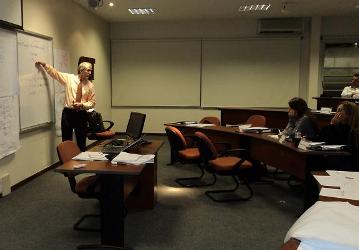
 Professor Patrick Noonan of the Goizueta Business School at Emory University in Atlanta, United States, visited the Faculty of Administration and Social Sciences at Universidad ORT Uruguay this week Universidad ORT Uruguay teach an intensive course on “decision analysis” to students in the Master of Business Administration (MBA) and Master of Technology Business Management (MGET) programs. Noonan, who holds a Ph.D. in “decision sciences” from Harvard University, has been visiting the university since 2005 with the support of the Fulbright Foundation’s Distinguished Professors, to provide postgraduate students with international perspectives and experiences. This year’s course is an introduction to the fundamental concepts of “decision analysis.” It covers the field of study, intensive courses, and the growing influence of “decision sciences” in business.
-What key aspects of “decision analysis” do you hope to convey to the students during this week’s course?
-The first step is to recognize the importance of making a decision. My hope is that students will be more intentional in the way they make decisions. At the beginning of the course, we want to make it clear that decisions are everywhere and are a fundamental part of life; everything we do—whether it’s marketing, finance, product design, logistics, investing, or accounting—involves decision-making. Obviously, if you’re in finance, there are a lot of specific skills related to financial decisions that differ from those in marketing. However, there are common elements in all decisions, and that’s what we try to convey in this course. For example, one thing students learn early on is that intuition can be a good way to make decisions, but also a very bad one. We can rely on intuition and a mix of intuition and analysis, but we have to do it the right way. That’s the first thing you learn and practice. And we try to recognize meta-decisions—that is, decisions about decisions. Then we move on to some specific tools used in decision analysis. I describe decision analysis as a discipline whose purpose is to facilitate a meaningful conversation about a decision. Analysis doesn’t give us the answer; it simply guides the conversation toward a better path. In the end, everything always comes down to a managerial decision, but this helps bring clarity to the conversation leading up to the decision. The rest of the week we deal with issues of risk, uncertainty, measuring success, and how we make trade-offs between tangible and intangible benefits.
-What are the unique aspects of “decision analysis” in technology-oriented companies?
-In my experience, technology-driven companies are more prone to falling into what is known as “analysis paralysis.” These are people who are comfortable with analytical approaches and reject the subjectivity inherent in decision-making. Thus, they find themselves saying they can’t decide yet because they need more analysis, one more experiment, more solid information, and they put up a barrier to decision-making by pushing analysis to its limits, when in reality it has practical and cognitive limitations. Therefore, in companies with a strong engineering culture, it is important to understand both the strength and the limits of analysis to establish a better balance between thinking and doing—and not just thinking—because otherwise they end up paralyzed without making a decision. The other extreme is known as “extinction by instinct,” which occurs in companies that do the opposite and take action without thinking or deliberating. The key is to find the right balance between analysis and intuition. Luck always plays a role in success or failure. The pharmaceutical industry is a good practitioner of decision analysis due to the role of uncertainty and the investment in research they make.
-Have South America and Uruguay incorporated the field of decision analysis into academic and business settings?
-No, but I don’t think it’s a problem specific to Uruguay. It’s a field that’s still struggling to gain acceptance. It’s relatively new—it’s been around for 50 years, compared to other sciences that are centuries old. It’s a field that requires an interdisciplinary approach, because it brings together economics, psychology, statistics, law, engineering, ethics, and more. That’s why it’s hard to categorize. So, by its very nature, it isn’t widely used or recognized as it should be. In Uruguay, I think there’s great potential. It’s a place where the economy and universities have a strategy focused on entrepreneurs. It doesn’t just train workers, but those who want to create new products, companies, and find new markets. In Uruguay, managers are much more accountable and are more directly exposed to the consequences of their decisions because the economy is small and people are closer to the impact of those decisions, which amplifies the need for sound decision-making. In the United States, there are many consultants specializing in this field, typically in the oil and gas and pharmaceutical sectors. They also work with the government on public policy design and investment in public infrastructure.
-How do you assess student enthusiasm and the curriculum of the university's graduate programs?
-I always enjoy coming here every year. I appreciate the students’ enthusiasm and the school’s excellent leadership. The university is rapidly advancing in terms of innovating new programs and seeking international recognition. The students do things I couldn’t do, such as taking very intensive courses—packed into a single week—with someone they’ve never met before, in a new field, and in a different language. And they do it with a smile.