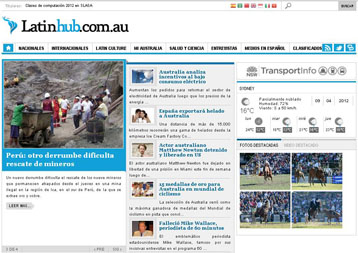
 When Florencia Melgar decided to move to Australia with her boyfriend and their daughter in 2010, she had to consider the job opportunities that might be available to a Spanish-speaking journalist. “There was no room for journalism,” she summarized. “There are private and community Spanish-language radio stations, but they don’t offer job opportunities; news websites don’t exist. But I came across a huge number of Latino organizations, groups, and associations, all operating separately. It’s not easy to make those connections when you’ve just arrived. It gave me a sense that the community was fragmented, and I thought of a news website that would also serve as a unifying force for the community.”
That’s how Latinhub came to be: as a news portal focused on the stories of greatest interest to Spanish speakers living in Australia, which also provides useful information for immigrants—ranging from how to vote in each country’s elections to announcements about when and where to study English.
According to its director and sole founder, Latinhub “filled a gap for something that didn’t exist; people from all walks of life—politicians, community leaders—tell me that every day.” Melgar explained that most of the information Latinhub gathers was already online “but wasn’t accessible,” since users had to go “through two or three steps in English before reaching the information in Spanish.” “It’s funny because they meet the requirement that the information is there, but if you don’t understand English, you’ll never get to the information in Spanish. And besides, it’s information that’s scattered across a lot of different sites. Here, it’s all in one place.”
“We have a daily schedule of Hispanic community events, along with all the services and administrative procedures that immigrants need to complete—all in Spanish. We explain how the political system works in this country, how to drive, how to access healthcare and education, and how to vote,” he described. “And, of course, we tell you how to access services and provide the toll-free numbers for interpreters. It’s a very useful introduction to life in Australia.”
The journalist—who graduated from ORT University in 2003—acknowledges that the challenge now is to maintain and improve the website. The content she curates focuses primarily on Latin America, but she doesn’t overlook local news. The fact is that Latinhub reaches some 90,000 Hispanic families living in Australia—which amounts to about 300,000 people, including those born in Latin America and Spain and their descendants. “Of course, the descendants are using English more and more,” notes Melgar, who, nonetheless, acknowledges that her target audience represents “a significant number.”
To meet these goals, the workdays are “pretty crazy,” according to Melgar. Although has correspondents in various countries, she is currently the only journalist working full-time for the site. Using official information and reports from local media, Melgar summarizes and writes up the main news stories. “I’m managing pretty well because Australia’s news cycle is repetitive, which is a bit demotivating for a journalist but at the same time makes my job easier right now that I’m handling everything on my own.”
The journalist announced that Latinhub is developing a citizen journalism project to engage Latinos in Australia: they will have their own section to share their stories in various formats—written, audio, and video.
Latinhub launched in April 2011, and its traffic grew from 7,000 to 11,000 and then to 21,000 visits. In the year since it went live, it has already garnered nearly 80,000 visits and more than 125,000 unique page views.
The site takes a particular stance on advertising: there is very little of it, by design. “We prioritize information and refuse to overwhelm users with ads. If the site does well, some ad spaces will be rotated, so more ads will appear without increasing the site’s overall size.”
In addition, sponsors can deduct 100% of the advertising they place on Latinhub from their taxes at the end of the fiscal year. “This is encouraging because, at the end of the year, it’s an investment rather than an expense. But also, if they know that a percentage goes to an NGO, then they have the option of directing part of their taxes to an NGO of their choice, which ultimately gives them more freedom over what to do with their money.”
Melgar believes that “giving back to the community is part of the company’s responsibility, and from this perspective, it is also an investment—not an expense or a loss.”