
The first piece of news was that theHong Kong Ballet wanted to rent the designs created by Millán—who is in charge of costumes and set design at the Ballet del Sodre and also teaches in the Fashion Design program.
The second piece of news, the designer says, was even more surprising: they decided to purchase the licenses and build them from scratch.
To do this, Millán traveled to Hong Kong with his assistant. Over the course of five days, they visited workshops, toured dozens of fabric stores, and looked at thousands of options before deciding on the materials for each outfit. The challenge was to narrow down their choices in a market with endless possibilities and no budget constraints.
*Le Corsaire* will be premiered by the Hong Kong Ballet in October.
What was your first reaction?
It was a surprise announcement. At 7:30 in the morning, I got a call from Julio Bocca [director of the Sodre National Ballet], who told me, “They want to rent the production in Hong Kong, so you’ll have to go there to stage it.” It caught me off guard—I was still half-asleep. My first reaction was, “Okay, let’s talk about it later; I’ll stop by at noon and we’ll discuss it.” I couldn’t sleep a wink after that.
Fifteen days later, he came back, but the news had changed. A second call: “The ballet company doesn’t want to rent the production; they want to stage it themselves: you’ll have to travel there to oversee the design.” That was much more exciting because it meant doing it all over again, but without any limitations: it’s a different market, with different possibilities.
And you start thinking about how you're going to do it, what it will be like to work with them, what the materials will be like…
What does your role in this project entail?
My job is to address an issue that helps round out the story. It’s a fantastic, fictional story that serves as the backdrop for choreography showcasing the dancers’ virtuosity.
In ballet, the costumes are technical; beyond their fantastical elements, they are specifically designed to complement the choreography and support the dancers.
The set design serves to support the story, ensuring it is understood in a discipline where verbal communication does not exist, but rather everything is conveyed through movement and dance.
What tasks were assigned to the Sodre workshops?
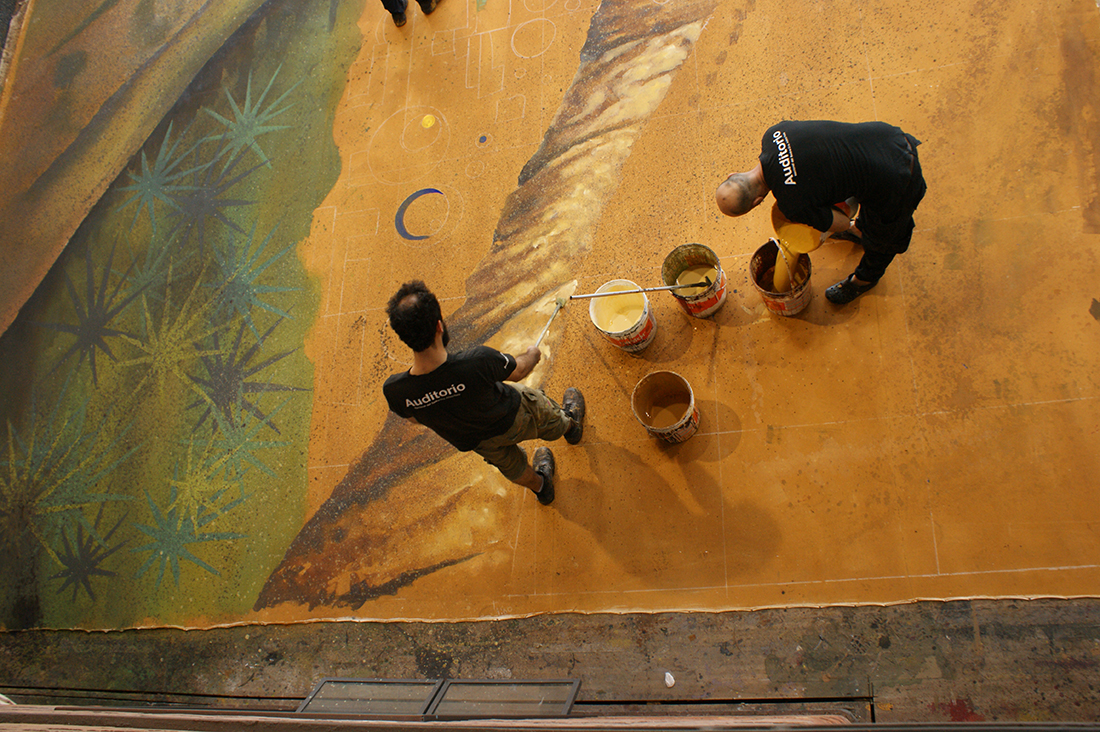
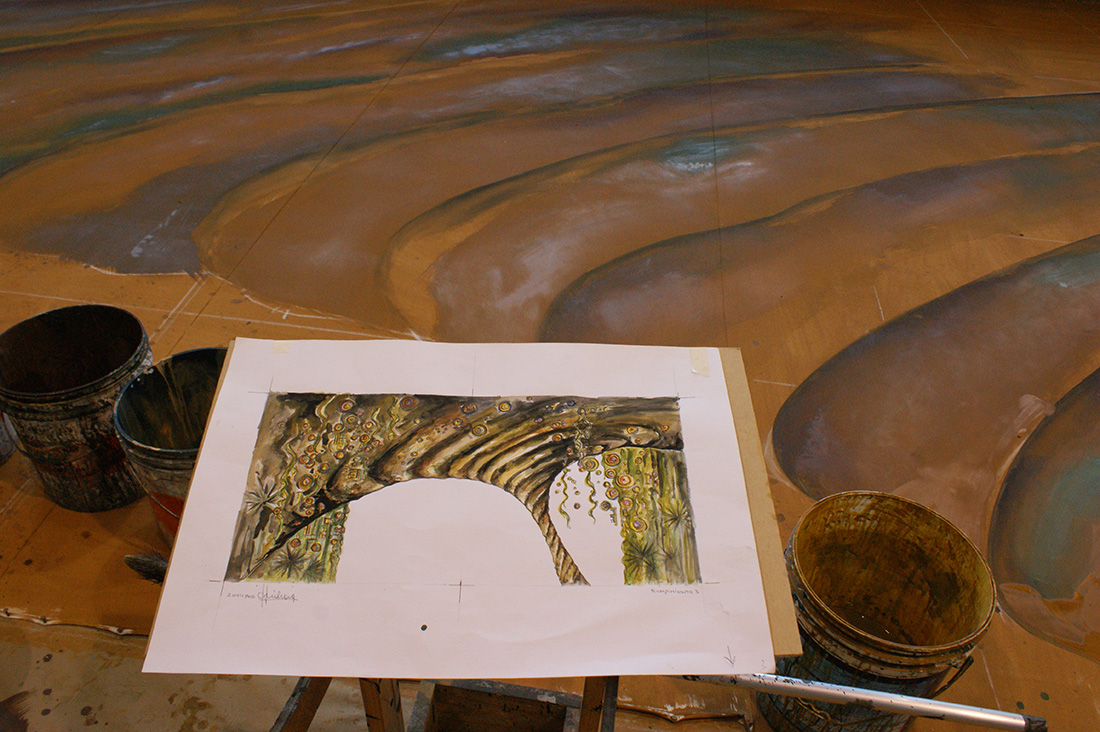
The curtains, which measure 20 meters by 10, are being hand-painted.
If this wasn't done here, it meant I'd have to travel to wherever it was being done. I was a little worried about not being able to stay in control; this takes a few months, and from a distance—via Skype and photos—how do you oversee a project like that? It's difficult.
This is also important as a stepping stone to another project: people know that we do this kind of work here, and we do it well.
How does this impact design at the local level?
This opens up the possibility of bringing in designs from elsewhere, from other designers, to produce them here.
When *Romeo and Juliet* was produced, the process was reversed: I was hired to carry out the production book that had come from England. The designer, Paul Andrews, had passed away, and the choreographer had also passed away; all that remained were the copyrights. A representative arrived with the costume production book, and I was hired to carry it out: that’s when the challenge of adapting it to the local market came into play. There were many costumes in velvet and linen, some of which were suddenly five meters long. Linen in Uruguay is completely prohibitively expensive and extremely limited in terms of color options; you have to find a color, dye it, and when you add it all up, the budget skyrockets. So you have to find a substitute that looks like what they want but using what we have here. That was interesting to do.
What differences will there be between what was performed at Sodre in 2014 and what the Hong Kong Ballet will present in October?
It’s the same production by the same choreographer, Anna-Marie Holmes. The last production she had done was at the Sodre, and since she was satisfied with the project, that’s where the decision was made to reuse my costumes and set design.
As for the costumes, everything will be done exactly as planned; exactly the same, yet different, because it’s one thing to work with the local market—with its limitations in terms of materials and even techniques—and quite another to work with the market over there, where the possibilities for costumes are endless: the range of fabrics and everything else that can be used in costume design is truly overwhelming. It’s one thing to design within a limited framework, and quite another to encounter something that’s infinite and have to narrow it down.
They wanted me to choose all the materials myself, so that nothing would be left to chance. That was my job on this first trip to Hong Kong—I spent five days working on it.
As for the set design, fortunately, since they outsource it, they usually have it made in central China or Spain. Julio Bocca suggested that I propose having it done at the Sodre workshop. He told me, “It’s better for you,” and it’s true—I can supervise them much better that way. They submitted a budget, it was accepted, and it’s already underway. I go there every day to monitor the work. It has to be finished by April so we can ship it.
What did you do on your trip to Hong Kong?
I brought the design manual, which lays everything out in detail—the sketches, the spec sheets, materials, colors—everything exactly as it should be. I left out the photos of what the project had looked like here. One of the things I didn’t want to bring—and they weren’t interested in seeing either—was the final product here.
The sketch design will be identical, but there are elements that were omitted here due to a lack of materials or technical capabilities. The design guide includes a fabric swatch, its characteristics, and its quality, shown in a neutral color—white or ecru. Then there’s a Pantone color code, give or take a shade, so they have some flexibility in finding it, along with a description of the fabric’s quality, type, or performance. All of that was in a massive tome. When I arrived, they were very grateful for it, but what they really wanted was for me to go to the location and choose the fabric myself. We had to start all over again.
Those five days were filled with work meetings, choosing materials, and finalizing every detail of the costumes. It was really exciting to go fabric shopping.
They told me to bring a suitcase, and I was wondering why. Then they picked me up at the hotel; I went with an empty suitcase, and we arrived at a fabric district—it’s like 18 de Julio between Andes and Ejido, nothing but fabrics; but not those shops where you walk in and see rolls of fabric—no, these are small offices, one next to the other, where the walls are covered with samples of a particular fabric in every color imaginable. Just like you take a Pantone swatch from the paint store, they give you a cardboard sheet with the entire color chart, with the 25 colors they have for that fabric. That’s what the suitcase was for, because you’d fill it with countless fabric samples of all kinds. And that meant working at the hotel at night, making a selection, then going to the workshop, making another selection, narrowing it down, and in one-on-one meetings, deciding that this is going to be made with that.
The possibilities in textiles are endless. There were things we couldn’t do here with lace or embroidery, but there are similar designs there. They also told me, “If you have the original design, we’ll make it exactly as you want it—we’ll knit it.” Those are the things that really blow you away; having the chance to have lace knitted exactly as you designed it is fantastic.
What was it like to complete this project in five days?
Exhausting. I barely slept a wink. There’s an 11-hour time difference, and maybe I was just nervous, but I couldn’t sleep—I didn’t start feeling sleepy until 1:00 p.m.
It was intense and interesting. I think the trip back will be much more relaxed.
What does this project mean for your career?
It means putting an experience to the test: being able to carry out things that my teachers taught me—things that used to be possible in this country but haven’t been for a long time, yet are possible today. We made use of everything the Auditorium has to offer—the effects, the spatial possibilities, the mechanisms—everything it has, we were able to use. Those are things that weren’t available in this country.
Through this project, I was able to see that there is no difference between the opportunities offered by the Auditorium and those offered by the Hong Kong Cultural Center.
Press
- From Montevideo to Hong Kong in a Bible - El Observador
- National Ballet: Export of curtains made in the Sodre Auditorium workshop to Hong Kong opens the door to working with markets in Asia and the U.S. - In Perspective