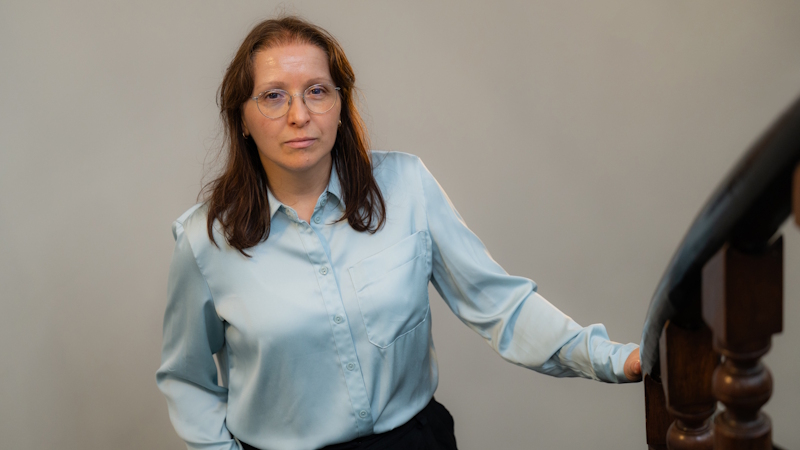
Campos-Climent is the coordinator of the Sustainable Entrepreneurship Lab: a program funded by Caixa Popular, recognized for combining lean methodologies with foresight techniques to design and scale high-impact business models.
During her visit, the professor shared key insights from her work and her thoughts on current challenges in sustainability.
He taught classes at the Business School and in theAdvanced Research Program in Management and Accounting, and came away with a clear impression: “There are highly motivated people who are eager to advance and do things right.”
Sustainability as the foundation of viability
For Campos-Climent, the old dilemma between sustainability and profitability no longer exists. On the contrary:
Businesses that are built with sustainability in mind—economically, socially, and environmentally—tend to be more resilient.
The scholar draws a parallel: “They don’t get off to a fast start, but they’re more resilient to the ups and downs of competition.” Sustainability, she says, acts as an extra layer of strategic strength.
Challenges: explaining the model clearly (and demonstrating that it works)
The biggest challenge for entrepreneurs with a sustainable approach is to clearly communicate the viability of their project.
According to Campos-Climent, a sustainable model makes it possible to demonstrate a triple impact and, in many cases, reduce costs—particularly through energy savings or environmental efficiency. But this must be explained with precision and backed by evidence.
Consumers also play a role: markets such as Germany—with a population of over 100 million—are showing increasing sensitivity to sustainability criteria, which is encouraging Spanish entrepreneurs to expand internationally from the very start.
Social and economic value: when impact transcends borders
Campos-Climent shares a specific example: the need to create a social sustainability label in Spain for agri-food producers who sell to German-speaking countries. Initiatives like this not only meet market demands; they also help retain the population in areas at risk of depopulation.
“It’s not feasible for everyone to live on the coast while the interior remains empty. Sustainable ventures—whether in production or processing—help sustain communities and improve their quality of life,” he said.
A global environment in transition
European companies are already shifting their business models toward sustainability, driven by both regulation and conviction. But this trend is also spreading to countries outside Europe, particularly those with strong trade ties to the European Union, where a regulatory “ripple effect” is evident.
“Whether the motivation is regulatory requirements or personal conviction, it’s better if it’s conviction. But in any case, it’s a positive step that they’re moving in that direction,” he says.
Tips for Starting a Sustainability Business
He sums up his advice in an Italian saying he often repeats to his students: Chi va piano va lontano. Not everything is achieved in the first two years; sustainability requires time, perseverance, and a long-term vision.
The crucial role of higher education
As the director of the research team that spearheads entrepreneurship education at the University of Valencia, Campos-Climent emphasizes the importance of training students to think in terms of triple impact.
At their school, they redesigned the course curriculum to introduce, among other things, tools such as Canvas TPP and adaptations of the Lean Startup methodology to incorporate social and environmental dimensions.
This shift in approach, he explains, allows aspiring entrepreneurs to incorporate criteria from the very beginning that they would otherwise likely overlook.