—When did you start writing?
—When I learned the alphabet.
Carolina Cynovich is 23 years old, and *The Syndrome of Beautiful Cities* is her second book: in 2014, she published *The Man Who Winds Up the World* after winning the Sigmar-Mosca Prize for Children’s and Young Adult Literature.
“The storyteller is someone who comes from the world of literature and moves into film. I come from the world of literature and moved into film,” said Cynovich, who began studying Audiovisual Communication with the intention of “acquiring new languages for storytelling, in addition to words.”
“I think what I learned most was how to receive and process different kinds of narratives. My medium for storytelling remains the written word, and being open to the visual and auditory stimuli of film helps me find new paths within the written word, rather than new ‘media,’” she told In situ, as she nears the end of her degree program.
When asked which aspect of audiovisual communication he found most interesting, Cynovich said he is particularly interested in the theoretical aspects: narrative, the construction of the viewer, film history, and the study of art. “If I had to delve deeper into something based on this, I suppose it would be the study of narratives and art in animated films.”
The 6:00 a.m. soap opera
“The Beautiful Cities Syndrome is a page-turner, sustained by the charm of its narrative world: a fictional city, a film director, and an actor alternate between scenes of filming, searching, and mystery, as an enigmatic universe is revealed. The careful characterization of the protagonists, the skillful handling of the dialogue, and the development of the narrative structure a witty story, filled with powerful images and fantastical settings that ultimately leave a lasting impression.”
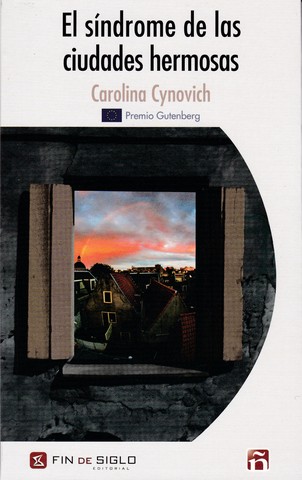
That was the decision of the jury for the Gutenberg Prize for Young Adult Fiction, which unanimously selected the work submitted by Cynovich. As a result, the novel *The Syndrome of Beautiful Cities* was published by Fin de Siglo, with support from the European Union (EU), the competition’s sponsor.
“I always keep a few notebooks where I jot down ideas, things I like, words… when I saw the contest proposal, I incorporated the whole European part along with other ideas I’d had before,” he said, while clarifying that he built this story “with details” he’d already worked out, “like the hobby of Julián, the narrator, who likes to buy books in languages he doesn’t understand so he can read them aloud and listen to other languages, even if he doesn’t understand them; that trait was in a character from a story I wrote when I was 17.”
“For two months, I’d get up while it was still dark because I liked to watch the sun rise while I wrote. I’d get up at six, or even earlier if I was really nervous about a scene,” she said enthusiastically. “What I’d do in the afternoon and at night was think about how to proceed from there, because I had an outline, but if the characters did something else, I could change everything.”
The author explained that the story ended that way because of time constraints. “That wasn’t the intended ending, but I loved that ending for the character—it was as if the character had asked for it. I think if I’d had more time for the character, it would have turned out worse.”
In that regard, she commented that “sticking to the outline was important but not difficult” because she had so much fun writing. “Since I was so immersed in it, waking up at six in the morning wasn’t difficult either. It wasn’t hard. Knowing that each sentence leads into the next is what I enjoy doing.”
Youth and Maturity
The Gutenberg Prize was open to writers under the age of 30. As the jury members explained during the presentation, which took place at the Book Fair at Montevideo City Hall, no one had imagined that the winner would be “such a young girl.”
“We were so impressed that she’s only just turned thirty. With this excellent book, Carolina proves she’s capable of producing outstanding work and has a very bright future in literature,” said journalist Jaime Clara. “And to top it all off, when we found out she wrote it in three months, we were even more impressed,” the jury laughed.
For his part, EU Ambassador Juan Fernández Trigo remarked that “he was like an archer who shoots an arrow with every sentence: he didn’t waste a single word.”
“I skimmed through three or four sentences and said to my colleague, ‘These are very forceful. I’m surprised this person is as old as they are—every sentence is aimed at conveying something very specific and very forceful.’ This is someone who knows exactly what they want to say and where they want you to focus your attention. There’s a sense of maturity in the prose and in what’s being said.”
Meanwhile, journalist Débora Quiring, also a member of the jury, praised “Carolina’s ability to tell a story and her mastery in crafting characters, moods, atmospheres, and scenes—especially in her narrative choices to maintain the intensity and pace of the story.”
“The novel is about a French translator who is hired by a Dutch director who has come to Montevideo to shoot a film. And the film is bilingual, which adds another unique aspect,” he noted. “There are many realities and many layers. On one hand, the world created by the film coexists in parallel with the reality of the other characters, which, at times, begins to blur, resulting in what feel like hybrid realities. All of this is achieved through direct, smooth language, without any complications, with a masterful handling of the reader’s expectations, so that the reader feels guided by the suggestion of a highly visual language, rich in symbols, while many parallel realities unfold—realities that are deeply unsettling.”