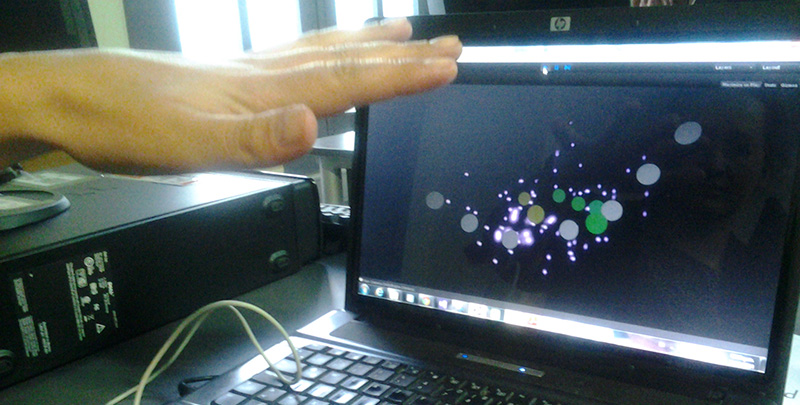
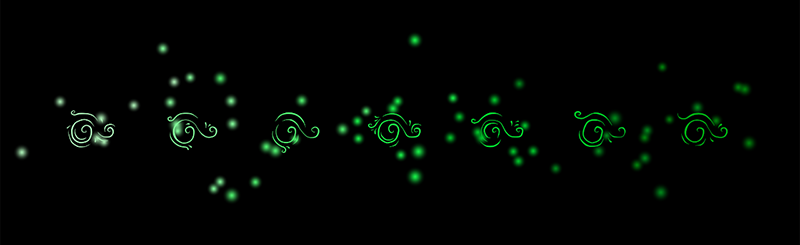
"TocaTú is a music game where players can interact with the virtual environment using hand gestures, creating musical compositions that are represented by shapes, colors, and lights on the screen," explained Lucía Rodríguez, one of the creators.
In addition, TocaTú was awarded third prize in the Idea competition.
The most innovative feature is that blind people can play without any difficulty, since navigation and gameplay are controlled through sounds and hand movements.
The origins of TocaTú
The idea originally came from Lucía Rodríguez, a student in ORT’s Bachelor’s program in Animation and Video Games.
During a class in the Production 3 course, where the goal was to develop a video game, Rodríguez shared his idea with Mónica Carle, a student in the Bachelor of Science in Systems program.
She was interested, and they began working together.
The instructors—Prof. Carolina Zunino (Animation and Video Games) and Prof. Diego Cáceres (Systems)—guided the students through the process.
“For students in the Animation and Video Games program, the course is structured like a workshop; in other words, the goal is to develop a video game by going through all the stages and learning along the way as we encounter various challenges,” Zunino explained.
“First, we brainstorm, and everyone shares what kind of game they’d like to make. Then we form teams and get to work.”
“When Lucía brought up the idea for the game, my professor suggested we use the Leap Motion device—a hand-motion tracker,” said Mónica Carle.
“Then Carolina gave us some time to discuss things and form teams. Since I liked Lucía’s idea, I immediately started talking to her. We considered another game concept she had, and of the two options, TocaTú was fun and challenging, but also risky because we’d never worked with Leap Motion before. We weren’t as excited about the other idea, but it was safer. In the end, we took the plunge.”
“The initial challenge was to create a game tailored to that group of people that would be both fun and intuitive,” said Diego Cáceres. “We saw it as highly feasible from the start, since it was an original idea that could also be realized using available technology.”
The TocaTú Process
“From the very beginning, Mónica showed interest in the idea I proposed,” recalled the animation and video game student. “Once we started working together, even though we each did our own part—she handled the programming and I handled the visuals and sound—the two of us worked out the navigation and gameplay.”
“We started working on the documents together, each of us making a little progress in our own area, but always sharing our opinions and reaching a consensus so that we’d both be happy with the result,” she summarized.
“It was my first time working with a programmer. We got along really well right from the start,” she concluded. “It was a very rewarding experience for me, as I learned to express my ideas more clearly and to communicate better with others.”
The challenges of the process
"The initial idea was to create a music game using Leap Motion, with the unique feature that it could be played by blind people," Rodríguez said. "That was quite a challenge," he added, "since it meant putting the visual aspect on the back burner and prioritizing the audio."
Carle, for his part, explained that the only technical requirement they had to meet was to develop the game using the Unity engine.
“The good thing was that Diego gave us his full support; that was essential for us to take the risk. He even lent us the device so we could develop and test it,” he said.
“The complexity was evident from the very beginning. Once we were able to achieve the first interaction with the device—detecting hand movements and displaying a response on the screen—we confirmed that it was possible,” he explained. “Then we had to fine-tune many details regarding navigation and game mechanics, that is, how to transition from one screen to another using audio cues and corresponding gestures. We made several prototypes to see how to arrange the points in the air so the player could interact with them, figuring out which method worked best—tapping with the fingers like a keyboard, tapping with the palm, and so on.”
Cáceres pointed out that the students “had to take into account the game’s navigation mechanics and the commands the player had to follow, since these had to be given verbally and as clearly and directly as possible.”
The teacher mentioned another challenge they had to overcome: “the fact that it also had to be playable for sighted users.”
Recognition in the Idea Contest
TocaTú was recognized in the fourth Idea competition, “ICT as Tools to Support Education,” winning third prize.
Diego Cáceres felt that the overall evaluation was very good. “To ensure they met the objective of applying the knowledge gained in the course, we established a set of criteria that all projects had to meet to some extent, so that they would all be at the same level of complexity. However, with the girls’ project, we had to adapt the criteria, since it was such an original game that it didn’t fit within the parameters we had defined; but we still wanted them to create that game because, from the start, we saw it as a very good experience with potential for the future.”
“In the end, they not only met the objectives set out in the course but also created an original and fun game of their own design. This is further evidenced by the well-deserved recognition they received,” the teacher summarized.
The final result: TocaTú
“We started developing the game before we even heard about the contest,” Rodríguez recalled. “Mónica had the idea to enter us, and when we saw that we met the requirements, we decided to participate.”
“I never thought we’d win—it was a huge surprise,” he admitted. “On a personal level, this is the first time I’ve entered a contest, and it’s also the first time since I started studying that someone has recognized and appreciated my work. It makes me proud, and it also motivates me to keep creating.”
Monica Carle, for her part, said that this recognition “meant a lot” to her because she had tried twice to switch fields—she is also a teacher—and work in IT. “This is a great incentive not to give up on the tech field.”