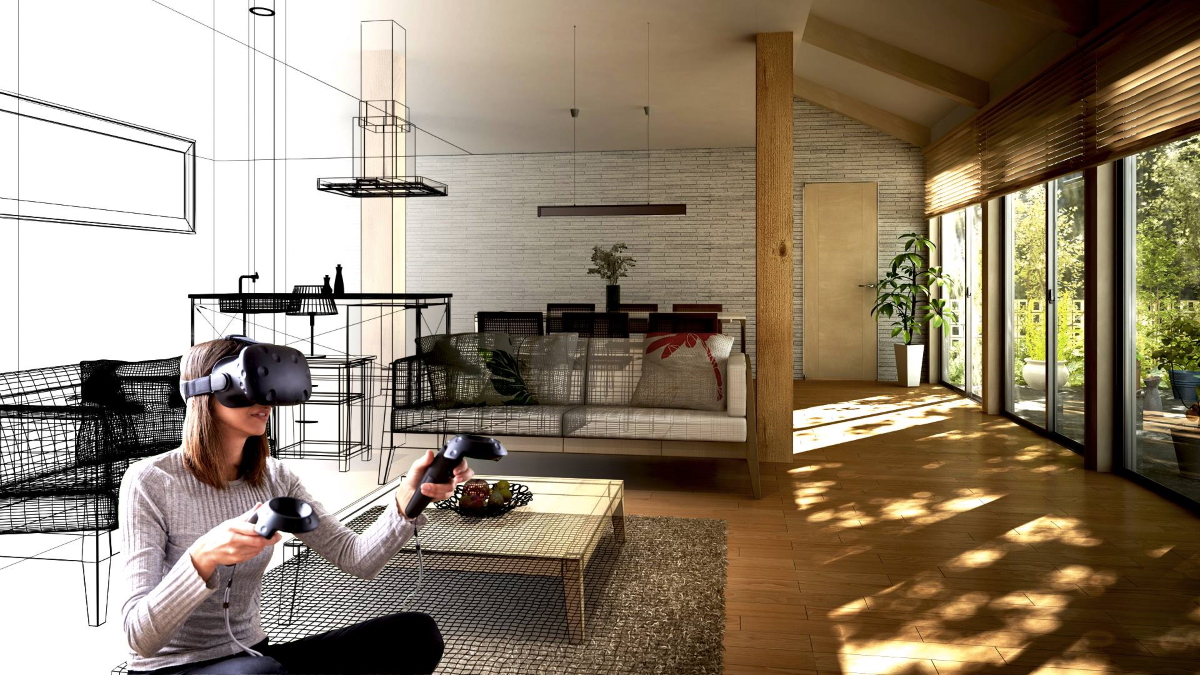
Sitting at home or in a real estate office. Just by putting on a pair of 3D glasses, your mind is transported to another place. It could be a house, a building, a museum, or a shopping mall. You can see a room with its furniture and decorative items, and then another, until you’ve toured the entire space. You can also simulate a journey through time and visit ancient Rome or the land of the dinosaurs. Simply move your head to get a 360-degree view and enjoy an experience that feels almost real.
Virtual reality has been around for over a decade, but the headsets that provide access to it are now available at almost any electronics store. However, the use of this technology in architecture and the real estate sector is still in its infancy in Uruguay, although industry experts say it is “the future.”
In 2017, Universidad ORT Uruguay an elective course on virtual reality to the curriculum of its architecture program. As the final project for this course, students must design a real-time virtual tour of a building.
“For people who have never worn virtual reality goggles, it feels similar to looking at a monitor or a 3D screen. But it’s different, because the sensation is like being transported to another place. You have a field of view that’s almost like that of the human eye, and you can use headphones that fully immerse you in that reality,” architect Gabriel Lambach, professor of the elective course Virtual Reality for Architecture, explained to ORT.
Traditional two-dimensional floor plans, graphics, and even images and renderings provide clients with only a partial understanding. Furthermore, for a real estate agent, this means having several folders and files on their desk for all the properties they manage. However, by creating virtual tours using virtual reality tools, agents can have all the company’s properties on their cell phones and save time on travel when showing them to clients.
Virtual reality tools for architecture work in perfect synergy with Building Information Modeling (BIM), the latest methodology that has revolutionized workflows in architectural firms and construction companies around the world. BIM enables a complete simulation of a building, allowing it to be visualized as if it were already built, complete with all the information about its components and in three dimensions.
Lambach explained that with the information contained in a BIM model, one can “tour the building on a computer screen before it is built. And this can also be done using virtual reality headsets.” The professor added that “a professional could conduct a site visit to check on any aspects they deem necessary, even long before actual construction begins.”
The combination of BIM and virtual reality can help identify construction errors early on and optimize financial resources.
At ORT, BIM is also the name of another elective course in architecture. For the past two years, it has been the primary computer software tool that students learn starting in their first year. “Today, the importance of these changes may not be fully appreciated, because they are very recent, but they are very significant,” Lambach emphasized.
The professor also serves as art director at the virtual reality studio SimDesign. There, he designed virtual tours for construction projects such as the Moddo Cavia, Escollera, and Torre Centra buildings, as well as Blue Sky 3 and Topaz.
SimDesign also participated in the creation of Planorbe, a recently launched real estate portal that is groundbreaking in Uruguay in terms of the quality and depth of the information it provides. According to Lambach, it is “unprecedented” in the country “and probably in the region as well.”
“While the projects mentioned—and a few others—do exist, there is still some resistance within the architecture and real estate sectors to ‘investing in something that, more often than not, they view as a cost,’” the professor noted. However, in the future, those who fail to adopt BIM and virtual reality technologies will fall behind, not only because most others will have them, but also because they will form a fundamental part of a new architectural paradigm.
“Presenting an architectural project using virtual reality headsets won’t be something you do at a booth where everyone stops to watch—it’ll be the norm,” Lambach said.
These aren’t ultra-exclusive technologies or ones accessible only to multimillion-dollar companies. For $500, for example, you could set up a basic setup, and costs vary depending on how sophisticated you want the virtual reality experience to be. The cost of VR headsets has also dropped since their launch, and as new models come out, older ones become cheaper.