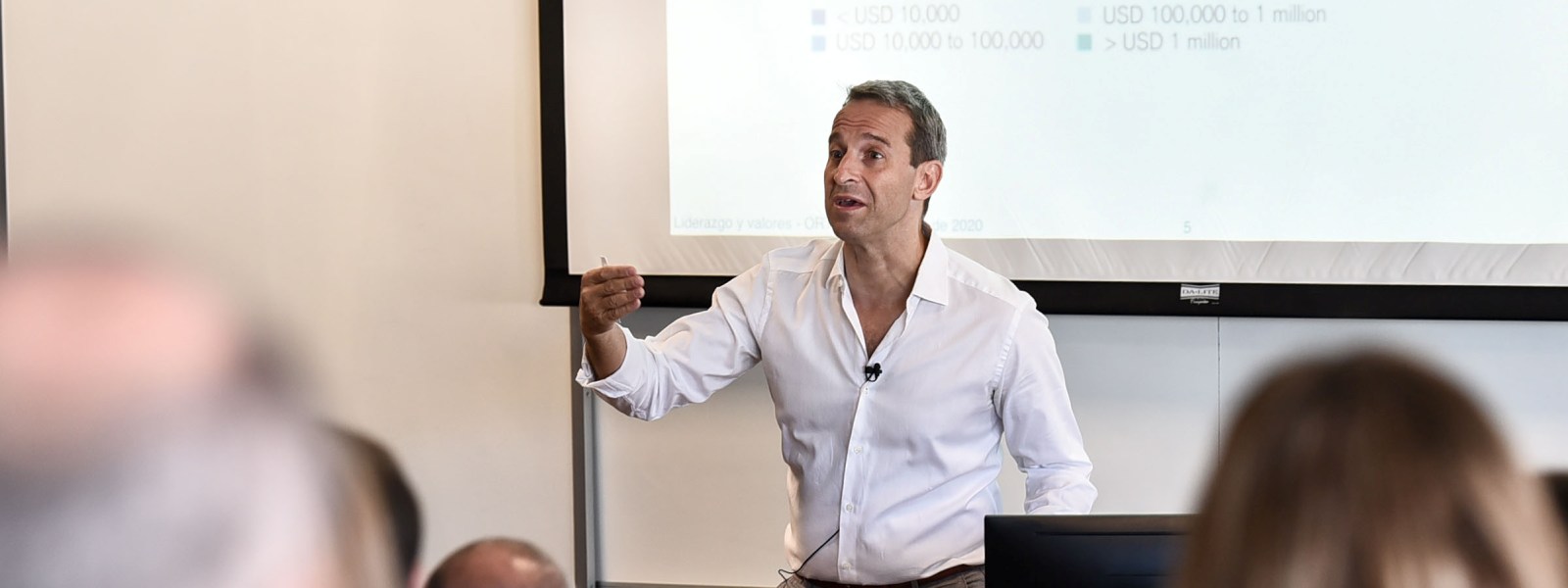
“In today’s world, it is no longer possible to lead by following instructions,” said David Ruyet, a visiting professor at the Graduate School of Business, during the conference “Leadership and Values.”
Ruyet holds an Executive MBA from ESADE Business School. He is a managing partner at Energías Renovables Del Plata S.A. (Argentina, Spain, Chile, and Uruguay). He is also an adjunct professor in the Department of Strategy and General Management at ESADE Business School.
The event took place on Tuesday, February 11, 2020, at the Pocitos Campus of Universidad ORT Uruguay. It was held as part of the Management and Business Lecture Series.
The development of the corporate strategy
“Utopias are linked not only to our personal aspirations but also to our aspirations as a society. It is through our ability to create realities shaped by our imaginations that we are able to transform reality, ”Ruyet said, adding that “the world no longer allows us to do work we are not comfortable with.”
Every organization has its own way of operating. People often notice this when they change jobs. At that point, they realize that the company they’ve joined handles problems differently than their previous one.
“Companies are built by people, with people, and for people. Organizations inevitably act in the same way we do. To the extent that we can establish the system of values that underpins organizational culture, we will be able to manage it. We can only transform organizations through values,” said the expert.
“It’s very hard to convince people if you aren’t convinced yourself. In today’s world, it’s no longer possible to lead by giving orders.” Ruyet added, “This approach was designed for a different era.”
The Dimensions of Leadership
Every organization has people with different strengths. Doers focus on achieving good results and strive for excellence. Strategists focus on planning to inform decision-making. Leaders are able to motivate others.
“We all possess these qualities to some extent. The challenge is to determine how much of each we have. They are interconnected: you can’t visualize without being strategic, and you can’t devise without thinking.”
In the past, instructions were limited, brief, and based on repetition. This model was rooted in the Industrial Revolution.
Starting in the 1970s, this changed. The “management by objectives” model began to prevail, based on the idea that members of the organization would carry out their tasks while a supervisor monitored them.
Today, there is a new way of organizing businesses: values-based leadership. When organizations lack strong leaders and opportunities for growth, talent leaves.
How do you retain talent?
There are three key factors for retaining talent in organizations. First, it is essential to have a committed leadership team that knows where it wants to go and is moving in that direction. Second, the team must share a common vision. Third, the organization should focus on valuing its people as the cornerstone of cultural transformation.
“Society’s core values are very much like the ones we want for organizations: empathy, fairness, justice, respect for others, and adherence to the rules,” the expert explained.
“When are we truly satisfied at a company today?” Ruyet asked himself, and answered: “When we’re well compensated, we’re doing meaningful work, we do it very well, and we enjoy it.”
Full lecture:
Image gallery:
