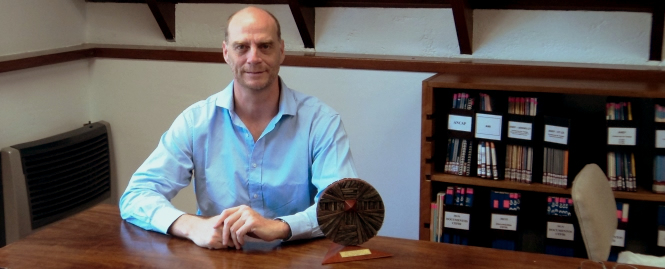
Rodolfo Gioscia, CEO of Manos del Uruguay and named 2012 Outstanding MBA by his fellow MBA graduates, spoke in December 2012 about his professional career, the importance of academic training for business leadership, and the responsibilities involved in leading a company.
-What has your career in business been like?
-Most of my early career was spent at my family's company, the Palacio de la Música, but in 1997 it was sold to another group of businesspeople. My great-uncle had founded it; he invited his brother, my grandfather, to join the business, and that’s how a company was created that remained in the Gioscia family for 78 years, with three generations participating in it. That experience gave me the advantage of being able to enter the business world from a young age.
When people ask me when I got started in the family business, I tell them: when I was six or seven years old and used to go with my father to check on sales; that’s how I began to develop an emotional connection to it, with all its ups and downs.
At some point, I realized that I needed to get a professional education; I couldn't just rely on being part of a business family. So I decided to pursue a Bachelor's degree in Management and Administration here at the university.
-Why did you decide to sell the family business?
-I attribute it to many factors. Relationship difficulties among the partners—we’re talking about a lot of cousins here. The diversity of interests and expectations makes it hard to get everyone on the same page. It can be done, and there are tools to help, but at the time we didn’t know how to do it.
There were other factors as well, such as what was happening in the music industry, where piracy was rampant. Today, I’m really happy that the Palacio de la Música is doing well in the market, even though it no longer belongs to my family, because I learned to love what I do and to feel proud of having been part of that organization.
At the time, I was studying and learning about the realities of family businesses, attending seminars, reading books, and trying to understand the challenges faced by family businesses. In fact, I am currently an Associate Professor of Family Business Management here at the university, and I teach the Family Business course in the Bachelor’s program in Management and Administration and in the Public Accounting program, as well as Family Business Management in the MBA program.
It is a reality I know firsthand, both from my experience advising family businesses and from an academic perspective.
While I was in school, I decided I wanted to be a good manager. From my father, I learned some fundamental values: to surround yourself with the best people, to support those you believe in, to stay true to yourself, and to respect everyone—these were the pillars that helped shape me as a person. My father was a good businessman, very intuitive, with excellent business acumen and strong leadership skills, but he had no formal training in management. I understood that to be a good manager, one also needed academic training.
In 1998, I applied for a general manager position at Manos del Uruguay and was selected
I faced a huge challenge, because the organization was in dire financial straits, had significant positioning issues, and its business focus was very unclear. It was a very different reality from what I was used to. And that’s when I began to realize the importance of training, which is what allows you to apply your knowledge to different organizations.
I entered a business I knew nothing about, where I had to coordinate a host of highly complex stakeholders with very different expectations—including the artisans working in the interior of the country, the technical staff who produce the samples, the people handling sales in both the local and international markets, the designers working here, those responsible for designing for the United States and Europe, and our international clients.
How do I bring all that together? The result is that a garment handmade by a woman in Fraile Muerto ends up on Fifth Avenue or in London. To make that happen, I had to draw on my knowledge and experience.
At a certain point, I decided to refocus Manos del Uruguay’s business. I wanted to move away from the idea of a purely textile business and shift toward one focused on branding and design. Previously, it was a production-oriented organization that made products and tried to sell them; later, it became a customer-oriented organization that researched what customers wanted and, based on what was feasible, tried to meet those needs.
The next step was to build customer loyalty. In the local market, Manos del Uruguay is now an iconic brand—a national brand.
-How is that loyalty achieved?
-Loyalty is never absolute, but to the extent that you make a commitment and follow through—and follow through, and follow through, and follow through—not only in terms of dedication but also in terms of quality, Manos del Uruguay began to support the design departments of much larger companies. It fills me with immense pride to see designers from Manos del Uruguay interacting on a completely equal footing with designers from Ralph Lauren or Marc Jacobs.
I build dedicated teams to foster personal growth, without me being the one who sets the limits for the organization. If someone has better ideas, I want them to challenge mine. If those ideas convince me, I’ll support them.
At some point, I realized I needed to become a better manager, so I decided to pursue an MBA [I started the program in 1999]. I wanted to connect and interact not only with top-tier professionals and faculty members like those at the school, but also with classmates who come from backgrounds completely different from my own. I wanted to learn from the perspectives of people working in entirely different industries.
Some managers tend to surround themselves with people who are very much like-minded in every way; I certainly understand that one should associate with people who share one’s core values, but without overlooking highly capable individuals or limiting oneself to a single perspective on things.
If I only meet with people who agree with me on everything, what new ideas are likely to come out of that? Not much. I might be able to do the things I was already doing better, but what we need to achieve here is innovation—fostering an entrepreneurial spirit among the people within the organization, not just the CEO.
-Aside from the perspectives of people coming from other types of businesses, what was the most valuable thing you gained from the MBA?
-It gave me various analytical tools, better strategic planning tools, and better diagnostic tools. It helped me improve in areas where I wasn't as strong. It broadened my perspective and gave me a comprehensive view of business.
I highly recommend it, because as a program with a strong academic foundation in terms of its bibliography and authors, it complements the case studies very well. It has a strong business focus and is very down-to-earth. This allows you to quickly see ways to apply these tools in your day-to-day work.
-What do you think makes a good manager?
-There’s no single standard for measuring it; obviously, you have to deliver results. I believe that a good manager must have a very clear vision of how to work with people and must foster leadership within the organization. That’s essential when it comes to driving change and building motivated teams.
And one thing that’s very important to me is making sure the organization doesn’t rely too heavily on the executive top. To the extent that you build strong teams, dependence on top executives decreases, and that’s safer for the organization. First, because something could always happen to that person. Second, because leadership styles that are so individualistic tend to operate under a model that can’t be replicated.
That is why I am interested in creating long-term value, and I am more likely to achieve this by building strong teams. To build those teams, I need strong interpersonal and leadership skills, along with a clear understanding of business, strategic planning, and diagnostic analysis of the current situation.
-Changing the subject, how did you feel about receiving this award?
-I was very pleased. It’s a very significant honor. It was awarded to me by a vote of my peers—MBA graduates from all graduating classes—which makes it all the more meaningful. Plus, it’s a sculpture by Ricardo Pascale, a highly acclaimed artist; it’s beautiful, and I’m truly delighted to have received it.
-Do you think it was a recognition of your career?
-Yes, my track record—and I’m sure those who elected me took into account the fact that I transformed a flagship organization in Uruguay, taking it to top-tier markets.
-What do you hope to convey to your undergraduate and MBA students?
-Beyond teaching them the specific details of the subjects, I try to give them the tools they need to become good managers, good directors, and good business leaders. I want them to understand that they are in Uruguay, a country with significant social divisions, which is why we must ensure that businesses help build a better country. All Uruguayans have the right to a good life.
Interview published in December 2012