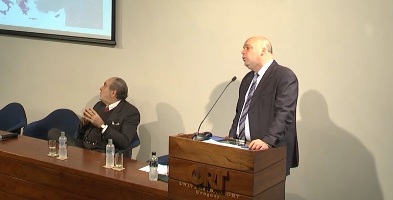
 On Wednesday, May 29, 2013, the lecture “Challenges for European Foreign Policy in 2013,” organized by the Department of International Studies, was held in the auditorium of the Faculty of Administration and Social Sciences at Universidad ORT Uruguay. The presentation was given by Alfonso Soria, a lawyer specializing in international law and Director for Europe at the Colombian Ministry of Foreign Affairs. According to the expert, the main challenges facing the European Union (EU) will be the creation of a European agenda on security issues, returning to the path of economic growth, reversing low birth rates, moving toward greater political unity, and achieving a common environmental management framework.
Following a long process of unification that began after World War II, the greatest challenges have emerged since 2000, according to Soria. The attacks in New York on September 11, 2001, made terrorism a major factor in European foreign policy. In that regard, “there was an evolution, shifting from discussions about maintaining ties with the Middle East to protect human rights to discussions about how to combat terrorism.” According to the expert, a “phenomenon of terrorism migration” is taking place, generating significant fears in Europe, even though the attacks are isolated incidents.
For Soria, the issue of security “must be rethought by the EU,” which is unsure whether the protection of democratic values and human rights should be carried out by military peacekeeping forces. Interventions have taken place, for example, in South Sudan and Mali, “but talking about human rights and the protection of democracy without a military presence is complex.” For Soria, some military interventions have failed to bring stability and governance to the countries. In Libya, for example, “supporting the rebels without knowing who they were, simply because we were against a dictator, was a historic mistake,” said Soria. “Today there is arms trafficking, and there isn’t even a government—only tribal clans controlling certain productive sectors. Neither stability nor governance was achieved.” The effectiveness of the intervention is also in question in Iraq and Afghanistan, he noted.
According to Soria, there is still “indecision” on security issues, and there is a lack of a unified foreign policy on security. He noted that just recently, European ministers lifted the arms embargo on Syrian rebels, while Russia continues to support the Syrian government with missiles. Even so, Soria pointed out that the EU was awarded the Nobel Peace Prize in 2012. “This is a minor detail given the crises in Egypt, Syria, Libya, Palestine, and Israel, but the EU has nonetheless promoted values and human rights,” he noted.
“The EU is working to secure a seat on the UN Security Council as a bloc, and that is something worth supporting. But what matters is not just whether it gets a seat, but what it can do and what tools it will have at its disposal. We need to discuss whether security is the exclusive responsibility of the Union or of the member states,” he said. Europe, said Soria, needs to discuss whether, in order to strengthen its foreign policy actions, it should or should not use military tools such as NATO to exert influence and resolve conflicts.
Regarding economic challenges, the expert pointed to Europe’s high sovereign debt and the policies that prevent countries from devaluing their currencies or printing money to emerge from the crisis, which affects smaller economies such as Greece, Ireland, Cyprus, and Slovenia. Soria said that the solution to emerging from the economic depression is not through breakups, but rather that with fiscal “austerity,” one “emerges with dignity.” “People forget that crises are cyclical. The important thing is to face them as such,” he said, recalling that the EU emerged following the post-World War II debacle.
On energy issues, he noted that the challenge is to overcome dependence on mining and energy, which often leads to “flexibilizing” the foreign policy agenda in accordance with energy interests. Added to this is the inclusion of climate change on the international agenda, which is a “cause for concern because it is an issue that we do not know how to address multilaterally.” He cited as an example that southern Europe is less strict regarding greenhouse gas emissions than northern Europe.
But the fundamental economic challenge is demographic change, said Soria. According to the expert, “Europe is a continent that is not renewing itself. There is no generational change, so the human factor does not drive renewal in the management of production chains, in education, or in consumption, which is why the pay-as-you-go pension system is not working.” Immigration does not alleviate the demographic crisis either, because with the crisis, Europe is not an attractive place to live, he noted.
As the EU prepares to expand its membership, the other challenge is ensuring that its common institutional framework adapts to the diverse interests of each nation. According to Soria, decision-making on international matters is decentralized, so reaching agreements with the EU requires renegotiating with each individual body. “This decision-making process reveals a certain fragility when it comes to seeking consensus on international issues,” said Soria. Furthermore, the foreign policies set by the EU’s central bodies often do not “trickle down” to smaller countries like Estonia or Lithuania, which are more inclined toward bilateral dialogue than bloc-level negotiation.
“The big question is whether there is a foreign policy for 2013,” Soria concluded. “We need to make Europe more effective and transparent; it must be a key player on the global stage. Security and values are paramount.”