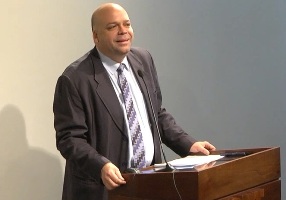
 Interview with Dr. Alfonso Soria Mendoza, visiting professor in the Bachelor’s Program in International Studies who taught classes in May 2013, and Director for Europe at the Colombian Ministry of Foreign Affairs.
-What does your role at the Colombian Foreign Ministry entail?
-I am assigned to the Ministry of Foreign Affairs, which is divided into four geographical departments: Africa, Asia, Oceania, and Europe. I am responsible for coordinating Colombia’s foreign policy in Europe and Eurasia, including Central Asia, which encompasses Russia, Turkey, and all the countries surrounding the Mar .
-What are the political guidelines in Europe and Eurasia?
-What we did when President Santos took office was to shift our foreign policy and change the perception of Colombia within the European Union. Our bilateral agenda had previously focused solely on human rights, drug trafficking, and the fight against organized crime. We began to work on a positive agenda that would reflect the change we wanted to bring about. We began to talk more about investment, research, technology transfer, and innovation. When President Santos made an official visit to Germany in 2011, our central themes were science and technological innovation. We moved from a relationship of dependency to becoming good trading partners.
-Changing the subject, how did your connection with the university begin?
-I have great respect for the work the faculty does, especially in the area of international studies. I am a negotiator. I have always worked on international negotiation issues, and it was a great honor for me when they reviewed my resume and invited me to lead the communication and negotiation workshops. They later invited me to give lectures—the most recent one was on the challenges of European foreign policy—and I am currently teaching an introductory seminar on the geopolitics of mineral and energy resources in Eurasia.
Academic work is very important to me. My background is in academia; I come from a university setting. In Colombia, I had 10 years of research experience at the undergraduate, graduate, and master’s levels. I have always believed in the interdisciplinary nature of research, and here at ORT University, they support our efforts to foster that interdisciplinary approach.
-What do you mean by "mainstreaming"?
-I am a lawyer specializing in international relations. I believe that sociologists should also work on issues related to international relations, as should students of international relations, of course. This allows us to gain a cross-disciplinary and multifaceted perspective on international realities.
-Do you mean that people with different academic backgrounds bring different perspectives to a program, for example, in International Studies?
-Of course. Today, to give just one example, you can’t talk about the environment without taking into account relevant legislation, immigration issues, public policy, and urban planning.
-As a visiting professor, what knowledge do you hope to share with the students?
-First and foremost, an open mind. The key word here is “share.” Sharing experiences and different perspectives allows me to grow personally by seeing how Uruguayan youth are developing and what their main challenges are. I’m here to contribute my experience from a different perspective.
-In the lecture you gave at the university, you said that following the attacks of September 11, 2001, there was a shift in diplomatic relations with the Middle East. Do you believe that those attacks had unintended negative consequences for the people of that region?
-First of all, I want to provide some context. In the European Union, following the attacks, the concept of common security emerged. There is a major issue to analyze. In cooperation with the Middle East, the focus was on building democracies and promoting respect for human rights. Today, that is no longer enough; we must also fight terrorism. During that decade, there was a growing international awareness of the fragility of the situation regarding terrorism. It ceased to be a problem confined to the Middle East and became a global issue.
When it comes to foreign policy, the issue of legitimacy arises. In Libya, support was given to rebel groups, but that foreign policy is widely regarded as a failure. I am stating this as a fact. There is no consensus within the international community on whether the support being provided to rebel groups can serve as a solution to a specific conflict. What happened in Libya was a fragmentation of power among tribal groups.
-But in the case of Libya, what else could have been done?
-Building a society, a state, democratic behaviors, and values. This is not something that can be achieved through decrees, signatures, or orders. The answers must come from the very heart of the country itself. We need to conduct a sociological and historical analysis for the reconstruction of nations. We must move forward with a vision for the country. We often get bogged down in immediate issues and struggle to develop a long-term vision. We rushed to support a group without analyzing who was leading it or for what purpose. Today, the situation in Syria isn’t clear either.
-At the conference, you said that the effectiveness of the interventions in Iraq and Afghanistan is in question. What conclusions can be drawn 10 years after the invasions?
-This ties back to the previous answer: societies were not built. The concept of peace was not built on the basis of a socio-anthropological reality. There are strategies for doing so, but military invasions never build societies. Building a society involves drawing on all the fabric of society, fostering leadership, and instilling civic values.